On this page
Cell-potential numericals often go wrong in small, repeatable ways. Below, we work one copper–silver cell correctly, then run four common mistakes through it so you can see what each wrong answer looks like.
What are the most common mistakes in electrochemistry numericals?
Every rule below comes from Unit 2, Electrochemistry, of the NCERT Class 12 Chemistry textbook. The four slips are:
Reversing a half-reaction, changing the sign of E°, and then subtracting it as well.
Multiplying E° by the coefficient used to balance electrons.
Using the charge on one ion as n, instead of the electrons transferred in the whole reaction.
Writing the reaction quotient Q as reactants over products.
The standard cell potential is the reduction potential of the right-hand (cathode) half-cell minus that of the left-hand (anode) half-cell: E°cell = E°right − E°left, as NCERT states in section 2.2.
Worked example: one copper–silver cell
The reaction is Cu(s) + 2Ag⁺(aq) → Cu²⁺(aq) + 2Ag(s), in the cell Cu | Cu²⁺(0.10 M) || Ag⁺(0.010 M) | Ag at 298 K. NCERT's Table 2.1 gives E° = 0.80 V for Ag⁺/Ag and 0.34 V for Cu²⁺/Cu.
E°cell = 0.80 − 0.34 = 0.46 V, the value NCERT uses in Example 2.2.
Each copper atom gives two electrons, one to each silver ion, so n = 2.
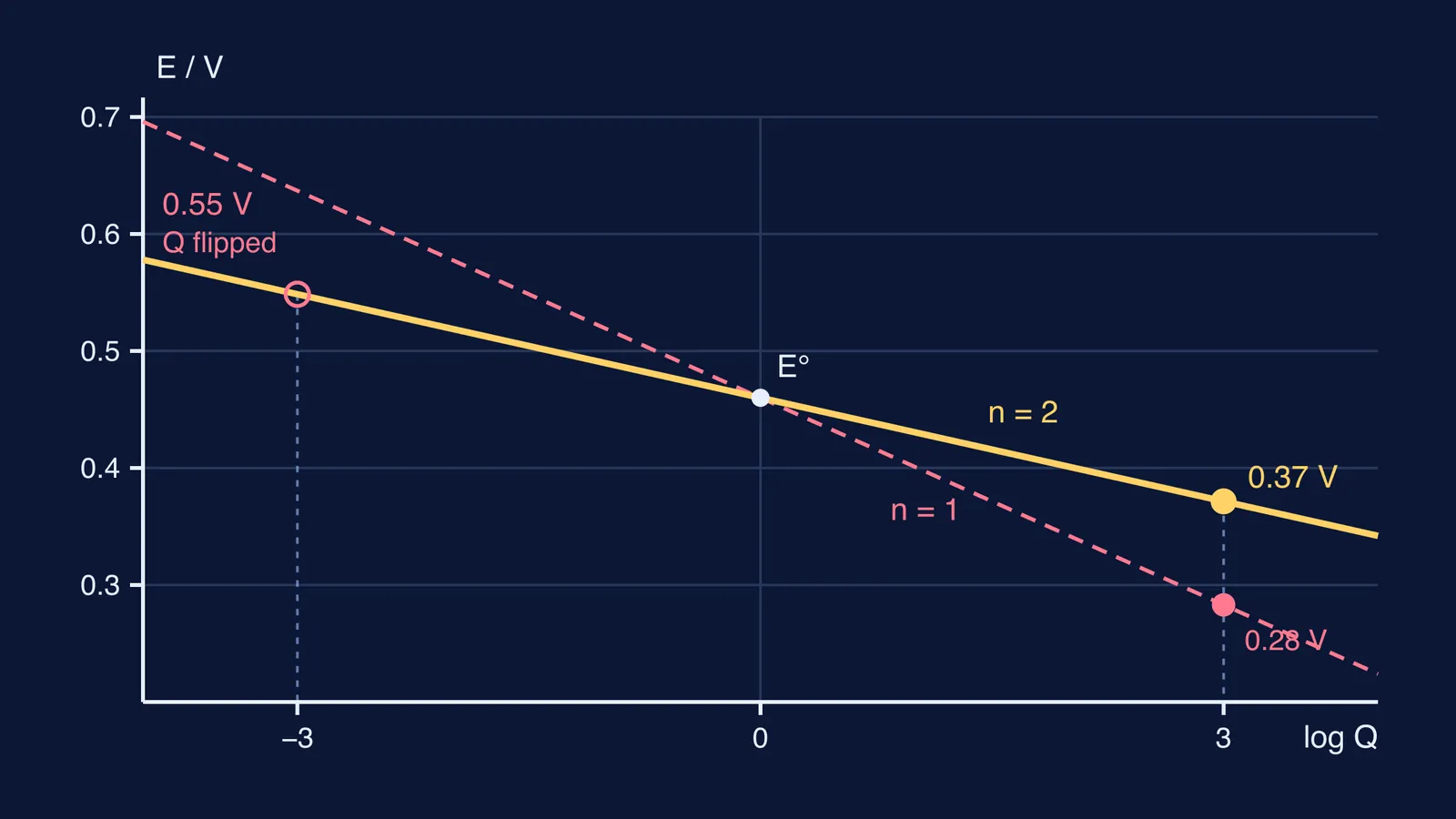
Q = [Cu²⁺]/[Ag⁺]² = 0.10/(0.010)² = 1000, so log Q = 3.
E = 0.46 − (0.059/2) × 3 = 0.46 − 0.089 = 0.37 V.
Each mistake below gives a different number.
Why does E° go wrong when you reverse or multiply a half-reaction?
Mistake 1: changing the sign twice. Copper is oxidised, so you write Cu → Cu²⁺ + 2e⁻ with E° = −0.34 V. That works if you then add: 0.80 + (−0.34) = 0.46 V. The slip is flipping the sign and then also subtracting: 0.80 − (−0.34) = 1.14 V.
Fix: copy both values as reduction potentials straight from NCERT's Table 2.1 and subtract, cathode minus anode.
Mistake 2: multiplying E° by the coefficient. The silver half-reaction is doubled to balance electrons, so it is tempting to write 2 × 0.80 − 0.34 = 1.26 V.
Fix: leave E° alone. NCERT's section 2.3.2 notes that E(cell) is an intensive parameter, while ΔrG is extensive and depends on n. LibreTexts/20:_Electrochemistry/20.04:_Cell_Potential_Under_Standard_Conditions) agrees that E° values do not depend on stoichiometric coefficients. The coefficient shows up in n instead: with NCERT's F = 96487 C mol⁻¹, ΔrG° = −nFE°cell = −2 × 96487 × 0.46 ≈ −88.8 kJ mol⁻¹.
How do you pick n and Q in the Nernst equation?
NCERT writes the Nernst equation as E = E° − (RT/nF) ln Q, with Q built like an equilibrium expression from the balanced cell reaction (NCERT, section 2.3). At 298 K this becomes E = E° − (0.059/n) log Q.
Mistake 3: the wrong n. Each Ag⁺ takes one electron, so some students use n = 1. That gives E = 0.46 − 0.059 × 3 = 0.28 V.
Fix: n is the number of electrons that cancel when you add the two half-reactions. Two Ag⁺ react for every Cu, so n = 2. NCERT puts it as: ‘We should use the same number of electrons (n) for both the electrodes.’
Mistake 4: an upside-down Q. Flip Q and you get [Ag⁺]²/[Cu²⁺] = 0.001, log Q = −3 and E = 0.46 + 0.089 = 0.55 V. Forgetting the square on [Ag⁺] gives Q = 10 and E = 0.43 V.
Fix: write Q as products over reactants, each raised to its coefficient, and leave solids out (NCERT takes a solid's concentration as unity). Then check the direction: here Q = 1000 is more than 1, so E must come out below 0.46 V, and 0.55 V fails. If log signs trip you up, our guide to common logarithm rule mistakes has quick checks.
How can you check a cell potential answer quickly?
Run these six checks:
Both E° values came from the reduction table and were subtracted cathode minus anode.
E° was not multiplied by anything; coefficients appear only in n, Q and ΔrG.
n equals the electrons cancelled in the balanced equation.
Q has products on top, powers equal to coefficients, and no solids.
If Q is more than 1, E is less than E°; if Q is less than 1, E is more than E°.
0.059 V is 2.303RT/F at 298 K (NCERT, equation 2.12); at other temperatures, recompute it.
Unsure which electrode is the cathode? Start with electrolytic vs galvanic cells and the anode trap, then see how to read a cell diagram and get the EMF sign right.
For practice, the Fermi Problem Library has worked problems with a step-by-step solver that explains the reasoning rather than printing an answer, so you can find where your working went wrong. If the slip is really a gap in an idea, such as what E° measures, the Fermi Concept Library gives each chemistry concept its own lesson.