

On this page
A cell diagram squeezes a whole experiment into one line: Zn(s) | Zn²⁺(aq) || Cu²⁺(aq) | Cu(s). An AI chatbot can read it, name the electrodes and work out the EMF in seconds. It can also subtract the two potentials in the wrong order and hand you a confident −1.10 V, or quietly drop the minus sign. Below, using the convention from the NCERT Class 12 Chemistry electrochemistry chapter, is how to get the AI to show its working so you catch that slip before an exam does.
How do you decide the anode and cathode from a cell diagram?
In a galvanic cell, oxidation happens at the anode and reduction happens at the cathode (NCERT, Unit 2).
The accepted convention is to write the anode on the left and the cathode on the right, with a single vertical line between a metal and its solution and a double vertical line for the salt bridge (NCERT, Section 2.2). Our explainer on why a galvanic cell needs a salt bridge covers that double line.
So the diagram tells you which electrode the writer claims is the anode. Whether the cell really runs that way depends on the potentials. In the NCERT table, a more negative standard electrode potential means the couple is a stronger reducing agent, so that metal is the one that gets oxidised and is the true anode.
How do you compute EMF without getting the sign wrong?
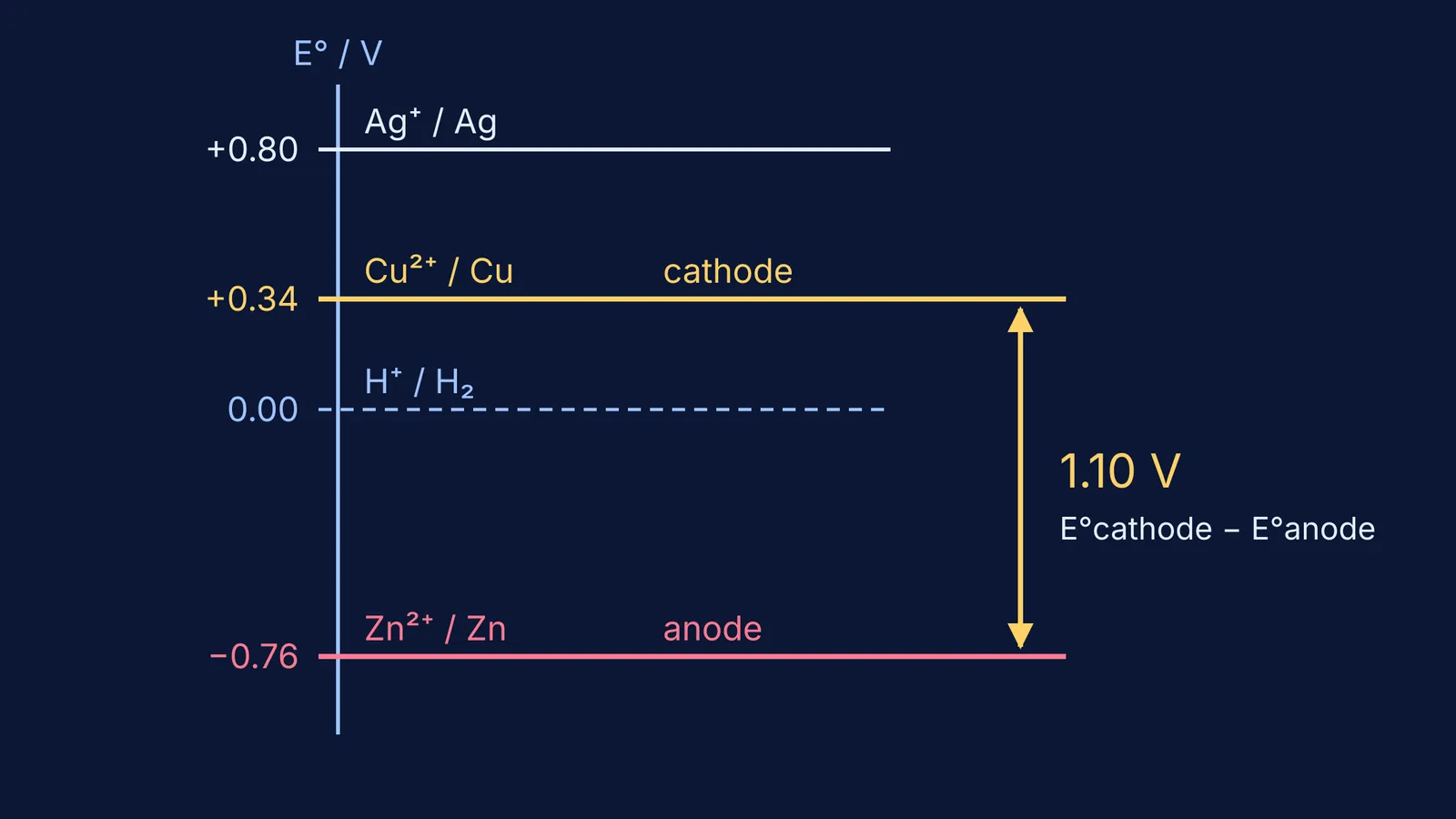
NCERT defines the cell potential as the difference between the reduction potentials of the cathode and the anode, written as E°cell = E°right − E°left (NCERT, Section 2.2).
The standard electrode potentials at 298 K in NCERT Table 2.1 are reduction potentials: +0.34 V for Cu²⁺/Cu, −0.76 V for Zn²⁺/Zn and +0.80 V for Ag⁺/Ag (NCERT, Table 2.1).
Worked example 1, the Daniell cell: Zn(s) | Zn²⁺(aq) || Cu²⁺(aq) | Cu(s). Right is copper, left is zinc. E°cell = 0.34 − (−0.76) = 1.10 V, the same value NCERT gives. The brackets around −0.76 are where most sign slips happen.
Worked example 2, copper and silver: Cu(s) | Cu²⁺(aq) || Ag⁺(aq) | Ag(s). E°cell = 0.80 − 0.34 = 0.46 V, which matches NCERT Example 2.2. The balanced reaction has 2Ag⁺, but you do not double 0.80. NCERT notes that E(cell) is an intensive parameter while ΔrG depends on n, and LibreTexts/19:_Electrochemistry/19.04:_Standard_Reduction_Potentials) states that E° values are independent of the stoichiometric coefficients.
Worked example 3, the reversed diagram: Cu(s) | Cu²⁺(aq) || Zn²⁺(aq) | Zn(s). Right minus left gives −0.76 − 0.34 = −1.10 V. Because ΔrG = −nFE(cell) (NCERT, Section 2.3.2), a negative EMF means a positive ΔrG: the reaction as written is not spontaneous, and the cell actually runs the other way. Zinc is still the real anode, and the diagram should be flipped.
Which AI mistakes should you watch for?
Each slip below gives a wrong number from the NCERT Table 2.1 values above:
Anode minus cathode. −0.76 − 0.34 gives −1.10 V for the Daniell cell, then the minus sign gets dropped without comment.
Double-flipping the zinc sign. Turning −0.76 into an oxidation potential of +0.76 and then still subtracting gives 0.34 − 0.76 = −0.42 V.
Scaling by coefficients. Doubling silver to 1.60 V gives 1.60 − 0.34 = 1.26 V instead of 0.46 V.
Trusting the order as written. Reporting a positive 1.10 V for the reversed diagram in example 3 without saying it was reversed.
What should you type to make the AI show its working?
Do the problem on paper first, then paste the diagram and send these one at a time:
"Before calculating, tell me which electrode is written as the anode and which as the cathode, and the half-reaction at each."
"Give the standard reduction potential for each couple, with its sign."
"Compute E°cell = E°cathode − E°anode and show the substitution, with negative values in brackets."
"Did you multiply any E° by a coefficient? Explain why or why not."
"If the EMF is negative, tell me what that means and rewrite the diagram the right way round."
Check the E° values against the NCERT table, not against the AI. If its number and yours differ, find the exact line where they split. That is the same habit as checking oxidation numbers with AI, and it carries straight into Nernst questions such as why a galvanic cell stops when its EMF reaches zero.
If the same sign slip keeps coming back, Fermi's AI tutor holds a line of reasoning across a session and notices where you are stuck, so it can ask you which electrode is the cathode before it explains. For more practice, the Fermi Problem Library has worked problems with a step-by-step solver that explains the reasoning rather than printing an answer.


