On this page
A transcranial magnetic stimulation (TMS) coil never touches the brain. It sits on the scalp, and no current flows from it into the head. Yet a single pulse can make a finger twitch. The link is Faraday's law: a magnetic field that changes quickly creates an electric field, and that electric field pushes ions in nerve tissue. It is a physics explainer only. TMS is a regulated clinical and research procedure, and whether and how it is used for anyone is decided by doctors.
How does a TMS coil create an electric field inside the head?
A TMS machine charges a large capacitor and then dumps it into a coil of thick copper wire in a fraction of a millisecond. The current in the coil rises to several thousand amperes, so the magnetic field near the coil rises from zero to about a tesla. A review of brain stimulation describes the field as rising to, and falling from, 1 tesla or more within 1 ms.
What matters is how fast the field changes. Faraday's law says the line integral of E around any closed loop equals −dΦ/dt, the rate of change of magnetic flux through it. If the field is uniform over a circle of radius r, the flux is B·πr², and the loop has length 2πr. So:
E × 2πr = πr² × dB/dt, which gives E = (r/2) × dB/dt.
This is the same result derived for a long solenoid in Faraday's law for a changing B inside a solenoid.
The induced field lines are closed circles. They have no start and no end, because no charges create them. In the head, the induced E drives small currents through the salty, conducting tissue, and those currents shift the voltage across nerve membranes.
Why is it the electric field, not the magnetic force, that acts on nerves?
You might expect the magnetic field to push ions directly through F = qvB. But ions in tissue barely move, so v is tiny and the magnetic force on them is negligible. The force that matters is qE, and an induced E acts on charges whether they are moving or at rest. This is the same reason a charged wheel at rest starts to spin when the field is switched off.
How big are the current and the field in a TMS pulse?
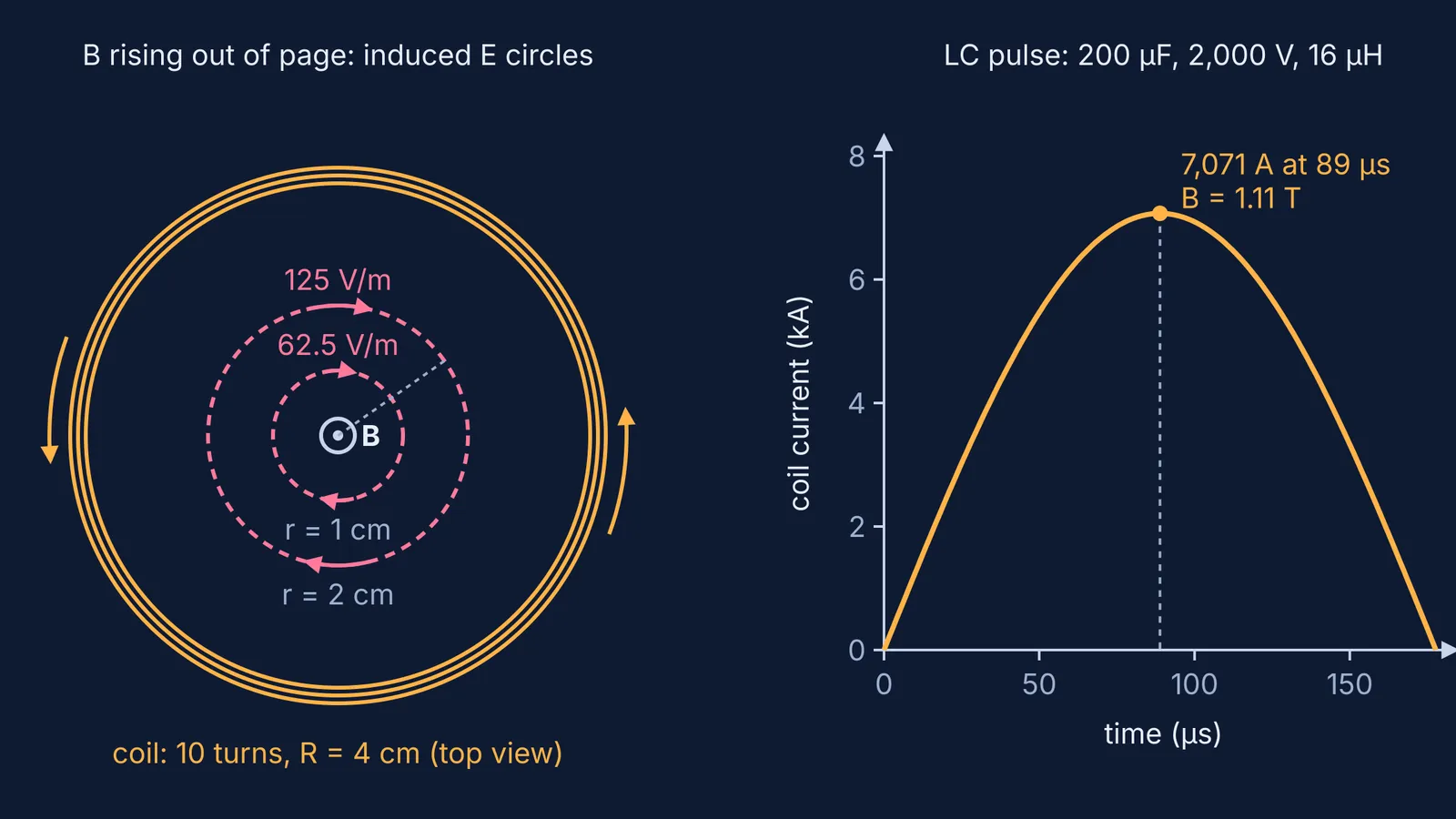
Treat the stimulator as an LC circuit. These coil values are round illustrative numbers, but they sit within the range of real devices: one published research stimulator charges its capacitor to between 100 and 2,800 V and drives coil currents of up to about 7 kA.
Take C = 200 µF, V = 2,000 V and a coil of L = 16 µH.
Stored energy. U = ½CV² = ½ × 200 × 10⁻⁶ × (2,000)² = 400 J.
Angular frequency. ω = 1/√(LC) = 1/√(16 × 10⁻⁶ × 200 × 10⁻⁶) = 17,678 rad/s. That is a frequency of about 2.8 kHz.
Time to peak current. The current is a sine wave that starts at zero, so it peaks a quarter period later: t = (π/2)√(LC) = 89 µs.
Peak current. All the energy is in the coil at that moment, so ½LI² = ½CV², giving I = V√(C/L) = 2,000 × √12.5 = 7,071 A.
Field at the coil centre. Model the coil as a flat 10-turn ring of radius R = 4 cm. Then B = μ₀NI/(2R) = (4π × 10⁻⁷ × 10 × 7,071)/(2 × 0.04) = 1.11 T.
So a 400 J pulse gives a field of about 1 T in under a tenth of a millisecond.
What electric field does a TMS pulse induce in the brain?
Now use E = (r/2) × dB/dt.
Average rate of change. The field rises from 0 to 1.11 T in 89 µs, so dB/dt ≈ 1.11/(89 × 10⁻⁶) = 1.25 × 10⁴ T/s.
At r = 1 cm. E = (0.01/2) × 1.25 × 10⁴ = 62.5 V/m.
At r = 2 cm. E = (0.02/2) × 1.25 × 10⁴ = 125 V/m.
Check the units. m × T/s = m × (V·s/m²)/s = V/m.
Because the current is a sine wave, its slope is largest at the very start of the pulse, π/2 times the average. So the peak E at 1 cm is closer to 98 V/m.
How does this compare with what it takes to activate nerve tissue? Head-modelling studies estimate that at the threshold for a muscle response, the field in the motor cortex is about 50 to 70 V/m, and 100 V/m is often quoted as the accepted threshold. Our simple estimate lands in the same range.
Be honest about the limits of this model. E = (r/2) dB/dt holds only on a circle centred in a uniform field. A real coil's field is not uniform, it weakens quickly with depth below the scalp, and the head's conducting tissue and boundaries reshape the induced field. Treat these figures as order-of-magnitude estimates, not a dose for any person.
Why does an MRI's 3 T field not do the same thing?
An MRI scanner's main field is almost three times the peak of our TMS pulse, yet it induces nothing in a patient lying still. The reason is dB/dt. The main field is steady, so dB/dt = 0 and E = (r/2) × 0 = 0. You can read how that steady field is used to make images in how an MRI scanner works.
MRI does switch smaller fields quickly. Its gradient coils turn on and off many times a second, and at high switching rates they can stimulate nerves in the body. Researchers treat this peripheral nerve stimulation as a design limit for fast gradient coils. That is Faraday's law again: a large B with no change does nothing, and a small B that changes fast can.
If you find it hard to picture closed loops of E appearing around a changing field, the Fermi Simulation Lab has interactive simulations of induction you can change and watch.
What mistakes cost marks on induced field questions?
Thinking a strong magnetic field alone induces an electric field. Only a changing field does.
Using E = V/d. An induced E does not come from a potential; its field lines form closed loops.
Forgetting the factor of 2 in E = (r/2) dB/dt. It comes from πr² divided by 2πr.
Mixing up µs and ms. A 1 T change in 89 µs is over 11 times faster than the same change in 1 ms.
Quick checklist
A changing B creates circular E: E = (r/2) dB/dt inside a uniform field.
The induced E, not the magnetic force, pushes ions at rest.
LC pulse: peak current I = V√(C/L) after a quarter period, (π/2)√(LC).
200 µF at 2,000 V into 16 µH gives 400 J, 7,071 A and about 1.1 T in 89 µs.
That rise gives about 62 V/m at 1 cm and 125 V/m at 2 cm, near reported activation levels.
A steady 3 T MRI field induces nothing, because dB/dt = 0.
Medical use of TMS is a decision for doctors, not for a physics formula.