On this page
Ship propellers, pump impellers and hydro turbines often end up with pitted, spongy-looking metal, as if something had chewed them. Nothing chemical did it. The damage comes from water that boils at room temperature because it is moving fast, and then collapses back with a violent jolt. This is cavitation, and Bernoulli's equation tells you when it starts.
What is cavitation?
Water boils when its pressure falls to its vapour pressure. At 100 °C that happens at 1 atm, which is why a kettle boils. But you can also make water boil by keeping it at room temperature and lowering the pressure. At 25 °C the vapour pressure of water is only 3.17 kPa, about 3% of atmospheric pressure, according to NIST's water property data.
Cavitation is this boiling, caused by low pressure in a fast-moving liquid. Where the flow speeds up, the pressure drops. If it drops to the vapour pressure, vapour bubbles appear. When the flow carries them into a region of higher pressure, they collapse.
Cavitation is not the same as dissolved air coming out of water. That is degassing, and it makes gas bubbles that do not collapse violently. Cavitation bubbles are filled mostly with water vapour, which condenses almost instantly when the pressure rises again.
How fast must water move before it boils at room temperature?
Use Bernoulli's equation along a streamline, ignoring height changes:
p + ½ρv² = constant
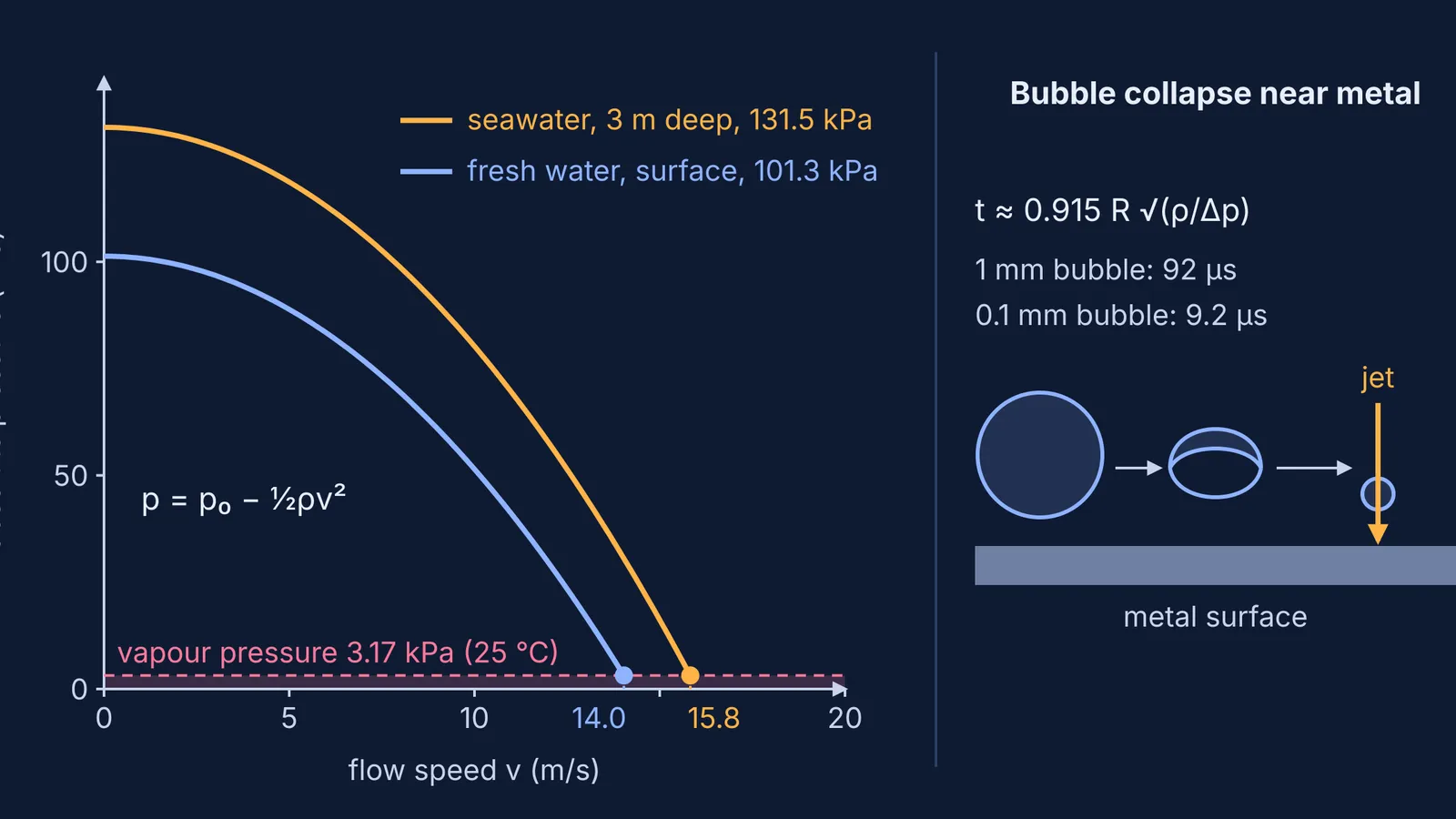
Suppose water starts at rest at pressure p₀ and speeds up to v. Its pressure falls to p₀ − ½ρv². Cavitation begins when that equals the vapour pressure pᵥ. So the threshold speed is:
v = √(2(p₀ − pᵥ)/ρ)
Here is the worked example for water near the surface.
Data. p₀ = 101.3 kPa (1 atm), pᵥ = 3.17 kPa at 25 °C, ρ = 997 kg/m³.
Pressure margin. p₀ − pᵥ = 101.3 − 3.17 = 98.2 kPa = 98,200 Pa.
Threshold speed. v = √(2 × 98,200 ÷ 997) = √197 = 14.0 m/s.
Units. Pa ÷ (kg/m³) = (N/m²) × (m³/kg) = m²/s², and the square root gives m/s. Good.
So water accelerated from rest at 1 atm reaches its boiling point at about 14 m/s, roughly 50 km/h. Below the surface the starting pressure is higher, so the water can move faster before it boils. At 3 m depth in seawater (ρ ≈ 1025 kg/m³):
p₀ = 101.3 + ρgh = 101.3 + (1025 × 9.81 × 3 ÷ 1000) = 101.3 + 30.2 = 131.5 kPa.
v = √(2 × (131,500 − 3,170) ÷ 1025) = 15.8 m/s.
Seawater's vapour pressure is a little lower than pure water's because of the dissolved salt; the difference barely changes the answer.
Temperature matters too. Warmer water has a higher vapour pressure, so it cavitates at a lower speed. How vapour pressure climbs with temperature is worked out in the Clausius-Clapeyron equation post. Near room temperature the effect is small: at 20 °C the threshold is 14.1 m/s instead of 14.0 m/s.
Will a ship propeller cavitate?
Engineers judge this with the cavitation number:
σ = (p − pᵥ) ÷ (½ρv²)
The top is the pressure margin before boiling. The bottom is the dynamic pressure of the flow. A small σ means the flow has enough dynamic pressure to use up the whole margin.
Take an illustrative propeller: 4 m across, turning at 120 rpm, with its tips 3 m below the surface.
Tip speed. v = πDn = π × 4 × (120 ÷ 60) = 25.1 m/s. (This ignores the ship's forward speed, which adds to the water's speed relative to the blade.)
Dynamic pressure. ½ρv² = ½ × 1025 × 25.1² = 324 kPa.
Margin. p − pᵥ = 131.5 − 3.17 = 128.3 kPa.
Cavitation number. σ = 128.3 ÷ 324 = 0.40.
How do you read 0.40? On the curved back of a blade, the flow speeds up beyond the blade's own speed, so the local pressure drops below the free-stream value by an amount comparable to ½ρv². Cavitation starts roughly when σ falls below that local dip, which for many blade shapes is of order 1. So σ = 0.40 means the tips are likely to cavitate. Treat σ as a guide, not a sharp line: the real start point depends on the blade shape and on how clean the water is.
The same calculation shows why depth helps. To raise σ to 1 at a 25.1 m/s tip, the margin must equal 324 kPa, so p must be about 327 kPa. That needs about 22 m of seawater above the tips.
Why do collapsing bubbles damage metal?
A vapour bubble has almost nothing inside it to resist the surrounding water. Once the pressure outside rises again, the water rushes inward. In 1917 Lord Rayleigh worked out how long an empty spherical cavity takes to collapse:
t ≈ 0.915 R √(ρ ÷ Δp)
where R is the starting radius and Δp is the outside pressure minus the vapour pressure. For water at 1 atm, Δp = 98.2 kPa:
a 1 mm bubble collapses in 0.915 × 0.001 × √(997 ÷ 98,200) = 92 µs;
a 0.1 mm bubble collapses in 9.2 µs.
The collapse time scales with R, so smaller bubbles collapse faster. As the wall rushes inward, its speed grows, and the final instant produces a sharp pressure spike. Near a solid surface, the bubble often collapses unevenly and fires a tiny jet of water at the metal. Repeated hits fatigue the surface and tear out small pieces, which is the pitting you see on old propellers and pump impellers. Real bubbles are not empty and do not stay spherical, so Rayleigh's time is an estimate. Early water turbines suffered from the same damage, as noted in the story of Viktor Kaplan's propeller turbine.
Can an animal make water cavitate?
Yes. The peacock mantis shrimp swings its club so fast that, Patek, Korff and Caldwell reported in Nature in 2004 that high-speed video showed evidence of cavitation. UC Berkeley's release on the study gives a peak club speed of 23 m/s. Check it with the numbers above:
½ρv² = ½ × 1025 × 23² = 271 kPa.
In water 0.5 m deep (an illustrative depth), p = 101.3 + 5.0 = 106.4 kPa, so the margin is about 103 kPa.
σ = 103 ÷ 271 = 0.38, well below 1.
The rest of that story, including the second hit when the bubbles collapse, is in how strong a mantis shrimp punch is.
For flow ideas that are easier to see than read, the Simulation Lab has interactive simulations you can try before attempting questions like these.
Quick checklist
Cavitation is boiling caused by low pressure, not high temperature.
Water's vapour pressure at 25 °C is 3.17 kPa (absolute).
Bernoulli threshold from rest: v = √(2(p₀ − pᵥ)/ρ), about 14 m/s at the surface.
Deeper water starts at higher pressure, so it tolerates faster flow.
Cavitation number σ = (p − pᵥ)/(½ρv²); well below 1 means cavitation is likely.
Rayleigh collapse time t ≈ 0.915R√(ρ/Δp): 92 µs for a 1 mm bubble.
Use absolute pressures throughout.