

On this page
A liquid boils when its vapour pressure equals the pressure of the air above it. Climb a hill and the air pressure falls, so water boils before it reaches 100 °C, which is why a pressure cooker matters more in the mountains. The Clausius-Clapeyron equation turns that idea into a number, and the hill-station question is a classic chemistry and physics numerical. Here is the equation, a full worked example for Shimla, and the mistakes that cost marks.
What does the Clausius-Clapeyron equation say?
Vapour pressure is the pressure exerted by a vapour in equilibrium with its liquid, and it rises steeply as the liquid gets hotter. The two-point form of the Clausius-Clapeyron equation, as set out by LibreTexts Chemistry/Physical_Properties_of_Matter/States_of_Matter/Phase_Transitions/Clausius-Clapeyron_Equation), can be written as:
ln(P2/P1) = (ΔHvap/R) × (1/T1 − 1/T2)
P1 and P2 are the vapour pressures at temperatures T1 and T2, in the same unit
T1 and T2 must be in kelvin
ΔHvap is the molar enthalpy of vaporisation, in J/mol
R is the gas constant, 8.3145 J mol⁻¹ K⁻¹
The rise is not a straight line. In the LibreTexts worked example, using ΔHvap = 40.7 kJ/mol for water and 1.0 atm at 373 K, the vapour pressure comes out as 0.697 atm at 363 K but 1.409 atm at 383 K. Ten degrees down removes about 0.30 atm; ten degrees up adds about 0.41 atm.
The same source explains why its results drift from measured values: the enthalpy of vaporisation varies slightly with temperature, so a constant ΔHvap is an approximation. If you have met ΔHvap before in entropy change during boiling (ΔS = ΔH/T), this is the same quantity at work.
How do you find the boiling point of water at a hill station?
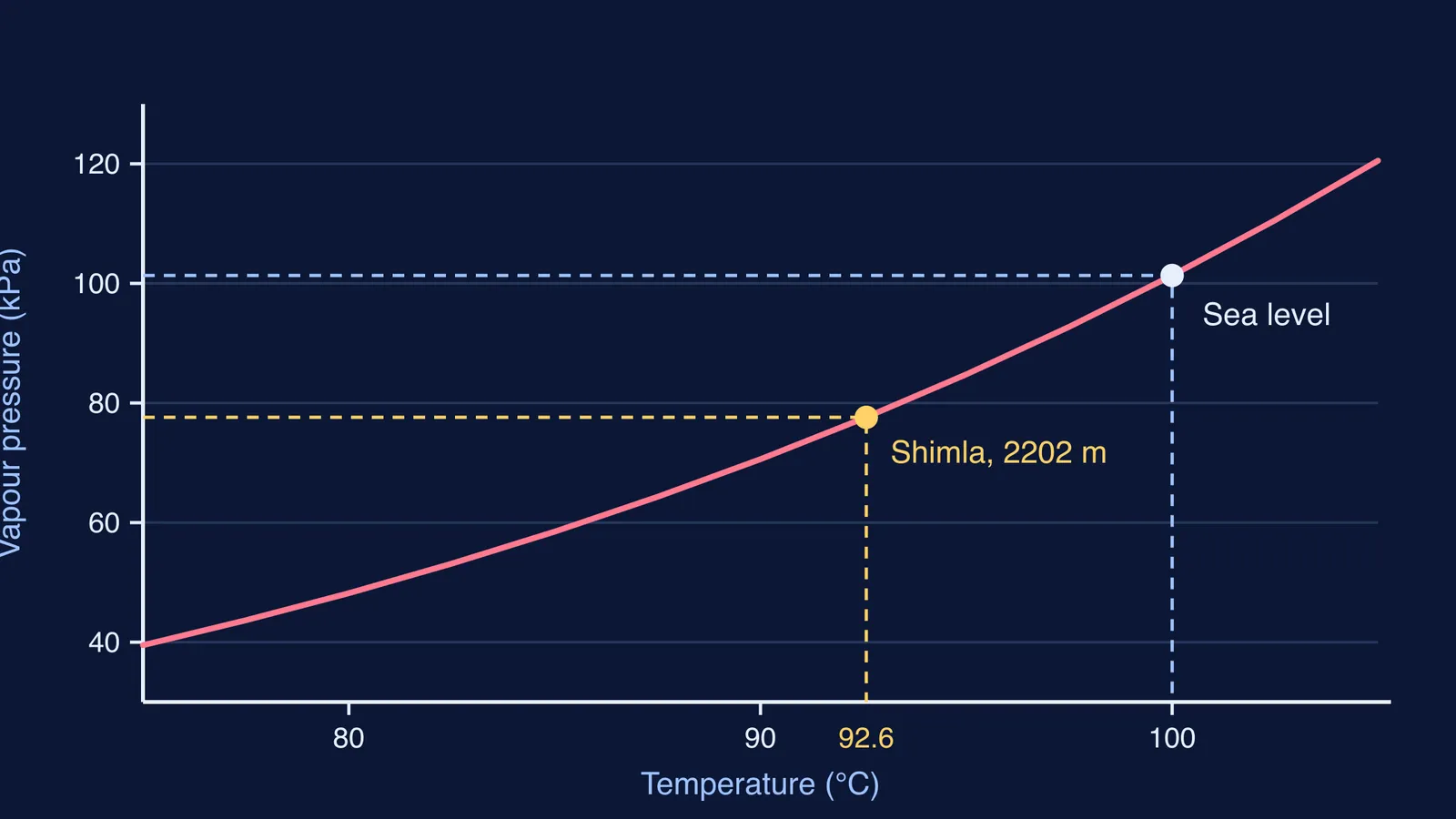
Read the equation the other way round. If you know the outside air pressure, the temperature at which water's vapour pressure equals it is the boiling point.
Take Shimla. The Shimla district administration gives its altitude as 2,202 metres above sea level.
For the air pressure, use NASA Glenn's standard atmosphere model. For the troposphere it gives T = 15.04 − 0.00649h (in °C) and p = 101.29 × [(T + 273.1)/288.08]^5.256 (in kPa), with h in metres. You can watch the same fall in our air pressure and altitude simulation.
Air pressure at h = 2,202 m: T = 15.04 − 14.29 = 0.75 °C, so p = 101.29 × (273.85/288.08)^5.256 ≈ 77.6 kPa.
Write the knowns: P1 = 101.325 kPa (1 atm) at T1 = 373.15 K; P2 = 77.6 kPa; ΔHvap = 40,700 J/mol (the LibreTexts/Physical_Properties_of_Matter/States_of_Matter/Phase_Transitions/Clausius-Clapeyron_Equation) value); R = 8.3145 J mol⁻¹ K⁻¹.
Left side: ln(77.6/101.325) = ln(0.7659) = −0.2667.
Divide by ΔHvap/R = 40,700/8.3145 = 4,895 K: 1/T1 − 1/T2 = −0.2667/4,895 = −5.45 × 10⁻⁵ K⁻¹.
Solve: 1/T2 = 1/373.15 + 5.45 × 10⁻⁵ = 0.0026799 + 0.0000545 = 0.0027344 K⁻¹.
Invert: T2 = 365.7 K, which is about 92.6 °C.
So in Shimla, water boils roughly 7 °C below its sea-level boiling point, on this model.
Why is the answer only approximate?
ΔHvap is not truly constant. LibreTexts/Physical_Properties_of_Matter/States_of_Matter/Phase_Transitions/Clausius-Clapeyron_Equation) points out that real data deviate from the equation because the enthalpy of vaporisation changes slightly with temperature.
The atmosphere is a model. NASA's equations describe a standard atmosphere; the barometer reading on a given day in Shimla will differ with the weather, and so will the boiling point.
Rounding adds up. Keep four significant figures in ln values and reciprocals until the last step; 1/T terms differ only in the fifth decimal place.
For an exam, the method matters more than the last decimal. Show the equation, the unit conversions and each step.
What mistakes do students make in Clausius-Clapeyron numericals?
Use this checklist before you write the final answer:
Temperatures in kelvin, never °C.
ΔHvap in J/mol when R is 8.3145 J mol⁻¹ K⁻¹ (the value LibreTexts/Physical_Properties_of_Matter/States_of_Matter/Phase_Transitions/Clausius-Clapeyron_Equation) uses); mixing kJ and J makes ΔHvap/R wrong by a factor of 1,000.
P1 belongs with T1 and P2 with T2; keep the pairs together.
If you use log base 10, multiply by 2.303: 2.303 log(P2/P1) = (ΔHvap/R)(1/T1 − 1/T2).
P1 and P2 can be in atm, kPa or mm Hg, but both in the same unit.
Check the direction: higher pressure, higher boiling point.
If the algebra goes wrong at step 4 or 5 every time, the Fermi Problem Library has worked problems with a step-by-step solver that explains the reasoning rather than printing an answer. If vapour pressure itself still feels shaky, the Fermi Concept Library gives each concept in physics, chemistry, biology, mathematics and computing its own lesson.
Next time you see a pressure cooker whistle in the hills, you can work out how much hotter it lets the water get.


