

On this page
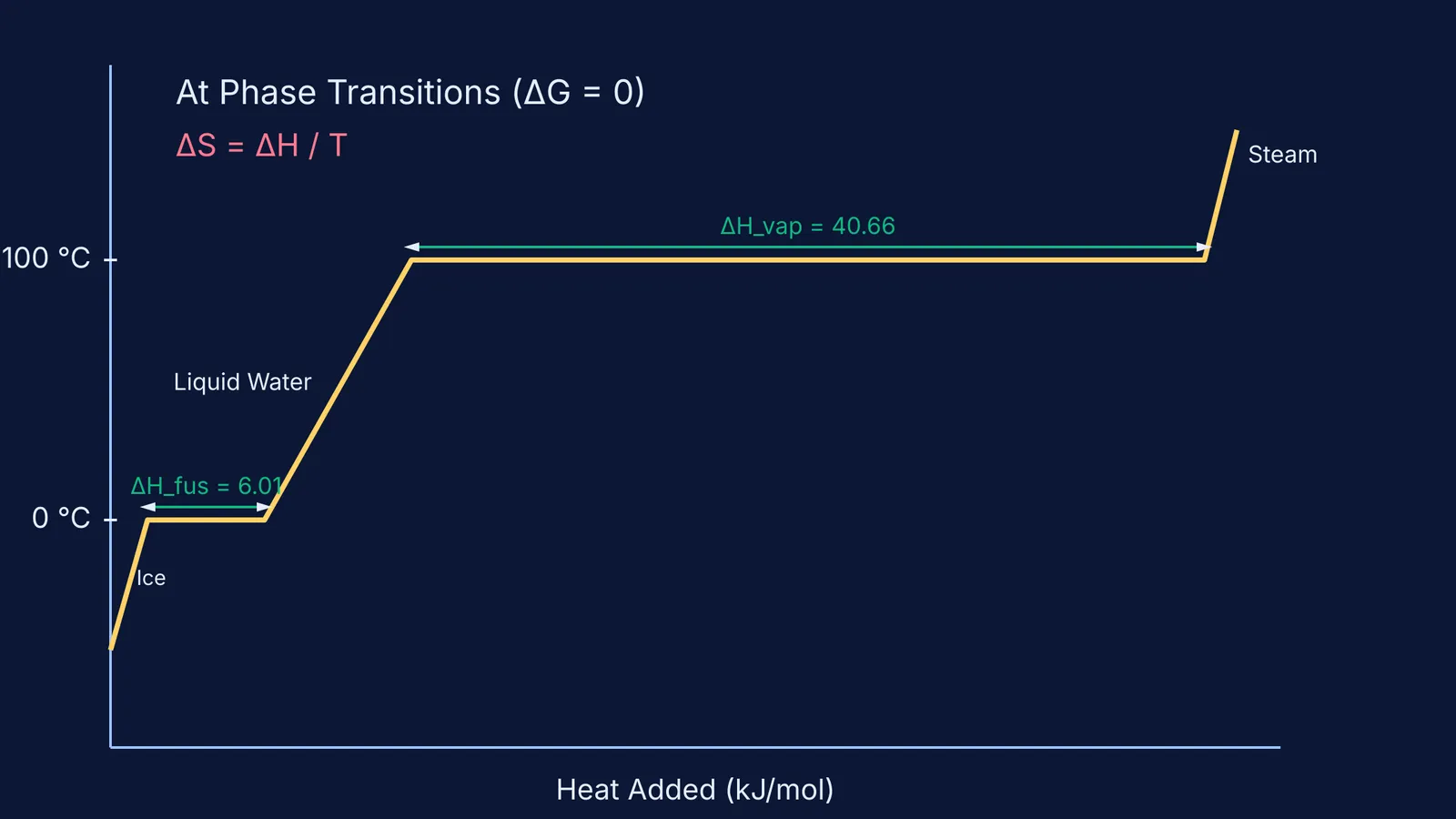
During a phase change, such as ice melting into water or water boiling into steam, heat is absorbed but the temperature does not rise. If you look at the standard equation for Gibbs free energy, ΔG = ΔH − TΔS, you can use this equilibrium state to find exactly how much the entropy (disorder) changes.
Why does ΔS = ΔH/T during a phase change?
When two phases coexist in equilibrium — like liquid water and steam exactly at the boiling point — the process is completely reversible, and the overall change in Gibbs free energy (ΔG) is identically zero. If you substitute ΔG = 0 into the equation, it rearranges directly to:
ΔS = ΔH / T
Here, ΔH is the enthalpy change (the latent heat added to overcome and break the intermolecular forces), and T is the absolute temperature. Because this is a thermodynamic equation, the temperature must always be measured in Kelvin (K). The entropy change (ΔS) tells you how much the system's disorder has increased by absorbing that exact amount of heat.
How do you calculate the entropy of fusion for ice?
When solid ice melts, the rigid hydrogen-bonded crystal lattice breaks down into a fluid liquid where water molecules can slide past each other. This creates more available microstates for the molecules to occupy, so the total entropy increases.
For water, the latent heat of fusion (ΔH_fus) is 6.01 kJ/mol. The melting point of pure water is 0 °C, which corresponds to an absolute temperature of 273.15 K on the Kelvin scale.
To find the entropy of fusion (ΔS_fus):
Convert the given enthalpy to joules: 6.01 kJ/mol = 6010 J/mol.
Divide that value by the absolute temperature:
ΔS_fus = 6010 / 273.15 ≈ 22.0 J/(mol·K)
Why is the entropy of vaporisation for water so high?
When water boils, it turns from a liquid into a gas. The molecules break completely free of their attractive hydrogen bonds and spread out rapidly to occupy a vastly larger volume. This massive increase in freedom means the entropy change of boiling is much larger than the entropy change of melting.
The latent heat of vaporisation for water (ΔH_vap) is 40.66 kJ/mol. Boiling happens at 100 °C, which is exactly 373.15 K.
Calculating the entropy of vaporisation (ΔS_vap): ΔS_vap = 40660 / 373.15 ≈ 109.0 J/(mol·K)
This value is roughly five times larger than the entropy of fusion. For most liquids, the entropy of vaporisation sits in a narrow band between 85 and 90 J/(mol·K) — a predictable pattern known as Trouton's rule. The rule holds because the transition from a compact liquid to a sparse gas represents a very similar leap in disorder across many different substances, from simple hydrocarbons to liquid noble gases.
However, water's value of 109.0 J/(mol·K) is unusually high. This exception happens because liquid water is highly ordered by an extensive hydrogen bond network. Since the liquid phase is already strictly organised, the leap to a disordered gas involves an especially dramatic increase in entropy. The same fundamental thermodynamic principles apply when calculating the enthalpy of atomisation and sublimation, where a solid transitions directly to a gas without becoming a liquid first.
How can a tutor help you master thermodynamics?
If thermodynamics equations feel like a confusing jumble of letters, the Fermi Concept Library can help you build the deeper intuition behind them. Fermi's AI tutor teaches rather than answers: it works out exactly what you know and builds a custom plan for the study session. It holds a coherent line of reasoning, checking your understanding as it goes, so you don't just memorise the standard formulas — you finally see where they come from. Whether you are navigating complex phase transitions or calculating heat in isobaric and isochoric processes, Fermi gives you a clear next step.


