

On this page
The peacock mantis shrimp (Odontodactylus scyllarus) is a reef crustacean that breaks snail shells with a club on its front limbs. Here is what the measurements of its strike and its eyes say, and how to check them with Class 11 physics.
How strong is a mantis shrimp punch?
In a 2005 study in the Journal of Experimental Biology, S. N. Patek and R. L. Caldwell of the University of California, Berkeley, measured the strikes of peacock mantis shrimp on a force sensor.
Peak limb impact forces ranged from 400 to 1,501 newtons (Patek and Caldwell, 2005).
The authors write that, despite their small size, these animals generate impact forces thousands of times their body weight.
How fast is the strike, and where does the speed come from?
The club's peak speeds were 14 to 23 metres per second, with peak accelerations of 6,300 to 8,000 times that of gravity, according to the UC Berkeley release on the 2004 study. The same release compares it with the trap-jaw ant, at 17 metres per second.
The 2004 paper in Nature says a strike this fast requires major energy storage and release, and explains it with a saddle-shaped spring in the shrimp's exoskeleton. Muscles load the spring while a latch holds the limb cocked, and when the latch lets go the stored elastic energy becomes kinetic energy of the club. A catapult works the same way.
What are the cavitation bubbles, and do they hit too?
Cavitation is the formation of vapour bubbles in a liquid where fast motion drops the local pressure very low. The 2004 Nature paper's high-speed images show vapour bubbles forming and collapsing next to the prey because the club moves towards it so fast (Patek, Korff and Caldwell, 2004).
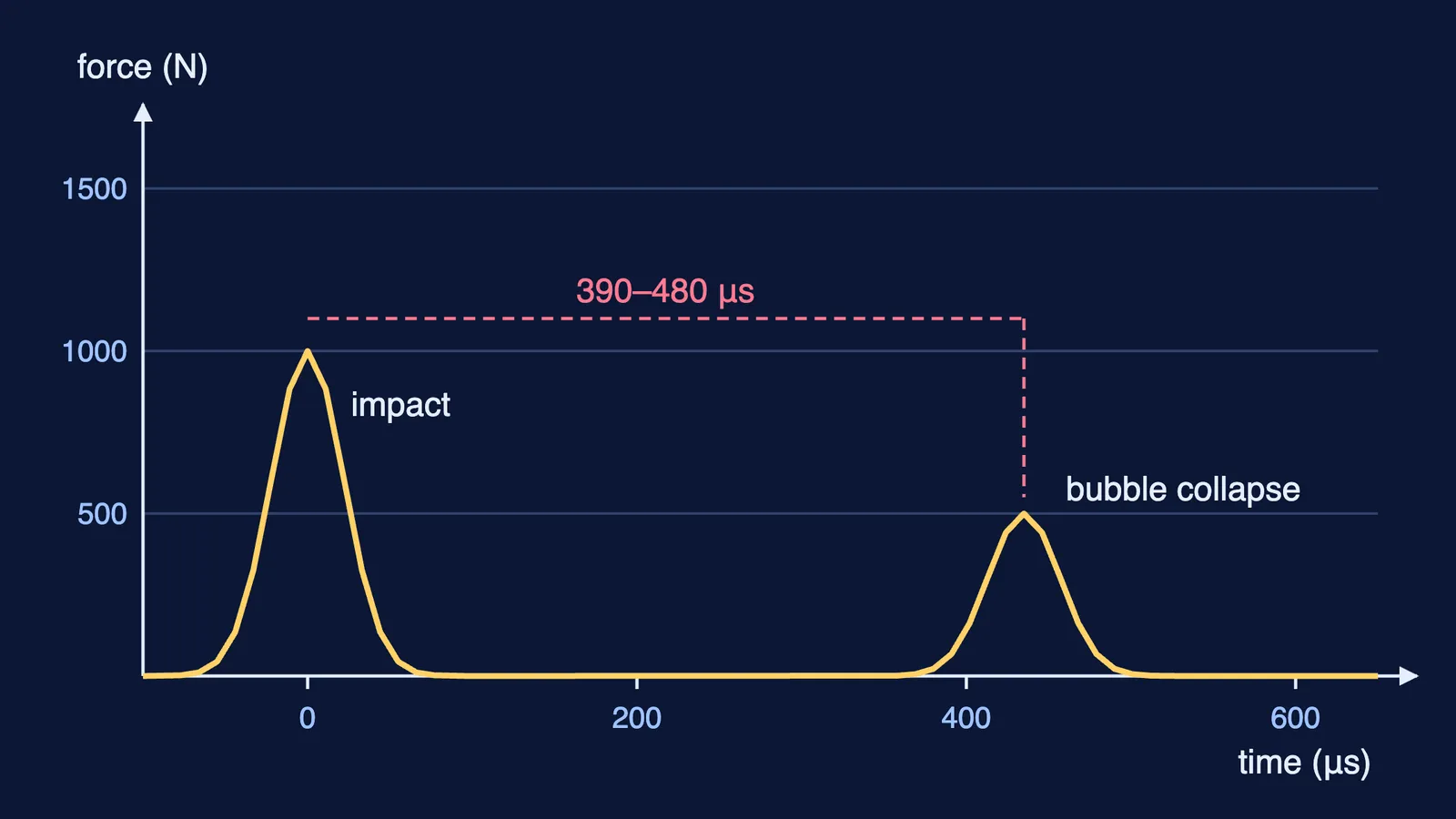
The 2005 study found that each strike produces two force peaks, typically 390 to 480 microseconds apart: the first from the limb's impact, the second from the bubbles collapsing (Patek and Caldwell, 2005). Cavitation peaks reached 504 newtons and averaged half the impact force. So the prey is hit twice by one punch. The Berkeley release adds that the impacts and the cavitation wear away the club's heel, which moulting renews.
Worked example: check the numbers with kinematics
Use the measured peaks from the Berkeley release and the 2005 force study, and take g = 9.8 m/s².
Peak acceleration: a = 8,000 × 9.8 = 78,400 m/s².
Time to reach 23 m/s if the club kept that acceleration the whole way: t = v/a = 23 ÷ 78,400 ≈ 0.29 milliseconds.
Distance covered while speeding up: s = v²/2a = 529 ÷ 156,800 ≈ 3.4 millimetres.
Force in everyday terms: 1,501 N ÷ 9.8 m/s² ≈ 153 kg. The peak blow equals the weight of a 153 kg mass, for a split second.
The catch: 8,000 g is a peak, not an average. The real acceleration is lower for most of the swing, so the true wind-up takes longer than 0.29 milliseconds and covers more than 3.4 millimetres. Your answer is a lower limit, which is still useful. Telling a peak from an average is a habit worth building for any physics exam.
If steps like these feel shaky, the Fermi Problem Library has worked problems with a step-by-step solver that explains the reasoning rather than printing an answer.
Before you share an animal record, ask four questions:
Which species was measured?
Is the number a peak or an average?
What are the units, and do they make sense?
Can you find the paper, not just a retelling?
Do mantis shrimp really have twelve colour receptors?
Yes, some species do. A 2014 paper in Science by Hanne Thoen, Justin Marshall and colleagues at the University of Queensland describes mantis shrimp with 12 photoreceptor types, each sampling a narrow band from deep ultraviolet to far red, 300 to 720 nanometres.
The surprise was what the receptors do. The authors point out that three or four colour channels are enough for fine colour discrimination. In their behavioural tests the shrimp were poor at telling close wavelengths apart (Thoen et al., 2014). The tests ruled out conventional colour-opponent coding; the team suggests the shrimp scan their eyes across a scene and recognise colours rather than finely discriminate them. So the popular line that they see far more colours than we do is not what these tests support.
Their eyes also read polarised light: a 2008 Current Biology paper reported circular polarisation vision in a mantis shrimp. For the basics, read why sunlight scattered at 90 degrees is plane polarised, and for colour vision going missing in people, John Dalton's account of his own colour blindness.
Bats solve a different physics problem with sound, as in how bats use echo delay and the Doppler effect. If you want a place to start with springs, waves or light, Fermi's AI tutor can work out what you already know and build a plan for the session.


