On this page
You know John Dalton from atomic theory. He also wrote one of the earliest scientific descriptions of colour blindness, about himself, and asked for his eyes to be examined after he died so his idea about the cause could be tested. It took until 1995 and a DNA lab to settle it.
What did John Dalton write about his colour blindness in 1794?
Dalton gave his first account of his colour vision to the Manchester Literary and Philosophical Society in 1794, and the Science and Industry Museum in Manchester calls it the first description of colour blindness. The paper, "Extraordinary facts relating to the vision of colours", was printed in the society's Memoirs in 1798.
His examples are vivid. "Green woollen cloth, such as is used to cover tables appears to me a dull, dark, brownish red colour", he wrote, and "the face of a laurel-leaf (Prunus laurocerasus) is a good match to a stick of red sealing-wax" (quoted by the same museum).
In a letter to his friend Elihu Robinson, quoted by the Royal Society, Dalton said "colours appear different to me to what they do to others", with "my brother excepted, who seems to see as I do." Like his brother, Dalton confused scarlet with green and pink with blue (Hunt and colleagues, Science, 1995).
Why did Dalton think the inside of his eye was blue?
Dalton supposed that his vitreous humour, the jelly that fills the eyeball, was tinted blue and absorbed the longer (redder) wavelengths (Science, 1995). That idea could be checked, and he asked for it to be. On 28 July 1844, the day after Dalton died, the Manchester doctor Joseph Ransome carried out the autopsy and found the vitreous humour "perfectly colourless" (Science and Industry Museum).
What did DNA from Dalton's eye show in the 1990s?
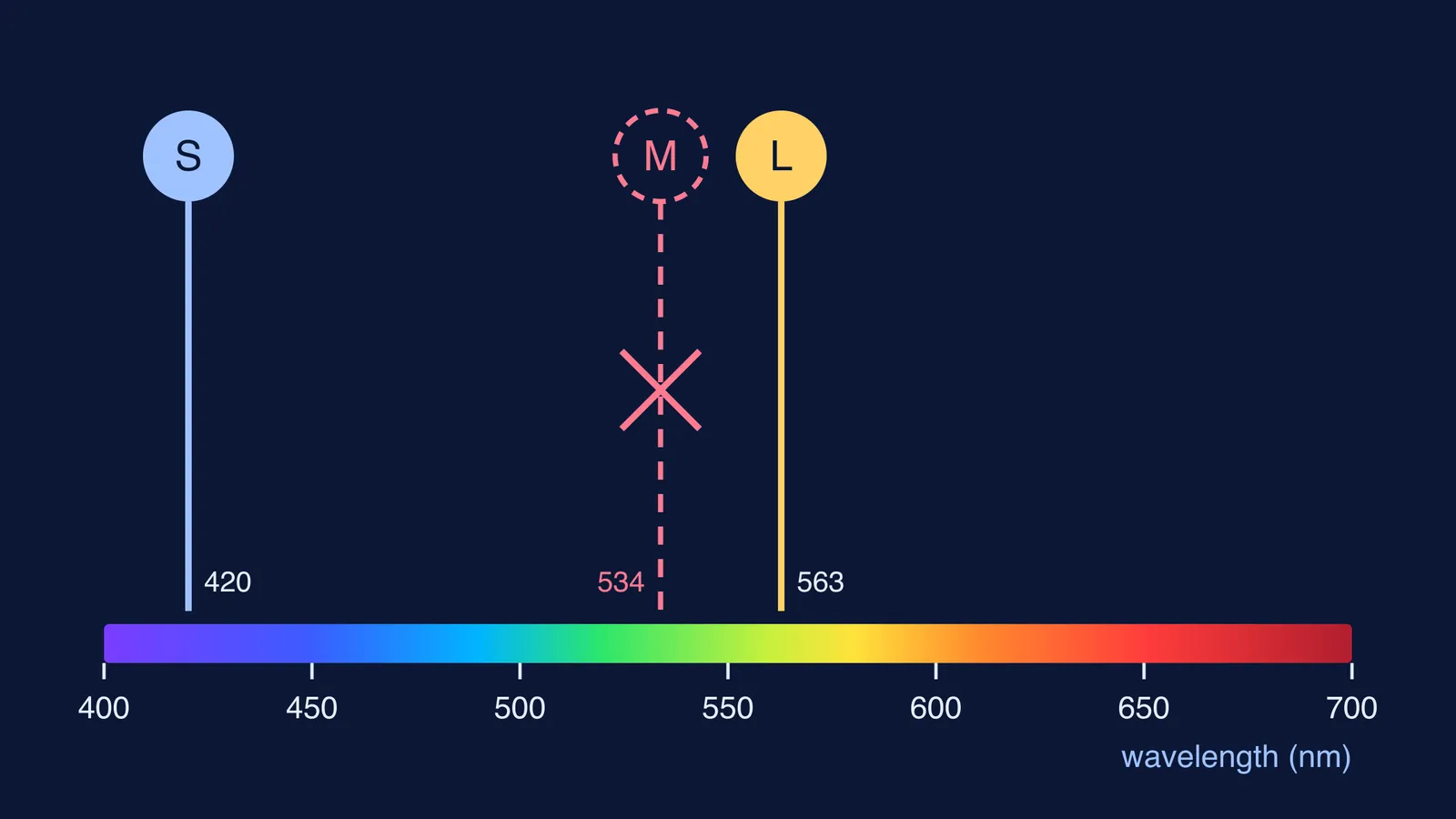
Dalton's eyes were kept by the Literary and Philosophical Society and later given to the Museum of Science and Industry in 1997 (Science and Industry Museum). In 1995, David Hunt, Kanwaijit Dulai, James Bowmaker and John Mollon reported in Science that DNA extracted from the preserved eye tissue showed Dalton was a deuteranope, lacking the middlewave photopigment of the retina (Science 267: 984-988).
It also corrected Thomas Young, of the three-colour theory of vision, who believed Dalton was a protanope, missing the long-wave pigment. The authors showed the new diagnosis fits the record of what Dalton saw.
Human cones have peak sensitivities near 420 nm (short-wave), 534 nm (middle-wave) and 563 nm (long-wave), from measurements on a human retina (Bowmaker and Dartnall, Journal of Physiology, 1980). Dalton had only the short and long cones. Colours that differ mainly in how strongly they excite the green-sensitive cone could look alike to him, which helps explain why a laurel leaf matched red sealing-wax.
If cones feel shaky, the Fermi Concept Library gives each concept in biology and physics its own lesson and place in the map.
Why are more boys colour blind than girls?
About 1 in 12 men have colour vision deficiency, and the most common type makes it hard to tell red from green, according to the US National Eye Institute. The genes for red-green colour vision deficiency are on the X chromosome. A boy has only one X, so one altered copy is enough; a girl needs altered copies on both. That is why, among people of Northern European ancestry, red-green deficiency affects about 1 in 12 men but 1 in 200 women (MedlinePlus Genetics).
A worked cross, with X^B normal and X^b affected:
Mother is a carrier (X^B X^b); father has normal vision (X^B Y).
Sons get Y from the father and one X from the mother: half X^B Y (normal), half X^b Y (colour blind).
Daughters get the father's X^B, so none is colour blind, but half are carriers.
Two affected brothers, as in Dalton's family, fit this pattern. For more practice, see how to solve X-linked crosses for colour blindness and haemophilia. When a cross goes wrong, the Fermi Problem Library has a step-by-step solver that explains the reasoning rather than printing an answer.
What should you do if you think you see colours differently?
A checklist:
Get tested by an optometrist or eye doctor. The most common test is a circle of coloured dots with a number or shape hidden inside (National Eye Institute), like the Ishihara colour blindness test. Online images are not a diagnosis.
Plan to work around it. The NEI says there is no cure for the inherited kind.
Tell your lab teacher. Titration end points, flame tests and litmus rely on colour; ask a partner to confirm.
Label by name. Mark wires, pens and map keys with words, not just colour.
Check before choosing a course or job. Some have colour vision rules; read the current official medical standards.
A script for your teacher: "I may not see some reds and greens the way others do. Can I check colours with a partner during practicals?" That is Dalton's method: say what you see and compare.