

On this page
Isaac Newton showed that white light is made of a continuous spectrum of colours. We can see these colours separated when light bends, such as in the dispersion of white light by a glass prism. But while a prism separates wavelengths, the human eye has to put them back together into a single image.
For a long time, scientists did not know how the eye managed this. It seemed impossible that the retina could have a unique receptor for every single wavelength in the infinite spectrum. The answer came from a polymath who decided to simplify the problem.
What is the trichromatic theory of colour vision?
In 1802, the physician and physicist Thomas Young published a paper titled "On the Theory of Light and Colours" in the *Philosophical Transactions of the Royal Society*. He proposed a radical idea: the eye does not need thousands of different receptors to see the world. Instead, it only needs three.
Young suggested that the retina contains three types of colour-sensitive particles, which he initially matched to red, green, and violet light. Every colour we see, he argued, is just a mixture of these three primary signals. If all three are stimulated equally, we perceive white light.
The theory sat largely untouched until the 1850s, when the German physicist Hermann von Helmholtz revived it. Helmholtz used precise colour-matching experiments to prove that any colour in the visible spectrum could be matched by mixing three primary wavelengths of light. Because of their combined work, this model became known as the Young-Helmholtz trichromatic theory. Helmholtz also used the theory to explain colour blindness, suggesting it happens when one of these three receptor types is missing or malfunctioning.
How do rods and cones work in the human eye?
Today, we know that Young and Helmholtz were exactly right about the receptors. In the Class 10 Science curriculum on the human eye, you learn about two main types of photoreceptor cells in the retina: rods and cones.
Rods are shaped like cylinders and respond to the intensity of light. They work best in dim conditions and peak at a wavelength of about 498 nm, but they cannot distinguish colours. This is why our night vision is essentially black and white.
Cones are cone-shaped and require bright light to function. They are concentrated in the central part of the retina and are responsible for high-resolution vision and colour perception.
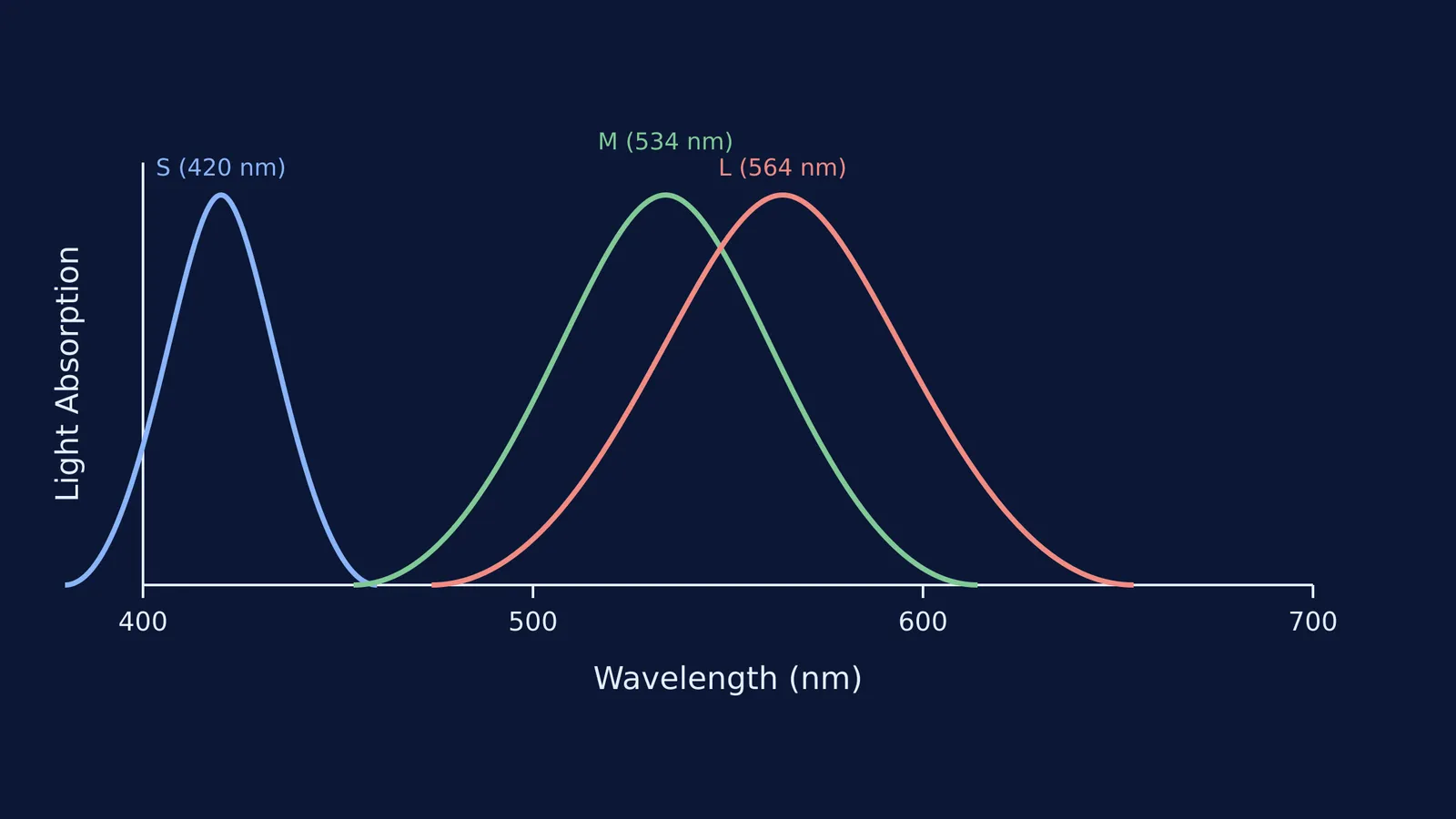
Modern measurements show that the human eye has three types of cones, perfectly matching Young's 1802 prediction. They are named for the wavelengths they absorb best:
S-cones (Short): Peak at roughly 420 nm, making them sensitive to blue and violet light.
M-cones (Medium): Peak at roughly 534 nm, capturing green light.
L-cones (Long): Peak at roughly 564 nm, which corresponds to red and yellow light.
How do three cones create millions of colours?
The secret to seeing millions of distinct colours lies in the overlap of these receptor sensitivities. A single wavelength of light usually triggers more than one type of cone.
For example, a wavelength of 550 nm (yellow light) sits right between the peaks of the M-cones and L-cones. When this light hits your retina, it stimulates the L-cones strongly and the M-cones almost as strongly. Your brain receives both signals at once and interprets the combined input as "yellow".
If a digital screen wants to show you yellow, it does not need to produce a 550 nm light source. It just shines red and green light into your eye at the same time. The cones react the exact same way, and the brain sees yellow. This principle of additive colour mixing drives every phone and television display today. If you want to see how these overlapping wavelengths create new colours, you can experiment with light frequencies in the Fermi Simulation Lab.
How does the eye connect physics and biology?
When revising for exams, you will find that physics and biology often overlap. While physical optics and phenomena like atmospheric refraction explain how light travels through space, the biology of the retina explains how we actually perceive it.
Connecting these ideas makes both subjects easier to learn. By understanding the physics of wavelengths, the biology of the cones makes perfect sense. If you ever get stuck tracing the path of light or understanding the anatomy of the eye, you can look up either topic in the Fermi Concept Library, which has every concept in physics, chemistry, biology, mathematics and computing, each with its own lesson and its place in the map.


