

On this page
A bat hunting at dusk is solving two physics problems many times a second: how far away is that moth, and is it getting closer? Distance comes from timing, speed comes from a change in pitch, and both work because the calls are pitched far too high for you to hear.
How do bats use echolocation to find distance?
An echolocating animal finds range by measuring the time delay between its own call and the echoes that return, as the overview of animal echolocation sets out.
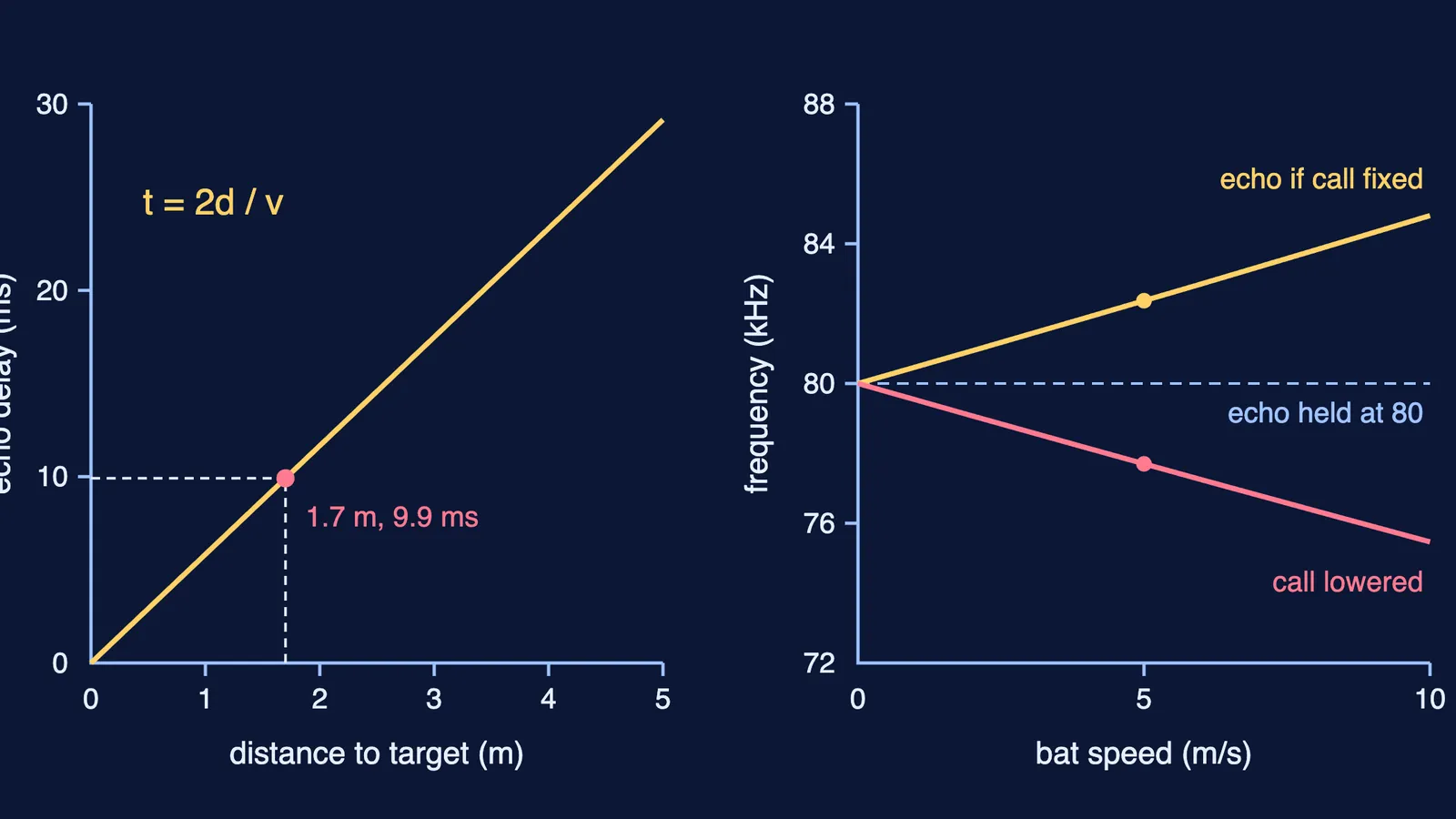
Sound in air at 20 °C travels at about 343 m/s, according to the speed of sound reference values. The sound goes to the target and back, so the distance is half the path:
d = v × t ÷ 2
If the echo returns after 10 ms, then d = 343 × 0.010 ÷ 2, which is about 1.7 m. If it returns after 1 ms, the moth is only about 17 cm away. Precision matters too: to tell apart two targets 1 cm apart in range, the bat has to notice a difference in delay of 2 × 0.01 ÷ 343 seconds, about 58 microseconds.
This is the same arithmetic as the minimum distance at which you hear an echo, only scaled down to milliseconds and centimetres.
How does the Doppler shift tell a bat about speed?
When a bat flies towards a still target at speed v, the echo comes back at a higher frequency than the call. Two shifts stack up: the bat is a moving source, and then a moving listener for the echo. With c for the speed of sound:
f(echo) = f × (c + v) ÷ (c − v)
Take illustrative numbers: an 80 kHz call, a bat flying at 5 m/s and c = 343 m/s. Then f(echo) = 80 × 348 ÷ 338, which is about 82.4 kHz, a rise of about 2.4 kHz. A faster approach gives a bigger rise, so the shift carries speed information. Our explainer on why a moving source and a moving observer give different pitch works through the difference.
Horseshoe bats go a step further. They lower the frequency of their calls as they fly so the echo comes back at a nearly constant frequency, a behaviour called Doppler shift compensation that Hans-Ulrich Schnitzler described in 1968.
Studying greater horseshoe bats, Walter Metzner, Shuyi Zhang and Michael Smotherman (2002, Journal of Experimental Biology) found the bats compensated for about 95% of upward shifts in echo frequency but only 22% of downward ones. With our numbers, holding the echo at 80 kHz means calling at 80 × 338 ÷ 348, about 77.7 kHz.
Why are bat calls ultrasonic?
Human hearing runs from about 20 Hz to 20 kHz, while bat calls range from as low as 11 kHz to as high as 212 kHz, according to the overview of animal echolocation. That is why a hunting bat seems silent to you.
The reason is wavelength. Using λ = v ÷ f with v = 343 m/s, a 1 kHz sound has a wavelength of about 34 cm, a 20 kHz sound about 17 mm, and a 100 kHz sound about 3.4 mm.
Small things reflect sound well only when they are not much smaller than the wavelength. Measuring echoes from five objects of different sizes, Arjan Boonman and colleagues (2013, Frontiers in Physiology) found that target strength rose steadily as the ratio of target size to wavelength grew towards 1, then levelled off. For a 5 mm insect, that ratio is about 0.3 at 20 kHz and about 1.5 at 100 kHz.
High frequency has a price, because air absorbs it. Raising the call from 45 to 90 kHz increases atmospheric attenuation from 1.4 to 4 dB per metre at 25 °C and 80% humidity, report Lasse Jakobsen, Signe Brinkløv and Annemarie Surlykke (2013, Frontiers in Physiology).
How do you solve echo and Doppler questions in an exam?
Use this checklist on any echo or sonar problem:
Draw the path. There and back means 2d, so t = 2d ÷ v.
Convert units first: milliseconds to seconds, kHz to Hz.
For a reflected wave, apply Doppler twice: the target as a listener, then as a source.
Sanity check the size. A bat at a few m/s shifts an 80 kHz call by a few kHz, not tens.
Check the wavelength with λ = v ÷ f to see whether the wave can detect the object at all.
If the two-step Doppler for a reflected wave is hard to picture, the Fermi Simulation Lab has interactive simulations for ideas that are easier to see than to read. And if waves as a whole feel shaky, Fermi's AI tutor can work out what you already know and build a plan for the session.
For the biology side of the story, read how bats find insects in total darkness.


