On this page
A horn sounds 500 Hz. In one case it rushes towards you at 34 m/s; in the other, you rush towards it at 34 m/s. The relative speed is the same, yet you hear 555.6 Hz in the first case and 550 Hz in the second. Here is why, using the standard Doppler formulas from OpenStax, with both cases worked side by side.
Why does the Doppler formula change when the source moves instead of the observer?
There are three things in the problem, not two: source, observer and air. In the words of the OpenStax University Physics chapter on the Doppler effect, "The sound moves in a medium and has the same speed v in that medium whether the source is moving or not." The air sets the frame in which sound has speed v.
Now follow one period T of the wave in each case.
Source moves at u towards you. It sends a crest, then moves forward uT before sending the next, so the wavelength in front of it really shrinks to (v − u)T. The crests still travel at v, so you hear f′ = v/λ′ = fv/(v − u).
Observer moves at u towards the source. The source is still in the air, so the wavelength in the air stays λ = v/f. Nothing about the wave changes. You simply run into the crests faster, at v + u relative to you, so f′ = (v + u)/λ = f(v + u)/v.
One case changes the wave itself; the other changes only how quickly you meet an unchanged wave. That is the whole asymmetry.
Isn't motion relative, so shouldn't both give the same answer?
It would be, if the air were not there. The Wikipedia article on the Doppler effect states that for waves in a medium, such as sound, the velocities of the observer and the source are measured relative to the medium in which the waves travel. The same article notes that for waves in a vacuum, such as light, only the relative velocity between observer and source needs to be considered. So a source moving through still air and an observer moving through still air are physically different situations. If a wind blows, the air's frame shifts again, which is why our post on the Doppler effect with wind adjusts v by the wind speed.
Side by side: same speed, different pitch
Take f = 500 Hz and v = 340 m/s, the speed used in the OpenStax worked example. Let u = 34 m/s, about 122 km/h, or v/10.
Source approaching: 500 × 340/306 = 555.6 Hz
Observer approaching: 500 × 374/340 = 550.0 Hz
Source receding: 500 × 340/374 = 454.5 Hz
Observer receding: 500 × 306/340 = 450.0 Hz
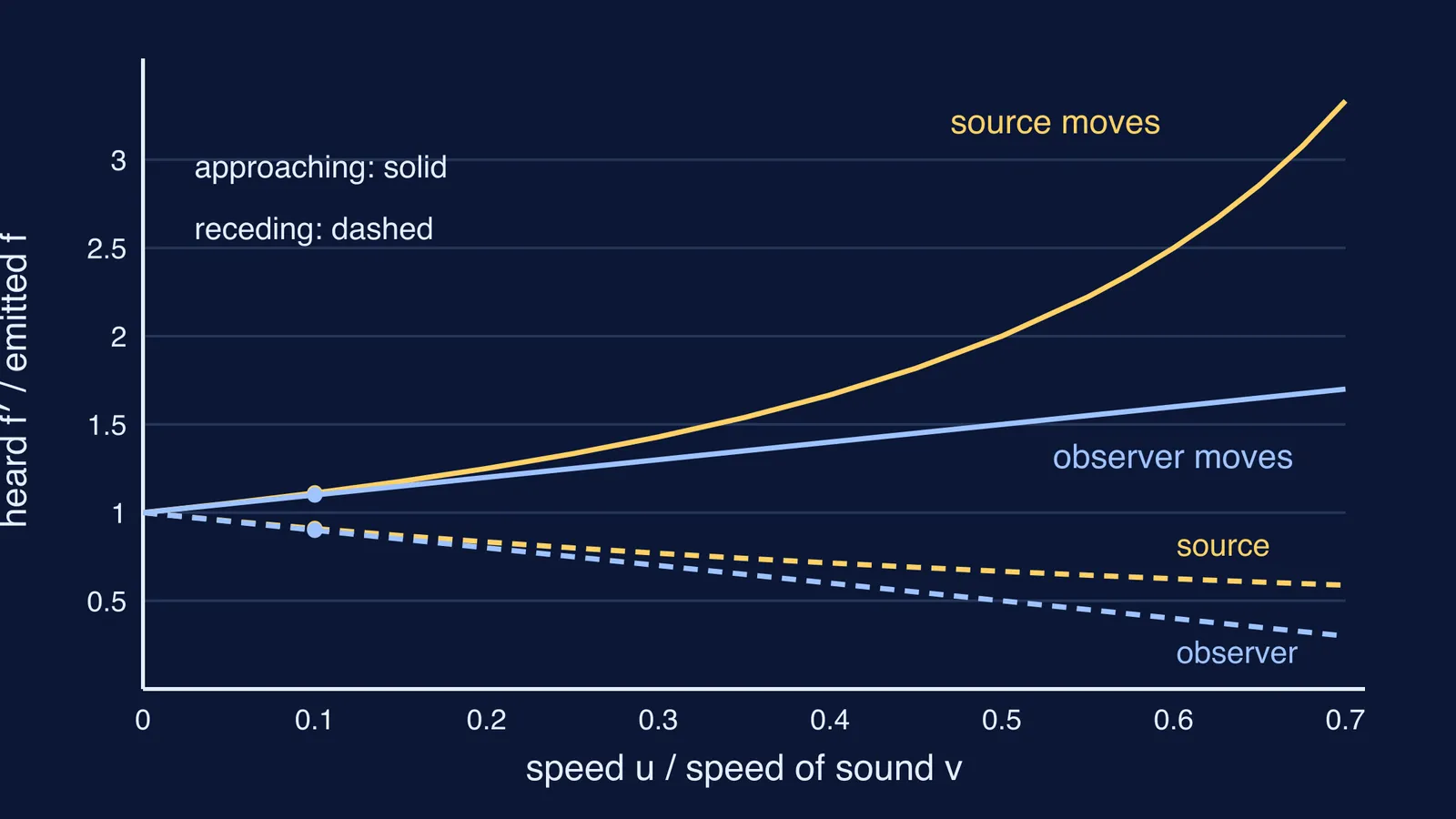
The gap is about 5 Hz either way. Now push u up to 170 m/s, half the speed of sound. An approaching source gives 500 × 340/170 = 1000 Hz. An approaching observer gives 500 × 510/340 = 750 Hz. As u nears v, the source formula grows without limit because the crests pile up in front of the source, while the observer formula only reaches 2f = 1000 Hz.
What happens at low speed?
Write x = u/v. Using the OpenStax moving-source and moving-observer formulas, for an approaching source, f′/f = 1/(1 − x) = 1 + x + x² + x³ + … For an approaching observer, f′/f = 1 + x exactly.
The two agree to first order in x, and the gap is roughly f x². Check it on the example above: 500 × (0.1)² = 5 Hz, against the exact gap of 5.6 Hz.
For a scooter at 10 m/s (36 km/h), the source formula gives 515.2 Hz and the observer formula 514.7 Hz, under half a hertz apart. So when u is much smaller than v, both collapse to f′ ≈ f(1 ± u/v). In a numerical with exact options, still use the correct formula.
A four-step check for any Doppler numerical
Name the medium: still air, or wind?
Write the speed of the source and of the observer relative to that medium, not relative to each other.
Put the observer's speed in the numerator and the source's speed in the denominator, then fix the signs. Our guide to Doppler sign rules for sound covers the signs in detail.
Compare with f(1 ± u/v). Approaching means higher pitch; receding means lower.
If you keep putting u in the wrong place, the Fermi Problem Library has worked problems with a step-by-step solver that explains the reasoning rather than printing an answer. Wavefronts bunching up is also easier to see than to read, which is what the Fermi Simulation Lab is for.
Next, try the classic exam case where both the pitch and the angle change: why a train whistle's pitch drops as it passes you.