On this page
A Doppler problem that says "a wind of 10 m/s is blowing" looks harder than it is. You only change one symbol in the formula you already know. The hard part is knowing which symbol and which sign, and this post sorts that out.
Why does wind change the Doppler formula at all?
Sound is a wave in air, so its speed is fixed relative to the air, not the ground. For waves in a medium, "the velocity of the observer and of the source are relative to the medium", and the total Doppler effect can come from motion of the source, the observer, the medium, or any mix of them (Wikipedia, Doppler effect).
The usual textbook formula assumes still air. OpenStax University Physics writes it as f_o = f_s (v ± v_o)/(v ∓ v_s) and draws its sound waves "in a stationary air mass" (OpenStax University Physics, Volume 1, section 17.7). Wind breaks that assumption: the air itself now moves.
Physics class notes from Highline College put it simply: "Wind has essentially the same effect as an increase or decrease in sound velocity" (Highline College physics notes on the Doppler effect).
What is the Doppler formula when wind is blowing?
Keep the still-air formula and swap the speed of sound for the speed of sound relative to the ground along the line from source to observer:
Wind blowing from the source towards the observer: use v + w everywhere you see v.
Wind blowing from the observer towards the source: use v − w everywhere you see v.
Keep v_s and v_o as speeds relative to the ground, with the same approach and recede signs as before.
So with wind along the source-to-observer direction, f_o = f_s (v + w ± v_o)/(v + w ∓ v_s).
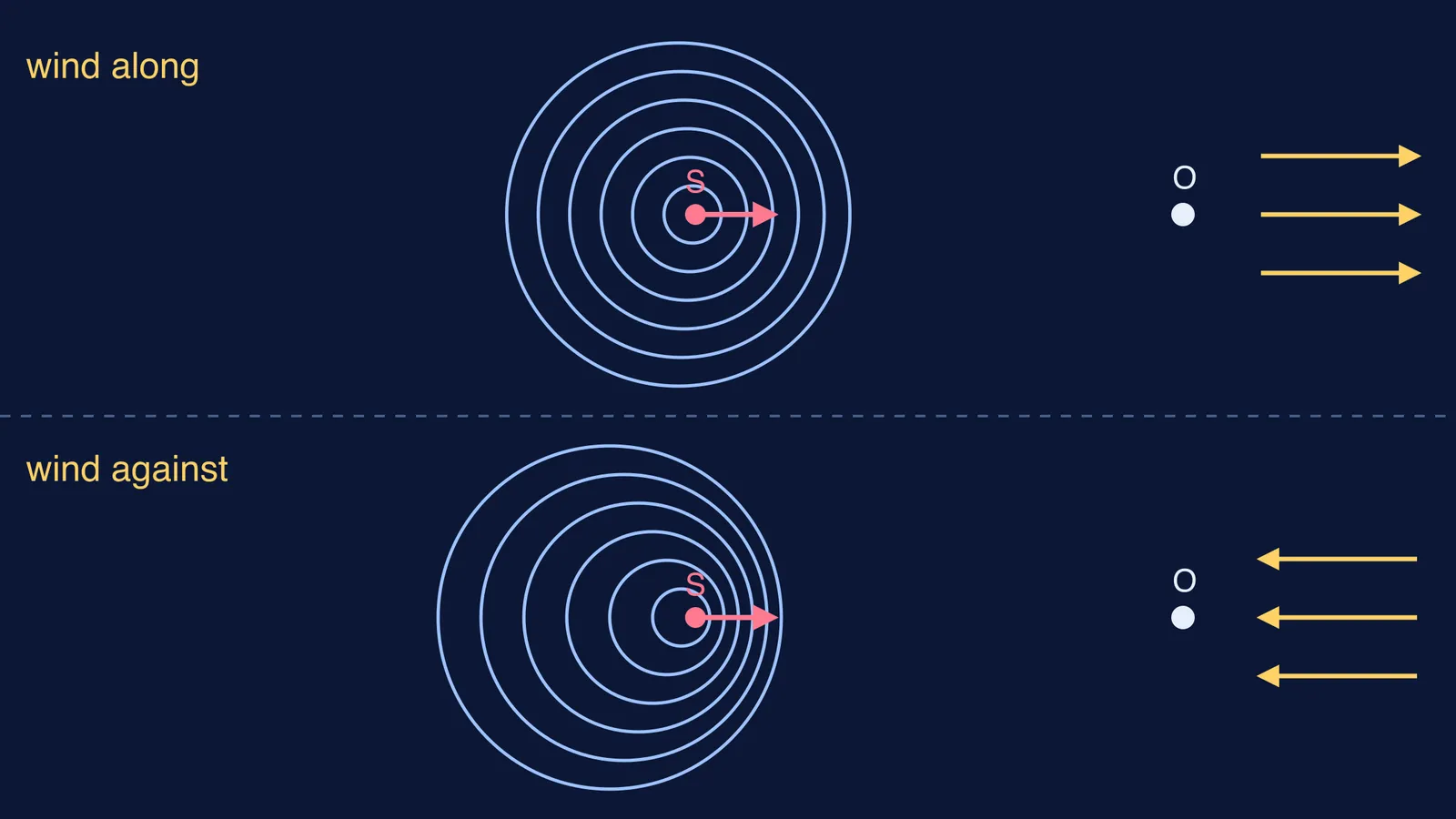
The Highline notes explain why the cancellation happens: wind along the sound stretches the wavelength, which lowers the frequency, but the stretched waves also arrive faster, which raises it. When neither the source nor the observer moves, "the two effects completely cancel" (Highline College physics notes).
Worked case: a horn moving towards you, with and without wind
A scooter with a 500 Hz horn rides straight towards you at 20 m/s. You stand still. Take the speed of sound in still air as 340 m/s, the value OpenStax uses in its train-horn example (OpenStax, section 17.7). The wind blows at 10 m/s along the road.
The source approaches, so the formula is f_o = f_s × V/(V − v_s), where V is the effective speed of sound.
Still air: V = 340 m/s. f_o = 500 × 340/320 = 531.25 Hz, about 531 Hz.
Wind blowing from the scooter towards you (along the source's motion): V = 350 m/s. f_o = 500 × 350/330 = 530.3 Hz, about 530 Hz.
Wind blowing from you towards the scooter (against the source's motion): V = 330 m/s. f_o = 500 × 330/310 = 532.3 Hz, about 532 Hz.
Notice the direction of the result. A tailwind behind the scooter slightly lowers the pitch you hear, and a headwind slightly raises it. The wavelength in front of the scooter is V − v_s divided by 500: 0.66 m with the wind along, 0.64 m in still air and 0.62 m against. Shorter waves ahead mean a higher pitch.
You can check case 2 another way. In the air's own frame, the scooter moves towards you at 20 − 10 = 10 m/s, and you move towards the scooter at 10 m/s. The still-air formula then gives 500 × (340 + 10)/(340 − 10) = 530.3 Hz, the same answer.
Which mistakes cost marks in wind problems?
Adding the wind to the source speed instead of to the speed of sound.
Changing v in the denominator but forgetting the numerator, or the other way round.
Taking the wind sign from the direction the source moves instead of from the source-to-observer direction.
Expecting a shift when nothing moves. Run the quick check above first.
If the plain Doppler signs still trip you up, start with our guide to Doppler sign rules for sound, then try the train whistle Doppler shift as it passes you and the two-step method for echoes from a moving reflector.
When you want more practice, the Fermi Problem Library has worked problems with a step-by-step solver that explains the reasoning rather than printing an answer, so you can see where the wind term goes in each line. If the idea of wavefronts drifting with the air is still hard to picture, the Fermi Simulation Lab has interactive simulations for ideas that are easier to see than to read.