

On this page
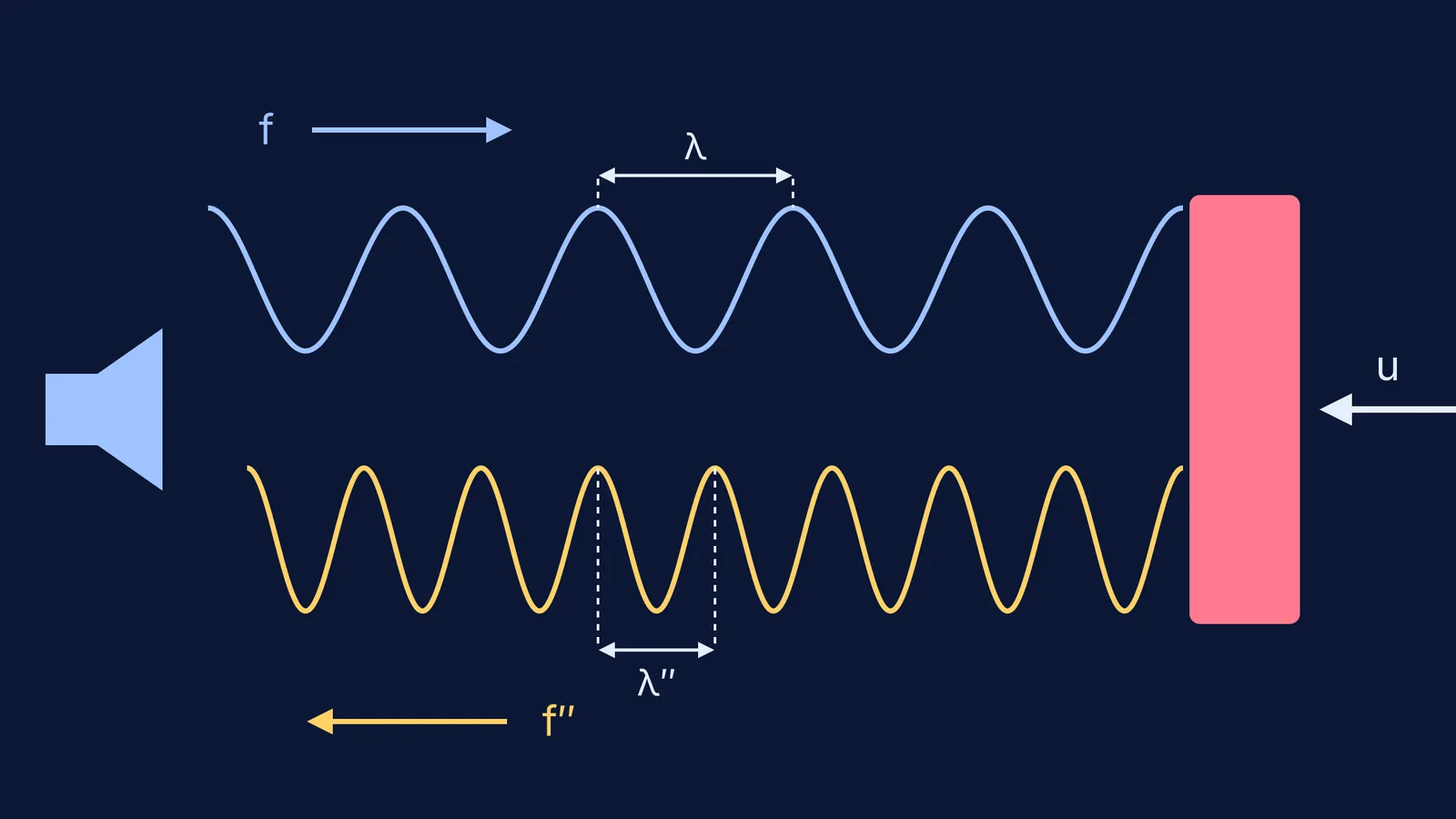
Send a sound of frequency f towards a car coming at you and the echo returns at a higher pitch. To find how much higher, apply the Doppler effect twice, once for each leg of the trip.
Why is sound reflected from a moving car Doppler-shifted twice?
The reflector does two jobs. First it is an observer, moving into the waves and meeting crests more often than they were sent. Then it is a source, sending back that frequency while still moving towards you, so the returning crests bunch up again. The schoolphysics notes on the Doppler shift in an echo say that in a radar speed trap, or a bat locating an insect, the reflected pulse “will be Doppler shifted twice because of the relative motion of the source and reflector.”
For each leg, use the general formula from OpenStax University Physics, section 17.7: f_o = f_s(v ± v_o)/(v ∓ v_s), where the top sign is for approaching and the bottom sign for moving apart. If the signs still trip you up, our post on Doppler sign rules for sound goes through every case.
How do you find the echo frequency from a moving reflector?
A fixed speaker sends 500 Hz towards a car approaching at 20 m/s (72 km/h). Take the speed of sound as 343 m/s, the value OpenStax gives for air at 20 °C, and assume no wind.
Step 1, the car is the observer moving towards a fixed source: f′ = f(v + u)/v = 500 × 363/343 = 529.2 Hz.
Step 2, the car is the source moving towards a fixed listener at the speaker: f″ = f′ × v/(v − u) = 529.2 × 343/323 = 561.9 Hz.
Combine the two: f″ = f(v + u)/(v − u). Check: 500 × 363/323 = 561.9 Hz.
If the car moves away at 20 m/s, flip both signs: f″ = f(v − u)/(v + u) = 500 × 323/363 = 444.9 Hz.
The same result covers a car honking as it drives towards a fixed wall: the wall receives a raised note and sends it back, and the driver, a moving observer, hears it raised again, at f(v + u)/(v − u).
What beat frequency do you hear with the echo?
When the original note and the echo reach the same ear, they produce beats; at tens of hertz you hear a rough, buzzing tone rather than slow swells. OpenStax section 17.6 defines the beat frequency as f_beat = |f2 − f1|. In our example the beat is 561.9 − 500 = 61.9 Hz for the approaching car and 500 − 444.9 = 55.1 Hz for the car moving away. For the driver honking at a wall, the horn reaches the driver unshifted, so the beat is f″ − f.
Questions often run this backwards: they give the beat and ask for the speed. Solving f(v + u)/(v − u) − f = f_beat for u gives u = v × f_beat/(2f + f_beat). Check: 343 × 61.9/1061.9 = 20.0 m/s. For more practice, including the tuning-fork method, see our guide to beat frequency problems in sound.
How does a radar speed gun measure a car's speed?
OpenStax notes that police use the Doppler shift of radar, a microwave signal, to measure car velocities. Subtract f from the exact echo and you get 2fu/(v − u); when u is tiny next to the wave speed, this becomes the echo shift schoolphysics gives, 2fv/c, with v the target's speed and c the wave speed (the step is explained in our post on binomial approximations in JEE physics).
Test it on the sound example: 2 × 500 × 20/343 = 58.3 Hz, short of the exact 61.9 Hz because 20 m/s is about 6% of the 343 m/s speed of sound. Radar waves travel at almost the speed of light, 299 792 458 m/s in vacuum, so at road speeds the shortcut is very close.
A practice number: suppose a gun sends 10 GHz and a car approaches at 30 m/s (108 km/h). Then Δf = 2 × 10^10 × 30/(3 × 10^8) = 2000 Hz. (Practice figures, not a real gun's specification.)
Which mistakes cost marks on echo questions?
Using the reflector's speed only once. An echo always has two shifts.
Starting step 2 from f instead of f′.
Using 2fu/v when the options are close together. If u is more than a few per cent of v, use f(v + u)/(v − u).
Assuming approach and retreat give equal beats. They do not.
Losing track of who hears what. For each leg, write down the source, the observer and who moves.
If you keep landing on the wrong option, the Fermi Problem Library has worked problems with a step-by-step solver that explains the reasoning rather than printing an answer, so you can see which leg went wrong. If the single-shift formula feels shaky, start with its lesson in the Fermi Concept Library.


