

On this page
Beats questions look easy: subtract two frequencies and you are done. Then the question adds wax on a tuning fork, or a string tightened slightly, and half the class picks the wrong answer. This post explains where beats come from, gives a three-step method for the "which frequency is it?" problems, and works through the common traps.
What are beats, and why do they happen?
NCERT Class 11 Physics, Chapter 14 Waves, describes beats as what you hear when two harmonic sound waves of close but not equal frequencies sound together. You hear a tone at about the average of the two frequencies, and its intensity waxes and wanes.
The chapter adds the two waves at one point, s = a cos ω₁t + a cos ω₂t, and uses the identity for cos A + cos B to get
s = [2a cos((ω₁ − ω₂)t/2)] cos((ω₁ + ω₂)t/2).
The second factor is the tone you hear. The bracket is a slowly changing amplitude. Loudness peaks whenever the bracket reaches +1 or −1, which happens twice per cycle of the bracket, so the beat frequency is
ν_beat = ν₁ − ν₂.
NCERT's figure uses 11 Hz and 9 Hz, which give 2 beats per second. Musicians use the same effect when tuning: they adjust until the beats disappear.
Beats are named in the oscillations and waves unit of both the JEE (Main) 2026 syllabus and the NEET (UG) 2026 syllabus. Check the syllabus for your own exam year before you plan.
Why does one beat count give two answers?
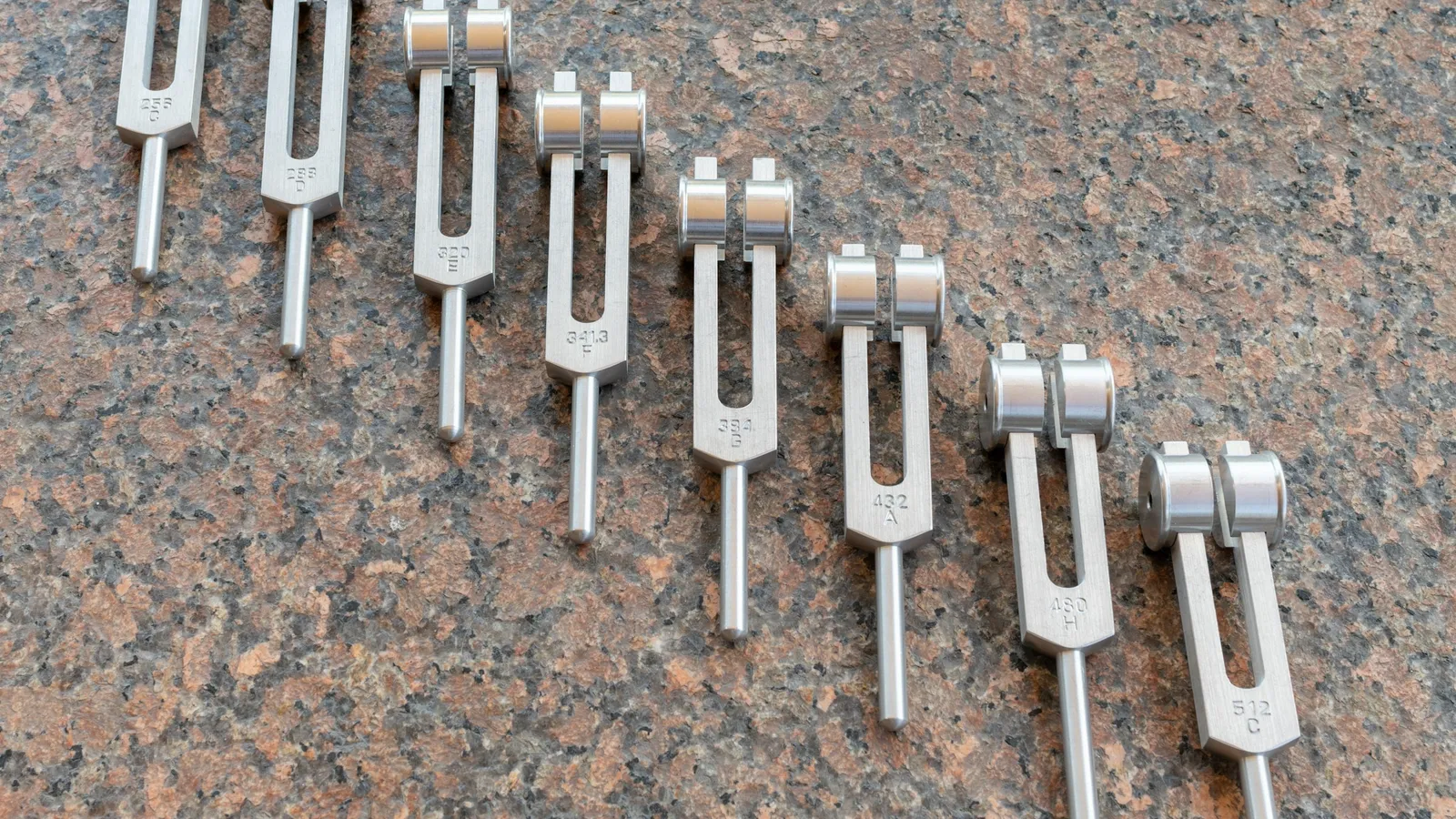
If fork A is 256 Hz and you hear 4 beats per second with fork B, then B could be 252 Hz or 260 Hz. Both give a difference of 4. The beat count alone cannot tell you which, so every well-made problem adds a second clue. Your job is to use that clue in the right direction.
The two most common clues:
Wax on a fork, or a small mass on it, lowers its frequency. The fork gets heavier.
Filing a fork raises its frequency. It loses mass.
Tightening a string raises its frequency, because the speed of a wave on a string is √(T/μ), and for a fixed length the frequency rises with that speed.
The three-step method
Write both candidates. Unknown = known ± beat frequency.
Apply the change to each candidate and see which way it moves the frequency.
Keep the candidate whose new beat count matches the one the question reports.
Worked example 1. Fork A has frequency 256 Hz. Fork B gives 4 beats per second with A. When B is loaded with a little wax, the beats become 6 per second. Find B's original frequency.
Candidates: 252 Hz or 260 Hz.
Wax lowers B's frequency.
If B were 260 Hz, lowering it would bring it closer to 256 Hz, and the beats would drop below 4. If B were 252 Hz, lowering it moves it further from 256 Hz, and the beats rise. The beats rose to 6, so B was 252 Hz (after loading it is 250 Hz).
Worked example 2, from NCERT. Example 14.6 in the chapter has two sitar strings A and B producing 5 beats per second, with A at 427 Hz. Tightening B slightly drops the beats to 3 per second. Tightening raises B's frequency. If B had started above A, the beats would have increased, so B started below: 427 − 5 = 422 Hz.
Worked example 3, a small change. Two identical strings both sound 400 Hz. The tension in one is raised by 1%. Since f is proportional to √T, the new frequency is 400 × √1.01, about 400 × 1.005 = 402 Hz. The strings now give about 2 beats per second. This "small change" form appears often, and the approximation √(1 + x) ≈ 1 + x/2 saves time.
Which mistakes cost marks?
Dividing by two. The amplitude bracket has (ω₁ − ω₂)/2 in it, but the beat frequency is the full difference ν₁ − ν₂, because loudness peaks twice per cycle of the bracket.
Mixing ω and ν. If the question gives angular frequencies, the beat frequency is (ω₁ − ω₂)/2π.
Getting the wax direction backwards. Wax adds mass and lowers frequency. Filing removes mass and raises it.
Forgetting the beat period. "How long between two loud sounds?" asks for 1/ν_beat. At 4 beats per second that is 0.25 s.
Ignoring harmonics. In pipe and string questions, the beats may be between overtones, not fundamentals. Our guide to standing waves in strings and pipes covers how to find each harmonic first.
If you need the wave equation behind all this, start with reading the travelling wave equation. When you get a beats answer wrong and cannot see why, the Fermi Problem Library has a step-by-step solver that explains the reasoning rather than printing an answer, so you can check the step where your direction went wrong.
A practice routine for beats
Day 1: Ten questions with two forks and a beat count. Write both candidates every time, even when the question only needs one.
Day 2: Eight wax, filing and string tension questions using the three-step method. Say out loud whether each change moves the frequencies closer or further apart.
Day 3: Six questions where beats come from harmonics of pipes or strings, plus two that ask for the beat period.
Day 4: A timed mixed set of ten, followed by an error log sorted by type: wrong direction, wrong formula, wrong harmonic.
Pick one tuning fork question from your textbook today and solve it with both candidates written down before you read the second clue.


