

On this page
Clap in front of a wall and you hear one sound. Walk back far enough and you hear two: the clap, then its echo. The Tamil Nadu Class 10 science text puts the switch at about 17 metres. Here is where that number comes from, why it changes a little with temperature, and how to set it out in an exam.
What is the minimum distance for an echo to be heard?
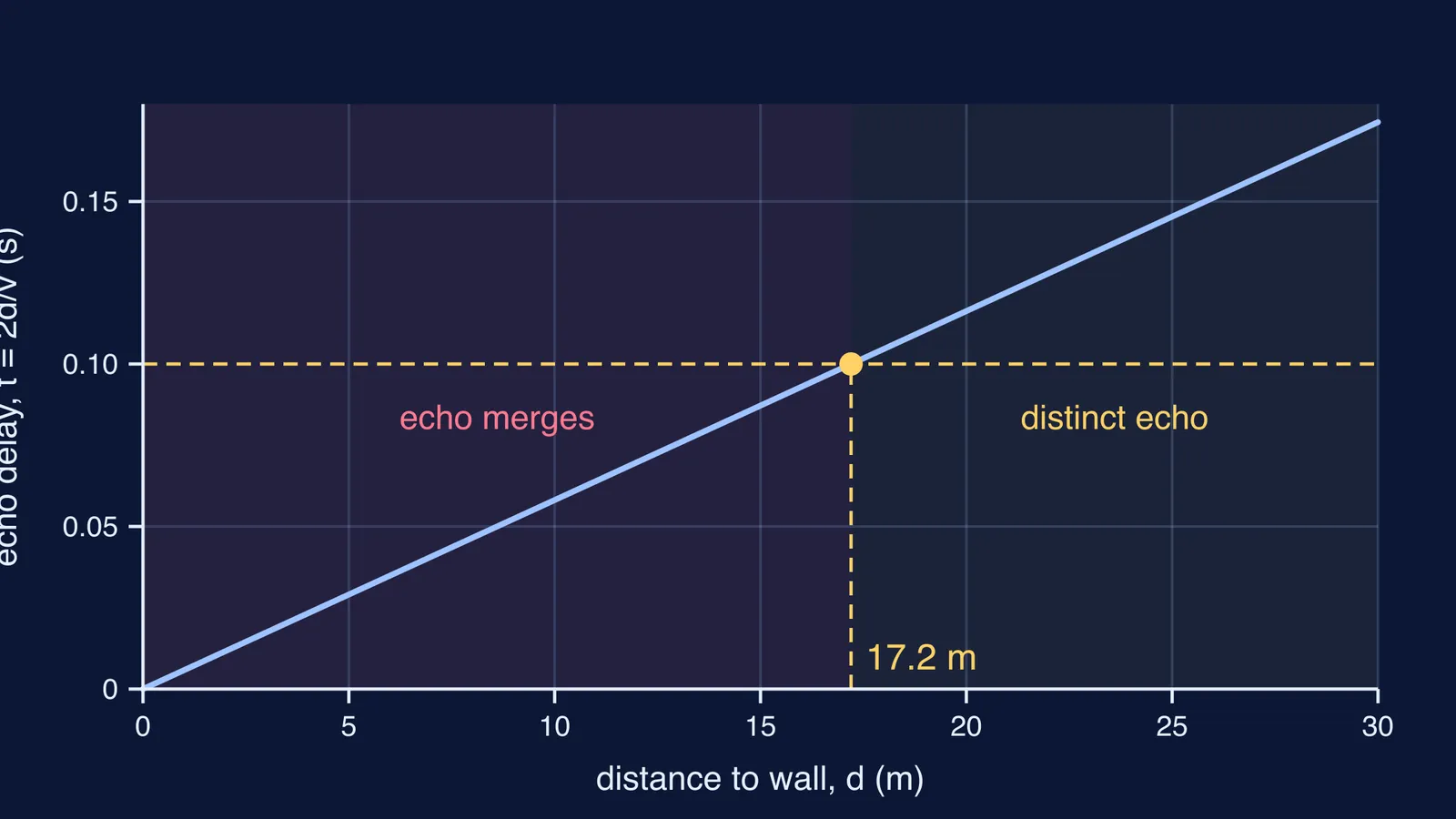
The Tamil Nadu State Board Class 10 science text states: "The persistence of hearing for human ears is 0.1 second" (Class 10 Acoustics chapter, reproduced on Brainkart). This means you hear two sounds separately only if they reach you at least 0.1 s apart. The same chapter takes the speed of sound as 344 m/s and gets a minimum distance of 17.2 m.
The working, in four steps:
Write the condition: the echo must arrive at least t = 0.1 s after the original sound.
Trace the path: the sound goes to the wall and comes back, so it covers 2d, not d.
Use distance = speed × time: 2d = v × t = 344 × 0.1 = 34.4 m.
Halve it: d = 34.4 ÷ 2 = 17.2 m.
Most lost marks come from step 2. If you forget the return trip, you get 34.4 m, which is the length of the sound's whole path, not the distance to the wall.
Why do some books say 17 m and others 17.2 m?
They use different speeds of sound, and the speed of sound in air depends on temperature. OpenStax University Physics gives v = 331 m/s × √(T / 273 K), with 331 m/s at 0 °C and 343 m/s at 20 °C (OpenStax, Speed of Sound). By that formula, 344 m/s matches air at about 22 °C. Books that round the speed to 340 m/s get exactly 17 m.
We worked out the speed with the OpenStax formula, then halved the distance sound travels in 0.1 s:
0 °C: v ≈ 331 m/s, so d ≈ 16.6 m
10 °C: v ≈ 337 m/s, so d ≈ 16.9 m
22 °C: v ≈ 344 m/s, so d ≈ 17.2 m
35 °C: v ≈ 352 m/s, so d ≈ 17.6 m
45 °C: v ≈ 357 m/s, so d ≈ 17.9 m
On a hot day the wall must be slightly farther away, because sound covers more ground in 0.1 s. In an exam, use the speed the question gives. If it gives none, write your assumption in one line, such as "taking v = 344 m/s".
Is 0.1 seconds an exact rule?
No. It is a model that works well for school problems. Hearing research describes the "precedence effect": a direct sound is followed by reflections that would be audible on their own, yet the first-arriving sound dominates many aspects of perception. A 1999 review also covers how precedence builds up and breaks down (Litovsky, Colburn, Yost and Guzman, 1999, Journal of the Acoustical Society of America). So whether a reflection is heard as a separate echo is not set by one fixed delay. Treat 17 m as a good estimate, not a sharp line.
How do echo questions change the numbers?
Try these variations before you check the answers. Each uses the 0.1 s condition from the Tamil Nadu text:
Speed given as 330 m/s. Minimum distance = 330 ÷ 20 = 16.5 m.
A wall 50 m away, speed 340 m/s. Delay t = 2 × 50 ÷ 340 ≈ 0.29 s. That is more than 0.1 s, so the echo is distinct.
A wall 10 m away, speed 340 m/s. Delay t = 20 ÷ 340 ≈ 0.06 s. That is less than 0.1 s, so you hear no separate echo.
When the source moves, as in a car approaching a cliff and sounding its horn, the outgoing and return paths have different lengths. With echoes between two cliffs, you set up one 2d = vt equation for each cliff. Turn the method around and you get a practical: measuring the speed of sound with an echo.
Before you submit an echo answer, check:
Did you double the distance for the trip there and back?
Did you use the speed given in the question?
Are all quantities in metres and seconds?
For a "can you hear it" question, did you compare the delay with 0.1 s?
If you get the right formula but keep losing marks in the setup, the Fermi Problem Library has worked problems with a step-by-step solver that explains the reasoning rather than just printing an answer. To revise reflection of sound and the speed of sound together, each idea has its own lesson in the Fermi Concept Library.
Next time you are near a large building or a cliff, pace out about 20 large steps from the wall and clap. You are testing the 17 m rule with your own ears.


