

On this page
How does an echo reveal the distance to a cliff?
An echo occurs when a sound wave travels from a source, reflects off an obstacle, and returns to the listener. Because acoustic waves propagate at a speed governed by air temperature, measuring round-trip transit time reveals the obstacle's distance. As tabulated by Carl R. Nave in HyperPhysics, sound travels at approximately 331.5 m/s at 0 °C and 344 m/s at 20 °C in dry air.
When sound strikes a sheer rock cliff, the acoustic impedance mismatch between air and stone reflects almost the entire wave. For boundary conditions and phase inversions, see our guide on wave reflection and phase change at boundaries.
Because the pulse covers the same distance on both legs of its journey, the total distance is 2d. Following the echo ranging principles in OpenStax Physics, round-trip time t and wave speed v yield 2d = v × t, or:
d = (v × t) / 2
How do you find the distance between two cliffs from two echoes?
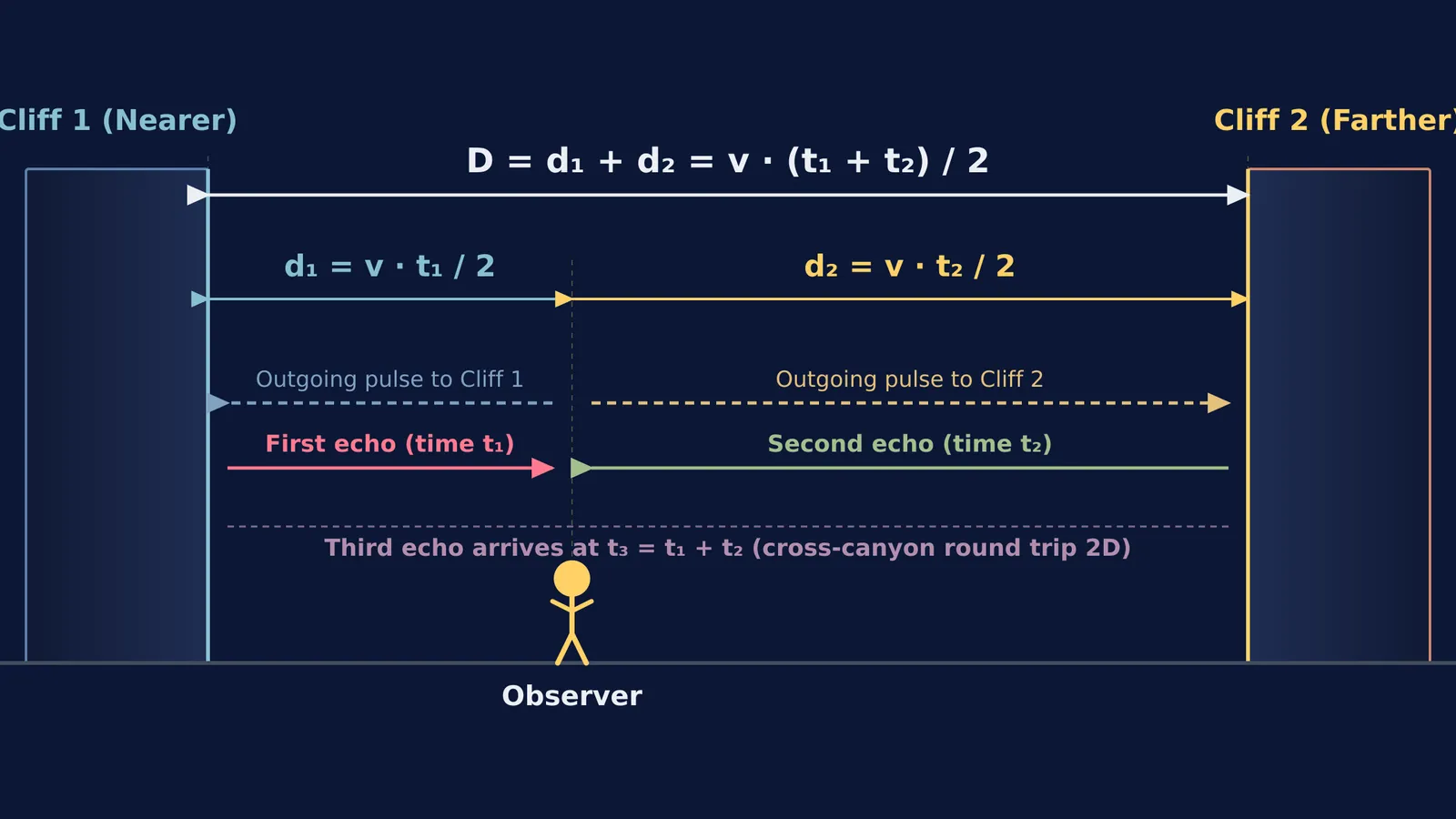
Consider standing between two parallel cliffs at an asymmetric position P. Let d₁ represent the distance to the nearer cliff and d₂ the distance to the farther cliff, giving total canyon width D = d₁ + d₂.
Following the time-of-flight acoustic framework demonstrated by Salvatore Ganci (Ganci, 2011), a single sound burst radiates outward in both directions simultaneously:
Nearer cliff echo: Sound travels distance 2d₁ and arrives at t₁ = 2d₁ / v, yielding d₁ = (v × t₁) / 2.
Farther cliff echo: Sound travels distance 2d₂ and arrives at t₂ = 2d₂ / v, yielding d₂ = (v × t₂) / 2.
Adding both equations gives the canyon width:
D = d₁ + d₂ = v × (t₁ + t₂) / 2
Summing both echo times and multiplying by half the speed of sound yields the total width directly without calculating each distance first.
Why does the third echo arrive at t₁ + t₂?
In physics examinations, students often assume the third echo arrives at 2t₁ as a second bounce from the nearer cliff. However, sound passing the observer continues across the valley toward the opposing cliff.
Tracking the wave that first strikes Cliff 1 reveals three legs:
Observer to Cliff 1: distance d₁
Across the canyon to Cliff 2: distance d₁ + d₂ = D
Cliff 2 back to observer: distance d₂
Summing these legs gives total distance 2D and transit time t₃ = 2D / v = t₁ + t₂.
Symmetrically, the wave heading first toward Cliff 2 covers d₂ + D + d₁ = 2D and returns at that exact same moment. As demonstrated in acoustic reflection experiments by Simen Hellesund (Hellesund, 2019), tracking successive echo returns provides an accurate measurement of acoustic transit times.
How do you solve a worked two-cliff problem?
Using the echo ranging formulas verified in OpenStax Physics, consider a standard numerical problem:
Problem: A person between two parallel cliffs fires a starting pistol, hearing echoes at 1.2 seconds and 2.0 seconds. Assuming sound speed in air is 340 m/s, calculate each distance and the third echo time.
Nearer cliff: d₁ = (340 m/s × 1.2 s) / 2 = 204 metres.
Farther cliff: d₂ = (340 m/s × 2.0 s) / 2 = 340 metres.
Total canyon width: D = 204 m + 340 m = 544 metres (alternatively, 340 m/s × 3.2 s / 2 = 544 m).
Third echo: t₃ = 1.2 s + 2.0 s = 3.2 seconds.
If you want to practice more wave kinematics and multi-obstacle reflection problems, the Fermi Problem Library provides worked problems with a step-by-step solver that explains the reasoning rather than printing an answer.
What conditions are needed to hear two distinct echoes?
Human auditory physiology and atmospheric conditions set physical boundaries on resolving distinct echoes:
Persistence of hearing: The human brain retains acoustic sensations for roughly 0.1 seconds. As detailed by The Physics Classroom, reflections arriving within 0.1 seconds blend with the original emission into reverberation. In air at 340 m/s, hearing a distinct echo requires a minimum obstacle distance of d_min = (340 m/s × 0.1 s) / 2 = 17 metres, a benchmark discussed in Class 9 sound waves and hearing range.
Echo separation interval: For two cliff echoes to be perceived as distinct sounds rather than an acoustic blur, their arrivals must differ by at least 0.1 seconds: |t₂ − t₁| ≥ 0.1 s. This requires a cliff distance difference of |d₂ − d₁| ≥ 17 metres. If the observer stands midway (d₁ = d₂), both reflections arrive simultaneously as a single louder pulse.
Air temperature also alters sound speed. Sound propagates via adiabatic compressions described by v = √(γRT / M), derived in our guide on the Laplace correction to the speed of sound. Laboratory tube measurements by Lutz Kasper, Patrik Vogt, and Christine Strohmeyer (Kasper et al., 2015) confirm that higher temperatures increase sound velocity, slightly stretching the distance needed for echo separation.
To see how sound pulses propagate across reflective boundaries in real time, the Fermi Simulation Lab provides interactive simulations for the ideas that are easier to see than to read.


