

On this page
When a driver honks their horn while driving toward a cliff, the sound travels forward, hits the cliff, and bounces back. Meanwhile, the car does not stand still. It keeps moving forward to meet the returning sound wave. This is a classic kinematics problem that tests your ability to track two objects moving at the same time.
To solve this, we track two moving objects: the sound wave and the car. We know that distance equals speed multiplied by time.
Let the initial gap between the car and the cliff be D.
Let the speed of the sound be v_s.
Let the speed of the car be v_c.
Let the time until the echo is heard be t.
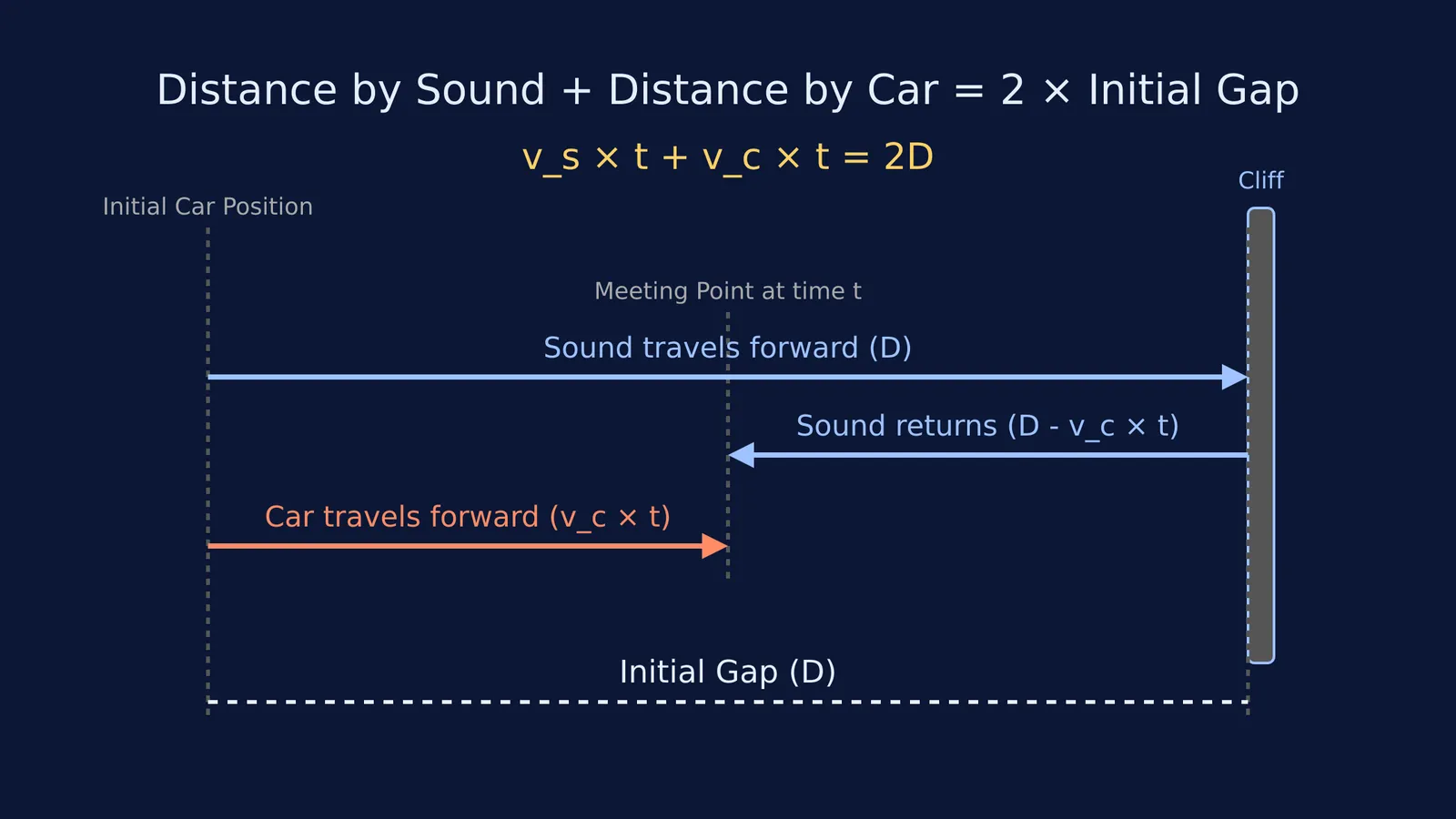
In time t, the car travels a distance of v_c × t. In that same time t, the sound travels all the way to the cliff (a distance of D) and then bounces back. It meets the car which has already moved forward.
How do you calculate the echo time?
Because the car has moved forward by v_c × t, the sound does not have to travel the full distance D on its return trip. It only has to travel D - (v_c × t).
The total distance travelled by the sound is the forward trip plus the return trip: D + (D - v_c × t). This simplifies to 2D - v_c × t.
We also know the total distance travelled by the sound is its speed multiplied by time, or v_s × t. By setting these equal, we get the central equation: v_s × t = 2D - v_c × t
Moving the car's distance to the left side gives us our key relationship: the distance travelled by the sound plus the distance travelled by the car equals twice the initial gap. v_s × t + v_c × t = 2D
Factor out the time (t), and you get the final formula: t = 2D / (v_s + v_c)
This simple relationship is why mastering kinematics often comes down to drawing a good diagram, a skill we practice when learning how to solve physics problems step by step.
What is a worked example of the echo time?
Let's put this into practice. Imagine a car driving toward a tall rock face. When it is exactly 680 metres away (D = 680 m), the driver presses the horn. The car is travelling at 16 metres per second (which is 57.6 km/h).
First, we need the speed of sound. At standard room temperature 20 °C (68 °F), the speed of sound in dry air is approximately 343.21 m/s. For simplicity in exams, this is often rounded. According to the NCERT Class 9 Science textbook, the speed of sound in air is 344 m/s at 22 °C. Let's use this value for our calculation.
Initial gap, D = 680 m
Speed of sound, v_s = 344 m/s
Speed of car, v_c = 16 m/s
Using our formula: t = 2D / (v_s + v_c)
t = (2 × 680) / (344 + 16)
t = 1360 / 360
t = 3.77 seconds
The driver will hear the echo 3.77 seconds after honking. By the time they hear it, the car will have travelled nearly 60 metres closer to the cliff (16 m/s × 3.77 s = 60.32 m). This means the car is now about 620 metres from the cliff.
How does this connect to your studies?
If you are preparing for JEE or NEET, this scenario is a gateway to more complex topics. Once you master the time delay, the next step is usually calculating the change in pitch, known as the Doppler effect. Because the car is moving toward the cliff, the sound waves are compressed, meaning the driver will hear an echo with a higher frequency than the original honk.
To build an intuitive feel for these shifts, try a Doppler effect simulation: what to predict before you press play. Observing how waves compress as the source moves helps you connect the mathematical formula to the physical phenomenon.
When you are ready to test yourself on a variety of kinematics and wave problems, the Fermi Problem Library has worked problems with a step-by-step solver that explains the reasoning rather than printing an answer. Practising these variations ensures you are ready when the exam paper adds a twist, like an accelerating car, a headwind, or a cliff that is also moving.