

On this page
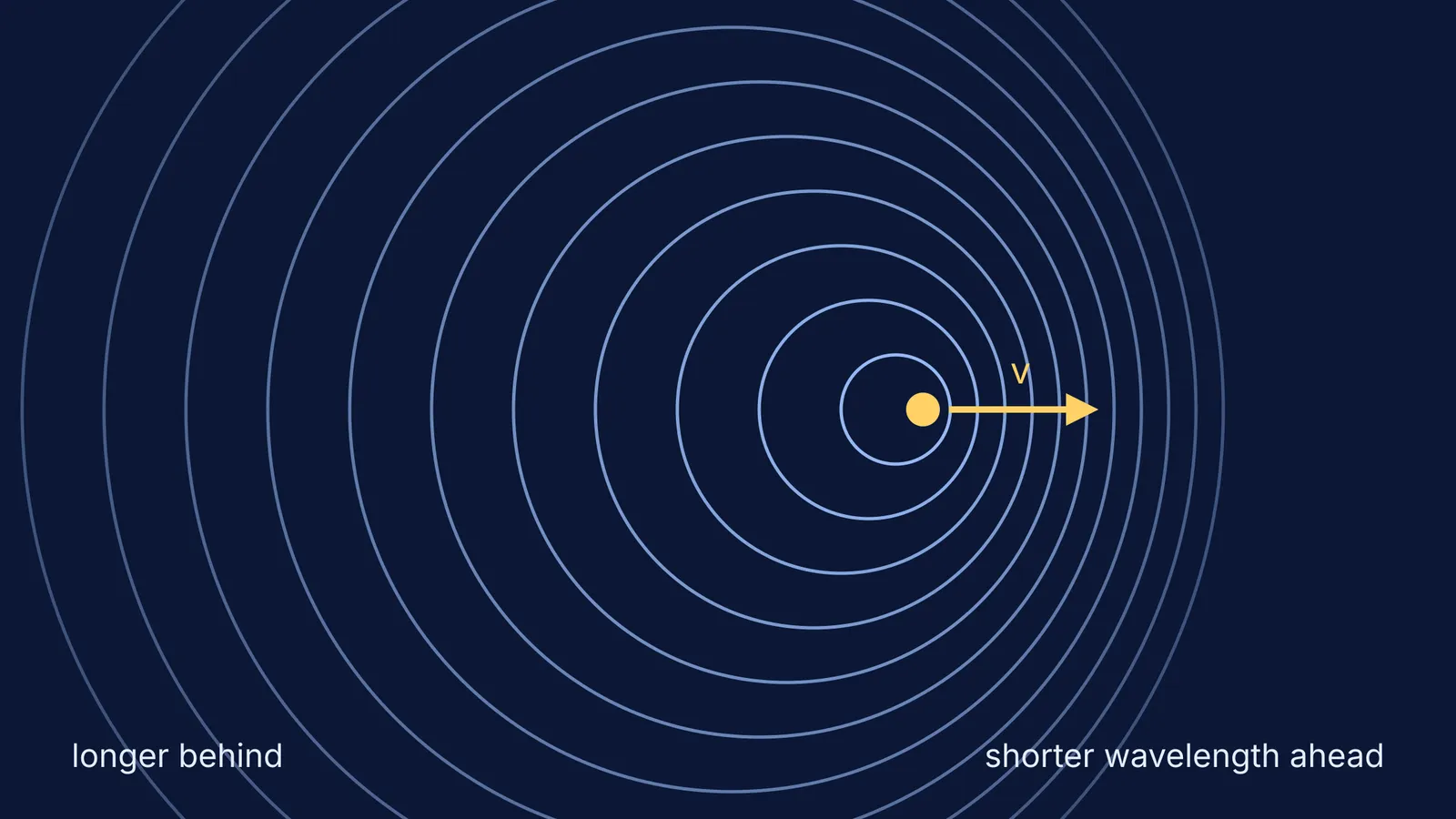
A siren drops in pitch as the ambulance goes past. A simulation shows you why: the wavefronts bunch up ahead of the source and spread out behind it. But just watching teaches less than you might expect. Below: a worked example, the sonic boom, and six predictions to write down before you press play.
What is the Doppler effect, in one sentence?
"The Doppler effect is an alteration in the observed frequency of a sound due to motion of either the source or the observer," in the words of OpenStax University Physics, section 17.7.
The same OpenStax section gives the general formula: fₒ = fₛ(v ± vₒ)/(v ∓ vₛ). Here fₒ is the frequency you hear, fₛ is the frequency the source gives out, v is the speed of sound, vₒ is the observer's speed and vₛ is the source's speed. Use the top signs when the two are getting closer and the bottom signs when they are moving apart. A quick check: getting closer should always raise the pitch.
Moving source vs moving observer: does it matter which one moves?
Yes. In OpenStax's words: "The shifts are not symmetric." Its worked example uses a 150 Hz train horn, a train speed of 35.0 m/s and a speed of sound of 340 m/s (OpenStax 17.7). Here are those numbers, plus the case where the observer moves instead:
Source approaches a still listener: fₒ = 150 × 340/305 ≈ 167 Hz.
Listener approaches a still source at the same 35 m/s: fₒ = 150 × 375/340 ≈ 165 Hz.
Source moves away: fₒ = 150 × 340/375 = 136 Hz.
Listener moves away: fₒ = 150 × 305/340 ≈ 135 Hz.
The train driver, moving with the horn: 150 Hz, because nothing moves relative to them.
The gap grows as the speed nears the speed of sound. A moving source changes the spacing between wavefronts in the air, so the wavelength itself changes. A moving observer leaves the wavelength alone and simply meets the wavefronts more or less often.
What happens at a sonic boom?
Set the source speed equal to the speed of sound and the denominator v − vₛ becomes zero. In a simulation, the wavefronts pile up into a single wall in front of the source. Go faster than that and they form a cone.
The Mach number is the speed of the source divided by the speed of sound, and a shock wave is "a constructive interference of sound created by an object moving faster than sound" (OpenStax University Physics, section 17.8). The half-angle of the cone obeys sin θ = 1/M, so at Mach 2 the cone has a half-angle of 30°.
A common mistake is to think the boom happens once, at the moment a plane "breaks the sound barrier". NASA calls this the most common misconception and explains that "a sonic boom is continuous" for as long as the aircraft flies faster than sound (NASA X-59 explainer). People on the ground hear it as the shock wave sweeps over them, usually after the plane has already passed (OpenStax 17.8). For the history, see our piece on Ernst Mach and shock waves.
Which predictions should you write down before pressing play?
In a study of classroom demonstrations, Catherine Crouch, Eric Mazur and colleagues found that students who passively watched demonstrations understood the concepts no better than students who did not see them at all. Students who predicted the outcome first understood them significantly better (Crouch et al., American Journal of Physics, 2004). The study used live demonstrations, not simulations, but you can predict first with either.
Write one line for each before you run anything:
Source still, observer still: do the rings change spacing?
Source moving at half the speed of sound: are the rings closer together in front or behind, and by roughly how much?
Observer moving at the same speed toward a still source: is the pitch higher or lower than in case 2?
Source moving away: does the pitch fall by the same amount it rose on approach?
Source at exactly the speed of sound: what shape do the wavefronts make?
Source at Mach 2: what is the cone's half-angle, and when does a listener off to the side hear the boom?
You can test all six in the Fermi Simulation Lab, which has interactive simulations for ideas that are easier to see than to read. For wave basics, see our guide to waves simulations.
How do you learn from a prediction that was wrong?
A wrong prediction tells you exactly where your picture breaks. Write down what you expected and what you saw, then redo the calculation with the formula above. Two slips to check first: using the moving-source formula for a moving observer, and flipping a sign when the two move apart.
When you are ready for exam-style questions, work through our Doppler effect problems for sound.


