

On this page
When sound hits a hard, flat surface, it bounces back as a reflection called an echo. In Class 9 physics, calculating the speed of sound from an echo is a classic problem.
Because sound travels fast, a single echo comes back too quickly for a human with a stopwatch to measure accurately. Our reaction time introduces a massive error. But with a bit of space and a steady rhythm, you can measure the speed of sound yourself with nothing more than a tape measure and a phone.
Here is how the method works, the physics behind it, and why you have to stand at a specific distance.
Why must you stand at least 17.2 metres away?
To understand echoes, we first need to look at how human hearing works. Our brains hold onto a sound for about 0.1 seconds after we hear it, an effect known as the persistence of hearing. To hear a distinct echo, the reflected sound must reach your ears at least 0.1 seconds after the original sound. If it arrives sooner, your brain blends the two sounds together, resulting in reverberation rather than a clear echo.
Because the speed of sound in air is about 343 m/s at 20 °C, we can calculate the minimum distance required for an echo. In 0.1 seconds, sound travels 34.3 metres (343 m/s × 0.1 s).
Since the sound has to travel to the wall and back, that 34.3 metres is the round-trip distance. The minimum one-way distance to the wall must therefore be half of that: roughly 17.2 metres. If you stand any closer, the echo will merge with the original sound and you will not hear it as a separate event. On a hot summer day, sound travels faster, so this minimum distance increases slightly.
How does the rhythmic clapping method work?
To bypass human reaction time, the Institute of Physics recommends a synchronization method. Instead of trying to time a single click and its echo—which happens too fast for a stopwatch—you create a steady rhythm where each new clap happens exactly when you hear the echo of the previous one.
Find a large, flat wall: A school building or gym wall works best. Ensure there are no other large buildings nearby that might create confusing secondary echoes. A flat surface gives a sharp reflection, while a rough or broken surface scatters the sound.
Measure the distance (d): Stand at a known distance from the wall. The Institute of Physics recommends standing as far away as possible; a distance of 50 metres or more works well. Use a long measuring tape for accuracy.
Set the rhythm: Start clapping. Two pieces of flat wood work even better than your hands because they produce a sharper sound that is easier to pick out. Adjust your clapping speed until each clap coincides exactly with the echo from the wall.
Time it: Once the rhythm is locked in, have a friend start a stopwatch and time a continuous sequence of 20 claps.
By timing 20 claps, any small timing error at the start or end is spread out across all 20 intervals, making the average time much more precise than trying to measure a single echo.
How do you calculate the speed of sound?
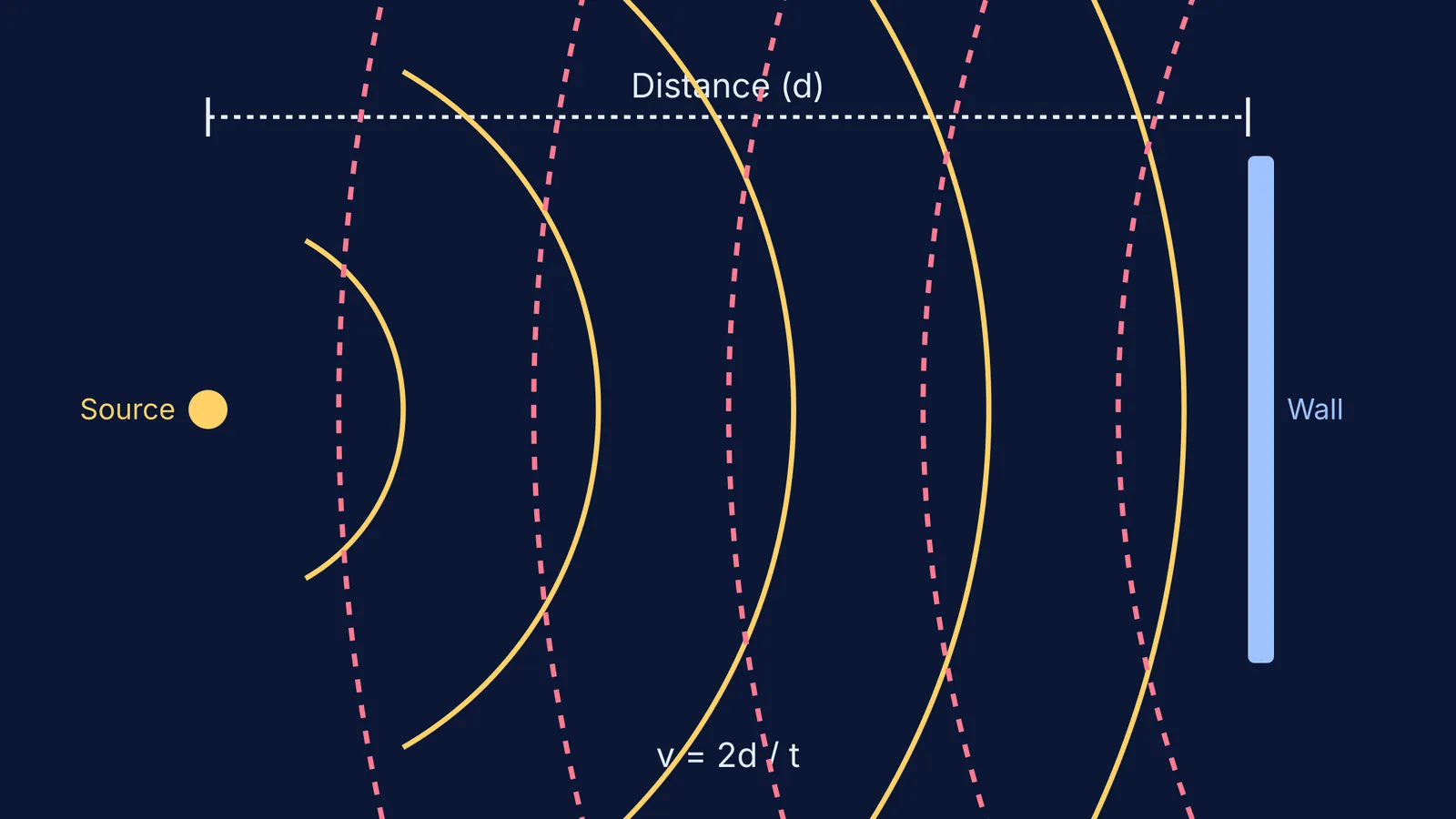
Once you have your measurements, finding the speed is a direct application of the standard speed formula. However, because the sound has travelled from you to the wall and back again for every clap, the total distance travelled by the sound in one interval is twice the distance to the wall (2d).
The formula for the speed of sound (v) using an echo is: v = 2d / t
Where d is the distance to the wall, and t is the time between one clap and the next.
A worked example
Imagine you are standing 50 metres away from a large brick wall. You lock into the clapping rhythm and time 20 claps. The stopwatch shows 5.8 seconds.
Distance to wall (d): 50 metres
Total distance for one echo (2d): 100 metres
Total time for 20 claps: 5.8 seconds
Time for one clap (t): 5.8 / 20 = 0.29 seconds
Speed of sound (v): 100 / 0.29 ≈ 344.8 m/s
This result is extremely close to the accepted value of 343 m/s at room temperature. The measured speed varies slightly depending on the weather, because sound travels faster in warmer air.
Taking the physics further
Doing a physical experiment like this locks the v = 2d / t formula into your memory much better than passively reading it in a textbook. Active learning makes physics intuitive and helps you connect classroom equations to the real world.
If you struggle to picture how waves actually travel and reflect in space, you can explore it visually in the Fermi Simulation Lab. The lab provides interactive simulations for the ideas that are easier to see than to read, letting you observe wavefronts and reflection dynamically without needing a 50-metre brick wall.
For more on how waves behave, read Displacement and pressure waves in sound: the 90° phase shift, or see how light behaves differently in Dispersion of white light by a glass prism, explained for Class 10.


