

On this page
To you, bats round a streetlight look silent. To a bat, the air is full of its calls and echoes. This is echolocation, and you can work out most of it with the echo formula from Class 9.
How do bats find insects in total darkness?
Insect-hunting bats send out calls and use the returning echoes to estimate the position, size and shape of objects, as a 2013 review in Biology Letters puts it.
According to the American Association for the Advancement of Science, in 1938 a Harvard undergraduate, Donald Griffin, took bats to physicist G. W. Pierce, whose detector picked up sounds above human hearing. The "silent" bats were making intense ultrasonic sounds. Griffin and Robert Galambos then showed that gagged or deafened bats collided with obstacles. Griffin called this "echolocation".
Human hearing covers roughly 20 Hz to 20 kHz, according to HyperPhysics at Georgia State University, and sound above that range is ultrasound. Across bat species, the peak frequency of echolocation calls ranges from 9 to 212 kHz, according to the Biology Letters review. Most of that range is far above anything you can hear.
How does a bat know how far away the insect is?
A bat judges distance from the time delay between its call and the returning echo, as a review by Cynthia Moss and Annemarie Surlykke explains. The sound goes out to the insect and comes back, so it travels the distance twice:
distance = speed of sound × echo delay ÷ 2
Sound travels at about 344 m/s in air at 20 °C, according to HyperPhysics. So every millisecond of echo delay means 17.2 cm of distance (344 × 0.001 ÷ 2).
An echo after 6 ms therefore means the moth is 344 × 0.006 ÷ 2 = 1.03 m away.
In experiments described in the same review, bats judged echo delay to within about 85 microseconds, a range difference of 1.5 cm. Check it: 344 × 0.000085 ÷ 2 = 0.0146 m.
What else do the echoes tell a bat?
The Moss and Surlykke review describes more cues:
Left or right: the echo reaches the two ears slightly differently, and bats use these binaural cues to place a target sideways.
Up or down: cues picked up by each ear on its own are essential for judging elevation.
Movement: some species lower the frequency of their calls as they fly, to cancel the Doppler shift caused by their own speed. That lets them pick out the Doppler shifts in echoes from a fluttering insect's wings.
Our post on the Doppler shift of an echo from a moving reflector works through this with numbers.
Why does a bat call faster as it closes in?
A hunt has three phases. In the big brown bat, search calls repeat 5 to 10 times a second; approach calls 20 to 80 times a second, lasting 2 to 5 ms each; and the final "terminal buzz" reaches around 170 calls a second, with calls only 0.5 to 1 ms long, according to Moss and Surlykke. Some species go faster still: the Biology Letters review reports up to 220 calls a second, driven by superfast muscles not previously known in mammals.
Why only at the end? Suppose each echo, travelling at 344 m/s, must return before the next call, so the bat does not mix them up:
At 10 calls a second there are 100 ms between calls. The farthest echo that fits is 344 × 0.1 ÷ 2 = 17.2 m.
At 170 calls a second there are about 5.9 ms between calls. That gives 344 × 0.0059 ÷ 2 = 1.0 m.
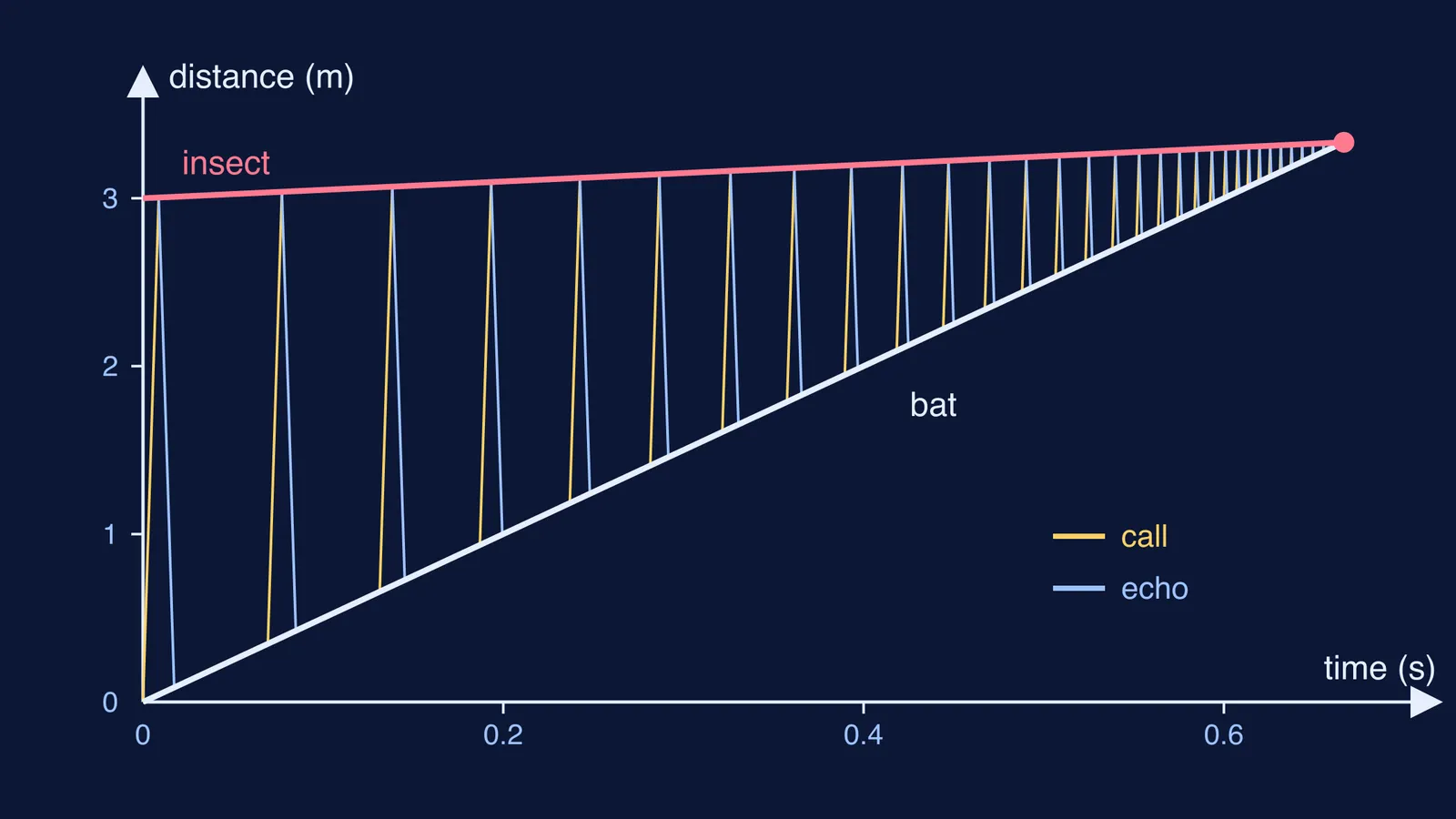
On this simple rule, the buzz works only once the insect is close, which is exactly when the bat needs the fastest updates. The diagram at the top of this post shows calls bunching into a buzz as a bat closes on an insect.
How does this connect to Class 9 sound?
Echoes and ultrasound are part of the Class 9 chapter on sound, and bats make a good test of both. Try these, using 344 m/s for sound in air.
A bat hears an echo 4 ms after calling. How far is the insect?
A bat is 2 m from a moth. How long until the echo returns?
A bat calls 50 times a second. How far away can a target be for its echo to return before the next call?
Answers: (1) 344 × 0.004 ÷ 2 = 0.69 m. (2) 2 × 2 ÷ 344 = 0.0116 s, about 11.6 ms. (3) The gap is 20 ms, so 344 × 0.02 ÷ 2 = 3.44 m.
For how people use the same frequencies, see our guide to uses of infrasound and ultrasound.
The Fermi Simulation Lab has interactive simulations for the ideas that are easier to see than to read. If wave basics are shaky, the Fermi Concept Library gives every physics concept its own lesson.
Next time you see a bat at dusk, remember: one millisecond of echo, 17 centimetres of distance.


