

On this page
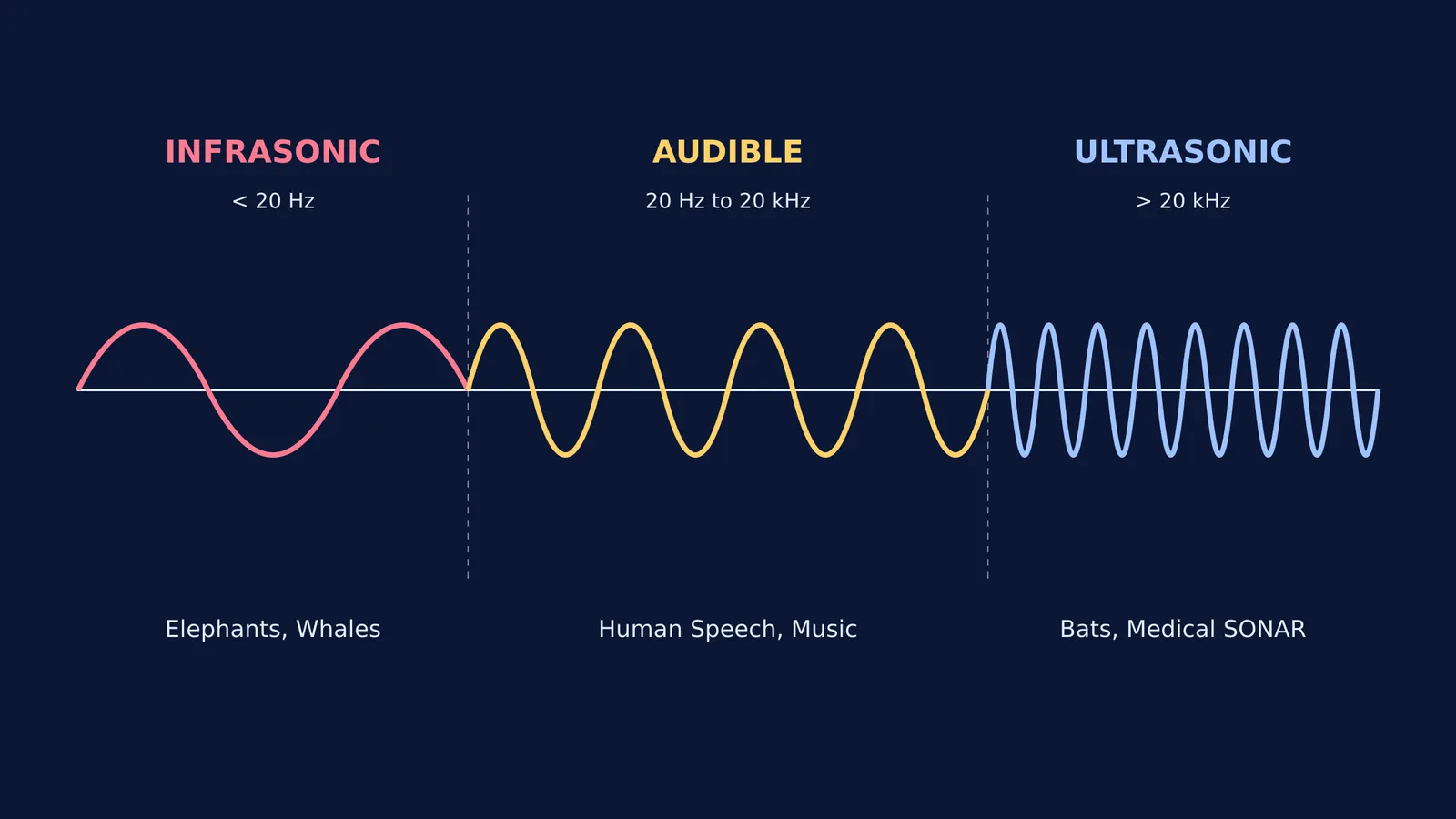
Humans hear sounds between 20 Hz and 20,000 Hz, but animals and engineers use frequencies far outside this range. Elephants and rhinos use infrasonic sound (below 20 Hz) to communicate across miles, while bats and industrial SONAR rely on ultrasonic sound (above 20,000 Hz) to locate objects.
What is the audible range for humans?
Sound is a mechanical wave that carries energy through a medium like air or water. The number of wave cycles that pass a point every second is the frequency, measured in hertz (Hz).
The audible range of hearing for an average human is 20 Hz to 20,000 Hz (or 20 kHz) 1. As we age, our ability to hear the highest frequencies drops, and many adults cannot hear sounds above 15,000 Hz. If you want to understand how these frequencies map to properties like pitch and wavelength, you can explore the Fermi Concept Library.
Sounds outside this 20 Hz to 20 kHz window are completely silent to human ears. However, they carry immense energy and are used constantly in both nature and technology.
How do animals use infrasonic sound?
Infrasonic sound (or infrasound) consists of sound waves with frequencies below 20 Hz. Because low-frequency waves have very long wavelengths, they can travel vast distances without being absorbed or scattered by obstacles like trees or hills.
Large mammals take advantage of this property to talk to one another across miles of terrain:
Rhinoceroses: Sumatran rhinos produce infrasonic sounds at frequencies as low as 3 Hz to communicate for mating and social interactions 2.
Elephants: African elephants use infrasonic rumbles ranging from 15 Hz to 35 Hz to coordinate herd movements over distances of up to 10 kilometers.
Whales: Baleen whales produce sounds between 10 Hz and 31 kHz. Because sound travels efficiently in water, low-frequency calls can reach other whales hundreds or even thousands of kilometers away.
Infrasound is also produced by natural disasters. Earthquakes generate low-frequency infrasonic waves before the main shock hits the surface, which is why some animals become restless just before an earthquake strikes.
How do bats use ultrasonic sound?
Ultrasonic sound (or ultrasound) refers to sound waves with frequencies higher than 20,000 Hz. These high-frequency waves have very short wavelengths, which means they bounce off small objects rather than flowing around them.
Bats use ultrasound to navigate and hunt in complete darkness through a process called echolocation. Most aerial-hawking bat species emit calls between 20 kHz and 60 kHz, though some can reach over 200 kHz 3.
The bat produces an ultrasonic pulse and listens for the echo bouncing off an object. By sensing the time it takes for the sound to return, the bat determines the distance to the target. This biological SONAR is so precise that a bat can detect the movement of a mosquito mid-air. You can read more about how to measure the speed of sound using an echo.
What are the applications of ultrasound in medicine and industry?
Because ultrasonic waves travel along well-defined paths and can penetrate solid materials, they have wide applications in modern engineering and healthcare.
Echocardiography and Ultrasonography: Doctors use ultrasound to produce images of internal organs without exposing patients to harmful radiation. Ultrasonic waves reflect off different tissues in the body, such as the heart or a developing fetus, creating a detailed image on a monitor 4.
Breaking Kidney Stones: High-intensity ultrasound can be focused on kidney stones to break them into fine grains, which the body then naturally flushes out.
Industrial Cleaning: Electronic components and spiral tubes are placed in a cleaning solution, and ultrasound waves are passed through. The rapid vibration dislodges grease and dirt from hard-to-reach places.
Detecting Metal Flaws: Engineers pass ultrasound through large metal blocks used in construction. If there is an internal crack, the wave reflects back immediately, allowing engineers to find hidden weaknesses without breaking the metal open.
Worked example: Calculating depth with SONAR
SONAR (Sound Navigation and Ranging) is an industrial tool used on ships to measure the depth of the ocean or find sunken objects. It works by sending an ultrasonic pulse downward and timing how long the echo takes to return.
If you struggle to structure physics numericals, the Fermi Problem Library features worked problems with a step-by-step solver that explains the reasoning rather than just printing an answer. Here is how you solve a standard Class 9 SONAR problem.
Question: A ship sends out an ultrasound pulse that returns after 4 seconds. If the speed of sound in seawater is 1531 m/s, how deep is the ocean?
Step 1: Write down what you know. The time for the echo to return (t) is 4 seconds. The speed of sound in seawater (v) is approximately 1531 m/s 5.
Step 2: Choose the correct formula. The sound travels down to the ocean floor and back up again. If the depth is d, the total distance travelled by the sound is 2d. Distance = Speed × Time, so: 2d = v × t
Step 3: Substitute and solve. 2d = 1531 × 4 2d = 6124 d = 3062 m
The ocean is 3062 metres deep. Knowing the wavelength range of audible sound and the speeds in different mediums will help you verify if your answers make sense in an exam.


