On this page
Pool and tap-water reports quote three chlorine numbers: free, combined and total. Our post on why swimming pool water turns your eyes red works out combined chlorine as total minus free, using 2.2 and 1.4 mg/L. Where do those readings come from? Usually from one reagent, DPD (N,N-diethyl-p-phenylenediamine). Chlorine turns it pink, and ferrous ammonium sulphate (FAS) turns it back. Behind the colours is Class 11 redox: n-factors and equivalent mass.
What does the DPD chlorine test measure?
Chlorine in water exists in two forms that matter here.
Free chlorine is hypochlorous acid, HOCl, together with its anion OCl⁻.
Combined chlorine is chloramines: monochloramine NH₂Cl, dichloramine NHCl₂ and a little nitrogen trichloride NCl₃. They form when HOCl meets ammonia from sweat, urine or sewage.
Total chlorine is the sum. In every form chlorine is at +1 and is reduced to Cl⁻ (−1), so each chlorine atom takes two electrons. That is why all readings are reported as mg/L "as Cl₂".
The DPD method, written up as method 4500-Cl F in Standard Methods for the Examination of Water and Wastewater (full 1992 text), separates these forms by how fast they react, not by isolating them.
Why does free chlorine turn DPD pink but chloramines do not?
DPD is a colourless aromatic diamine. A one-electron oxidation turns it into a coloured radical cation, a Würster-type dye, which is magenta. It is not a "DPD-chlorine complex"; there is no chlorine in it. HOCl does the oxidation at once:
HOCl + H⁺ + 2DPD → 2DPD•⁺ + Cl⁻ + H₂O
One HOCl takes two electrons; two DPD give one each. Charge is +1 on both sides.
Standard Methods states that in the absence of iodide, free chlorine reacts instantly with DPD to give the red colour, while chloramines react only slowly. So if you read or titrate quickly, the colour measures free chlorine. The sample is held at pH 6.2 to 6.5 with a phosphate buffer. The method notes that at this pH the colours titrate to a sharp, colourless end point.
How does potassium iodide bring the chloramines in?
Chloramines oxidise iodide much faster than they oxidise DPD. Iodide acts as a go-between:
NH₂Cl + 2I⁻ + 2H⁺ → NH₄⁺ + Cl⁻ + I₂
I₂ + 2DPD → 2I⁻ + 2DPD•⁺
The iodide is regenerated, so a trace is enough. Standard Methods adds one very small crystal of KI (about 0.5 mg in the 1992 text) for monochloramine. Dichloramine reacts with iodide much more sluggishly, so the method then adds several crystals (about 1 g) and waits 2 minutes:
NHCl₂ + 4I⁻ + 3H⁺ → NH₄⁺ + 2Cl⁻ + 2I₂
Each new pink is titrated away before the next reagent goes in. Nitrogen trichloride does not fall neatly into one step. Standard Methods says part of it shows in the free chlorine reading and part with dichloramine, and gives a separate reading to estimate it. The split is operational: it depends on the order of reagents and on timing, not on a clean chemical separation.
How does an FAS titration turn pink into mg/L?
FAS is Mohr's salt, Fe(NH₄)₂(SO₄)₂·6H₂O. Fe²⁺ gives back one electron per dye molecule:
DPD•⁺ + Fe²⁺ → DPD + Fe³⁺
So the n-factor of Fe²⁺ is 1, the n-factor of Cl₂ (or HOCl) is 2, and the equivalent mass of chlorine as Cl₂ is 70.90 ÷ 2 = 35.45 g per equivalent. The titrant in Standard Methods is made with 1.106 g of FAS per litre, which the method says is equivalent to 100 µg of Cl₂ per mL. Check it:
Molar mass of FAS = 392.1 g/mol.
Molarity = 1.106 ÷ 392.1 = 0.00282 mol/L, so 1 mL holds 2.82 µmol of Fe²⁺ = 2.82 µeq.
Chlorine equivalent = 2.82 µeq × 35.45 µg per µeq = 100 µg of Cl₂.
With a 100 mL sample, 100 µg in 0.100 L is 1.00 mg/L. So every 1.00 mL of titrant means 1.00 mg/L of chlorine as Cl₂.
Worked example: free, combined and total chlorine from one pool sample
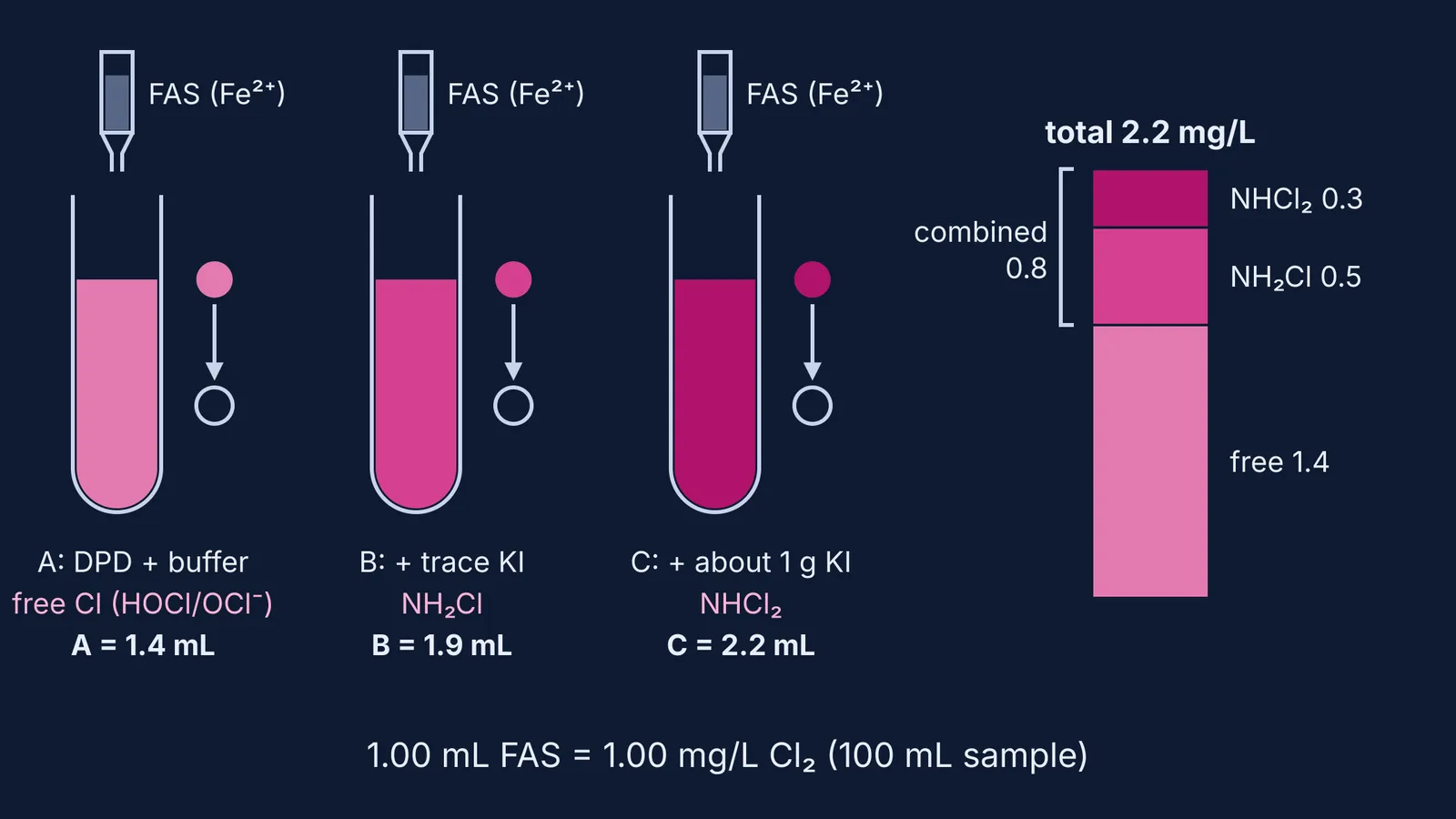
A 100 mL pool sample is added to buffer and DPD. The burette readings are cumulative.
Reading A (DPD alone): 1.4 mL
Reading B (after one tiny KI crystal): 1.9 mL
Reading C (after about 1 g KI, 2 minutes): 2.2 mL
Step 1. Free chlorine = A = 1.4 mg/L. To check it from first principles: 1.4 mL × 2.82 µmol per mL = 3.95 µmol of Fe²⁺, so 3.95 µeq × 35.45 = 140 µg in 0.100 L = 1.4 mg/L.
Step 2. Monochloramine = B − A = 1.9 − 1.4 = 0.5 mg/L as Cl₂.
Step 3. Dichloramine = C − B = 2.2 − 1.9 = 0.3 mg/L as Cl₂ (this also carries part of any NCl₃).
Step 4. Total chlorine = C = 2.2 mg/L.
Step 5. Combined chlorine = C − A = 0.5 + 0.3 = 0.8 mg/L.
These match the eye-redness post, now with the measurement behind each. Pool limits, and what operators do about high combined chlorine, are in that post and in our post on breakpoint chlorination and the 7.6 to 1 ratio. Dosing a pool is a job for trained operators.
If you want more practice with equivalents and n-factors, the Fermi Problem Library has redox titration problems with a step-by-step solver that explains the reasoning.
What can make a DPD reading wrong?
Oxidised manganese. Standard Methods names it as the most significant interference, because it oxidises DPD to the same pink. The method corrects for it with a blank in which the chlorine is first destroyed (with arsenite or thioacetamide) and only the manganese colour is titrated, then subtracted.
High combined chlorine. Chloramines are slow, not inert, so a lot of combined chlorine partly "breaks through" into the free reading. Titrating fast keeps this small.
Very high chlorine. Further oxidation takes the pink dye on to a colourless imine. A sample with far more chlorine than normal can flash pink and then fade, reading falsely low or even zero. A pool-trade guide to test interferences puts the point where this starts at roughly 10 to 15 ppm for colour-matching kits and above about 20 ppm for the FAS drop test, and the fix is to dilute the sample with chlorine-free water and retest.
Why not use the older orthotolidine test? Standard Methods records that the stabilised neutral orthotolidine method was deleted from its 15th edition because of the toxic nature of orthotolidine. DPD replaced it. The iodometric route in our post on iodometric and iodimetric titrations still measures total chlorine, but it cannot split free from combined.
Quick checklist
Free chlorine is HOCl + OCl⁻; combined chlorine is chloramines; total is the sum.
HOCl oxidises DPD at once to a magenta radical cation (a Würster-type dye), not a complex.
A trace of KI brings in NH₂Cl; about 1 g of KI and 2 minutes bring in NHCl₂.
FAS reduces the dye back: Fe²⁺ has n-factor 1, Cl₂ has n-factor 2, so 35.45 g per equivalent.
1.106 g FAS per litre gives 1.00 mL = 1.00 mg/L Cl₂ for a 100 mL sample.
Free = A, NH₂Cl = B − A, NHCl₂ = C − B, total = C, combined = C − A.
Manganese, chloramine breakthrough and bleaching at very high chlorine are the main traps.