On this page
A welder's helmet glass says "10" or "12", and most people assume shade 12 is a little darker than shade 10. It is not a little darker. It lets through about 7 times less light. Shade numbers are a logarithmic scale, like decibels or pH, and once you see how they are built you can work out exactly how much light any filter passes. This post does that, and also shows where the same physics meets the solar filters used to watch an eclipse.
What does a welding shade number actually mean?
A shade number (the standards call it a scale number) describes one thing: the filter's luminous transmittance τ, the fraction of visible light it lets through, weighted for how the eye responds to each colour. The international standard for welding filters, ISO 4850, Table 1, gives a band of allowed τ for each scale number from 1.2 to 16. For example, a shade 10 filter must pass between 0.0085% and 0.023% of visible light.
The same table has separate rows for ultraviolet (at 313 nm and 365 nm) and infrared. So the shade number only tells you how dark the glass looks. A filter also has to meet the UV and IR limits, which is why only a certified filter will do, not just any dark glass.
How do you convert a shade number to transmittance?
The scale is built on this relation (the form quoted with ANSI Z87.1):
S = 1 + (7/3) log₁₀(1/τ)
The log₁₀(1/τ) part is the optical density, OD, a measure of absorption. It is not the "optical density" of ray optics, which is about how much a medium slows light, as explained in optical density vs mass density. Rearranging:
OD = 3(S − 1)/7
τ = 10^(−OD)
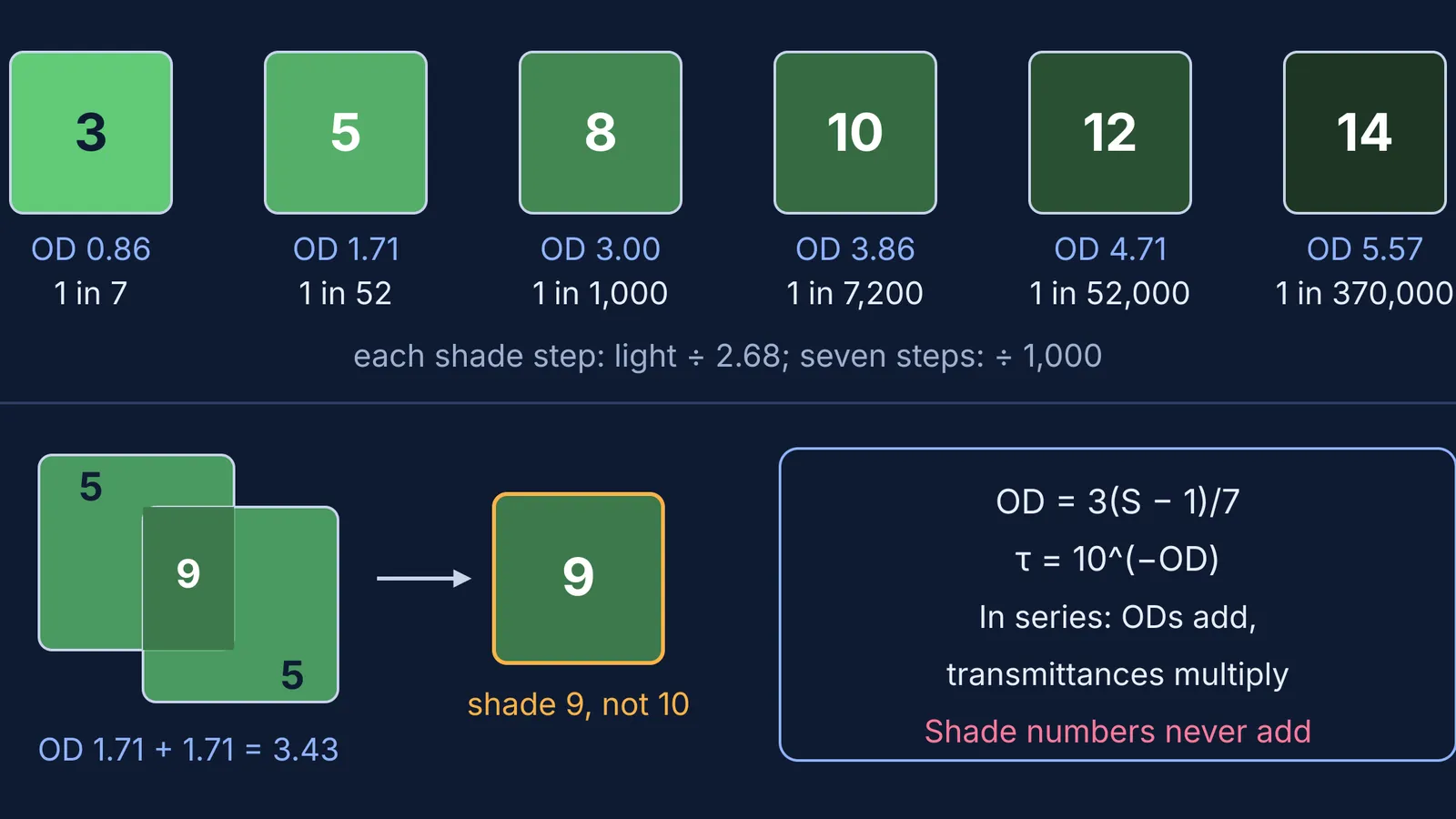
Each step of one shade adds 3/7 = 0.429 to the OD, so it cuts the light by 10^(3/7) = 2.68 times. Seven shade steps add exactly 3 to the OD, which is a factor of 1,000. The formula gives the geometric middle of each band in the ISO table: for shade 10 it gives 0.0139%, and √(0.0085 × 0.023) = 0.0140%.
Two values are worth remembering, because the numbers come out round: shade 8 has OD 3 (passes 0.1%) and shade 15 has OD 6 (passes one millionth).
Worked example: what fraction does each shade let through?
Use OD = 3(S − 1)/7, then τ = 10^(−OD).
Shade 3: OD = 3 × 2/7 = 0.857. τ = 10^(−0.857) = 0.139, so 13.9%, about 1 part in 7.
Shade 5: OD = 3 × 4/7 = 1.714. τ = 0.0193, so 1.93%, about 1 part in 52.
Shade 10: OD = 3 × 9/7 = 3.857. τ = 1.39 × 10⁻⁴, so 0.0139%, about 1 part in 7,200.
Shade 12: OD = 3 × 11/7 = 4.714. τ = 1.93 × 10⁻⁵, so 0.00193%, about 1 part in 52,000.
Shade 14: OD = 3 × 13/7 = 5.571. τ = 2.68 × 10⁻⁶, so 0.00027%, about 1 part in 373,000.
Check the units: OD and τ are both pure numbers, as a ratio of two light intensities should be. Check the sense: going from shade 10 to shade 12 is two steps, and 2.68² = 7.2, which matches 7,200 to 52,000.
Now a feel for why the numbers are so extreme. Suppose an arc is about 10⁷ cd/m² bright and a comfortable level to look at is about 10³ cd/m². These are round illustrative values, not measurements. The filter must cut the light by 10⁴, so OD = 4, and S = 1 + (7/3) × 4 = 10.3. That is the right neighbourhood for the shades used in arc welding.
Which shade should a welder use?
Not one you calculate. The required shade comes from the tables in the safety standards, because a brighter arc (higher current) needs a darker filter. The US rule in OSHA 29 CFR 1910.133, which requires eye protection meeting ANSI Z87.1, gives these minimum shades for shielded metal arc (stick) welding:
Below 60 A: shade 7
60–160 A: shade 8
160–250 A: shade 10
250–550 A: shade 11
The same page advises starting with a shade too dark to see the weld zone and then moving lighter until you can see well, but never below the minimum. Gas welding, cutting and other processes have their own rows. Use a filter marked to the standard that applies where you work, at the shade its table gives for your process and current.
Why do two shade 5 glasses make shade 9, not shade 10?
When light passes through two filters in a row, the second one acts on what the first let through, so the transmittances multiply. This is the same rule you use for intensity through polarisers in series in three polaroids and Malus' law.
Each shade 5 glass: τ = 0.0193, OD = 1.714.
Two in a row: τ = 0.0193² = 3.73 × 10⁻⁴. Because logs turn products into sums, the ODs add: 1.714 + 1.714 = 3.429.
Convert back: S = 1 + (7/3) × 3.429 = 9.0.
So shade 5 + shade 5 = shade 9. ODs add; shade numbers do not, because of the "+1" in the formula. Add the shades and you would expect 10, which is 2.68 times darker than what you actually get.
This is a physics exercise, not safety advice. Stacked lenses are not a substitute for a single filter of the required shade. Reflections between the surfaces, the UV and IR ratings of each piece, and scratches all change the result, and none of it has been tested as a combination. Always use a filter rated for the shade you need.
Is a solar eclipse filter the same as welding glass?
No. They are tested to different standards for different jobs. Solar viewers are tested to ISO 12312-2, which caps the visible transmittance at 0.0032% (3.2 × 10⁻⁵). Plug that into the formula: S = 1 + (7/3) log₁₀(1/(3.2 × 10⁻⁵)) = 11.5. In ISO 4850's table, 0.0032% is also the upper limit for shade 12, so the solar limit sits at the light end of shade 12. The solar standard also sets its own UV and infrared limits for staring at the Sun, which are not the same as the welding limits.
For an eclipse, use a viewer certified to ISO 12312-2, as how to watch a solar eclipse safely explains. Ordinary sunglasses fail by a wide margin even when they are rated UV400, for the reasons in what UV400 on sunglasses means.
If logarithmic scales still feel slippery, the Concept Library covers logs, intensity and absorption, so you can see why every scale like this works the same way.
Quick checklist
Shade number S sets visible transmittance only; UV and IR limits are separate.
OD = 3(S − 1)/7 and τ = 10^(−OD).
One shade step is a factor of 2.68; seven steps are a factor of 1,000.
Shade 8 passes 0.1%, shade 10 about 1 in 7,200, shade 15 one millionth.
Filters in series: multiply τ, add OD, never add shade numbers.
Pick a welding shade from the standard's table for your process and current.
Solar viewing needs an ISO 12312-2 filter; it is not welding glass.