

On this page
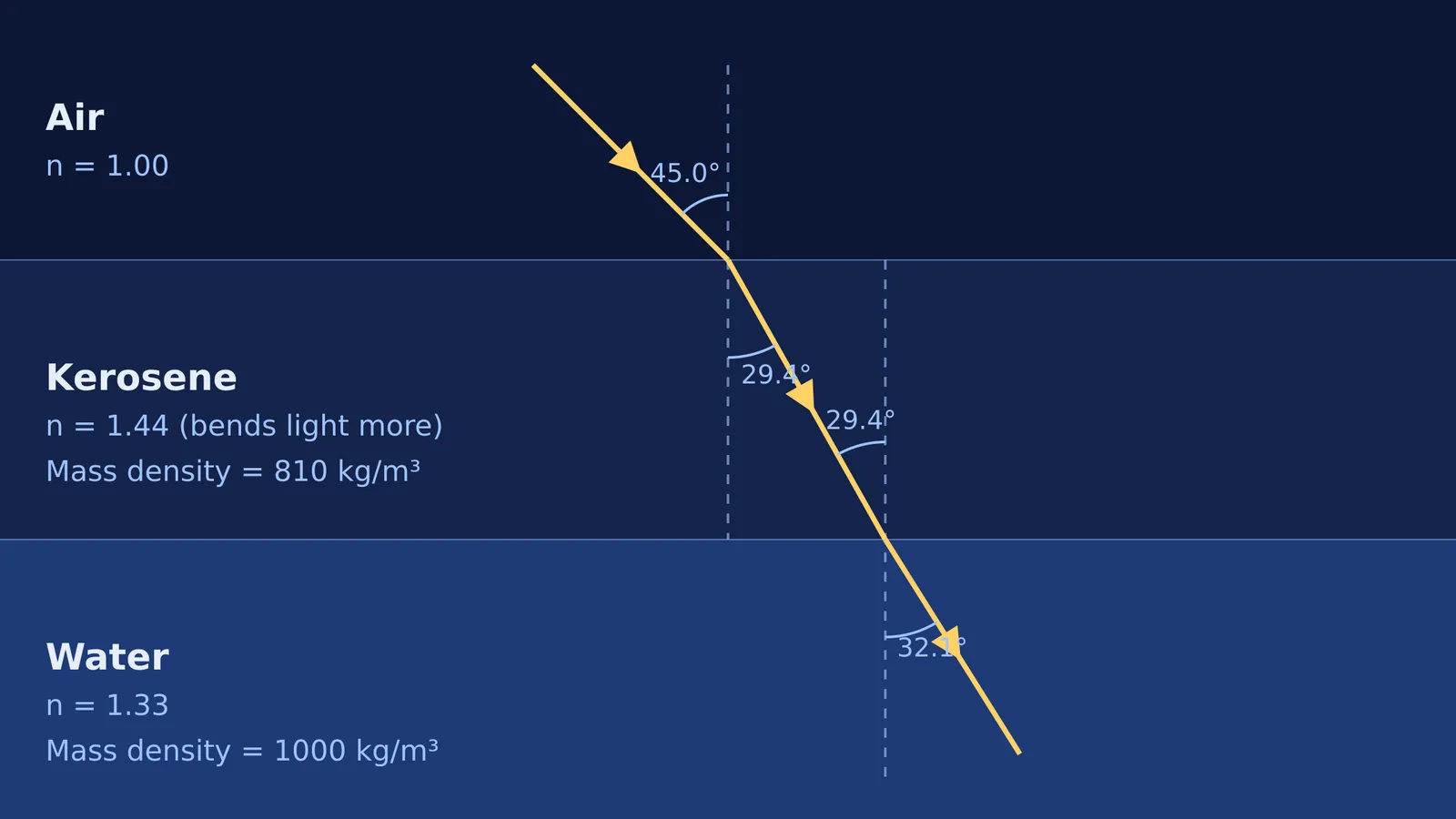
When you pour kerosene into water, the kerosene floats on top. But if you shine a laser beam through both liquids, the light slows down more and bends more sharply in the kerosene.
This simple experiment reveals that a material can be "lighter" in weight but "denser" for light. To understand why, we have to look at the difference between mass density and optical density.
What is mass density?
Mass density is what we usually mean when we say a material is "dense." It is a measure of how much matter is packed into a given space.
The definition: Mass density is the ratio of an object's mass to its volume.
The units: It is measured in kilograms per cubic metre (kg/m³) or grams per cubic centimetre (g/cm³).
The mass density of water is about 1000 kg/m³ at room temperature, making it a standard reference for other liquids. A substance with a high mass density, like iron, has heavy atoms packed closely together. When two immiscible liquids are mixed, the one with the lower mass density will float on top of the heavier one.
What is optical density?
Optical density has nothing to do with how heavy a material is. Instead, it describes how a medium affects the propagation of electromagnetic waves, specifically light.
The definition: Optical density is a measure of how much a material slows down the speed of light passing through it.
The units: It is often described using the refractive index (n), which is a dimensionless number (it has no units) because it is a ratio of two speeds.
In a vacuum, light travels at exactly 299,792,458 metres per second, and the refractive index is exactly 1. When light enters a denser optical medium, it interacts with the electrons in the atoms and slows down. The slower the light travels, the higher the optical density and the higher the refractive index.
When light enters an optically denser medium at an angle, it bends towards the normal—a process known as refraction. If you find optics principles hard to picture, the Fermi Concept Library breaks down the physics of refraction step by step so you can build a solid foundation.
Why does kerosene float on water but bend light more?
The comparison between kerosene and water is the classic example used to show that mass density and optical density are independent properties.
Kerosene has a mass density of roughly 810 kg/m³. Because it is physically lighter per unit volume than water, kerosene floats on the surface.
However, the refractive index of kerosene is 1.44. Meanwhile, the refractive index of water is 1.33. This means that kerosene is optically denser than water. Even though its molecules are lighter and less tightly packed, their specific electronic structure interacts more strongly with light waves, slowing them down more effectively.
How do you measure each one?
Because they measure completely different physical realities, the tools used for mass and optical density are different.
Measuring mass density: You can find this by measuring a sample's mass on a balance and its volume in a graduated cylinder, then dividing the mass by the volume. It can also be measured directly with a hydrometer, which floats at different depths depending on the liquid's mass density.
Measuring optical density: You measure this by observing light. You can shine a light beam into the material at a known angle and measure the angle of refraction to calculate the refractive index using Snell's law. Instruments like refractometers or spectrometers do this automatically.
How to tackle exam questions?
When you face a physics question comparing two unknown liquids, use this framework to avoid common mistakes:
Identify the property being tested: If the question asks which liquid floats, you need mass density. If it asks which liquid bends light more, you need optical density.
Check the refractive index: The liquid with the higher index of refraction (n) is the optically denser medium.
Determine the speed of light: Light always travels slower in the optically denser medium.
Draw the normal line: When a ray travels from a rarer to a denser optical medium, it bends towards the normal line.
Understanding how light bends is crucial for everything from designing camera lenses to explaining why the sky looks the way it does. You can see how these principles apply to the atmosphere in our guide to Atmospheric refraction: why stars twinkle and planets don't, or explore how curved shapes handle light in Refraction through a glass sphere: imaging with two surfaces.


