

On this page
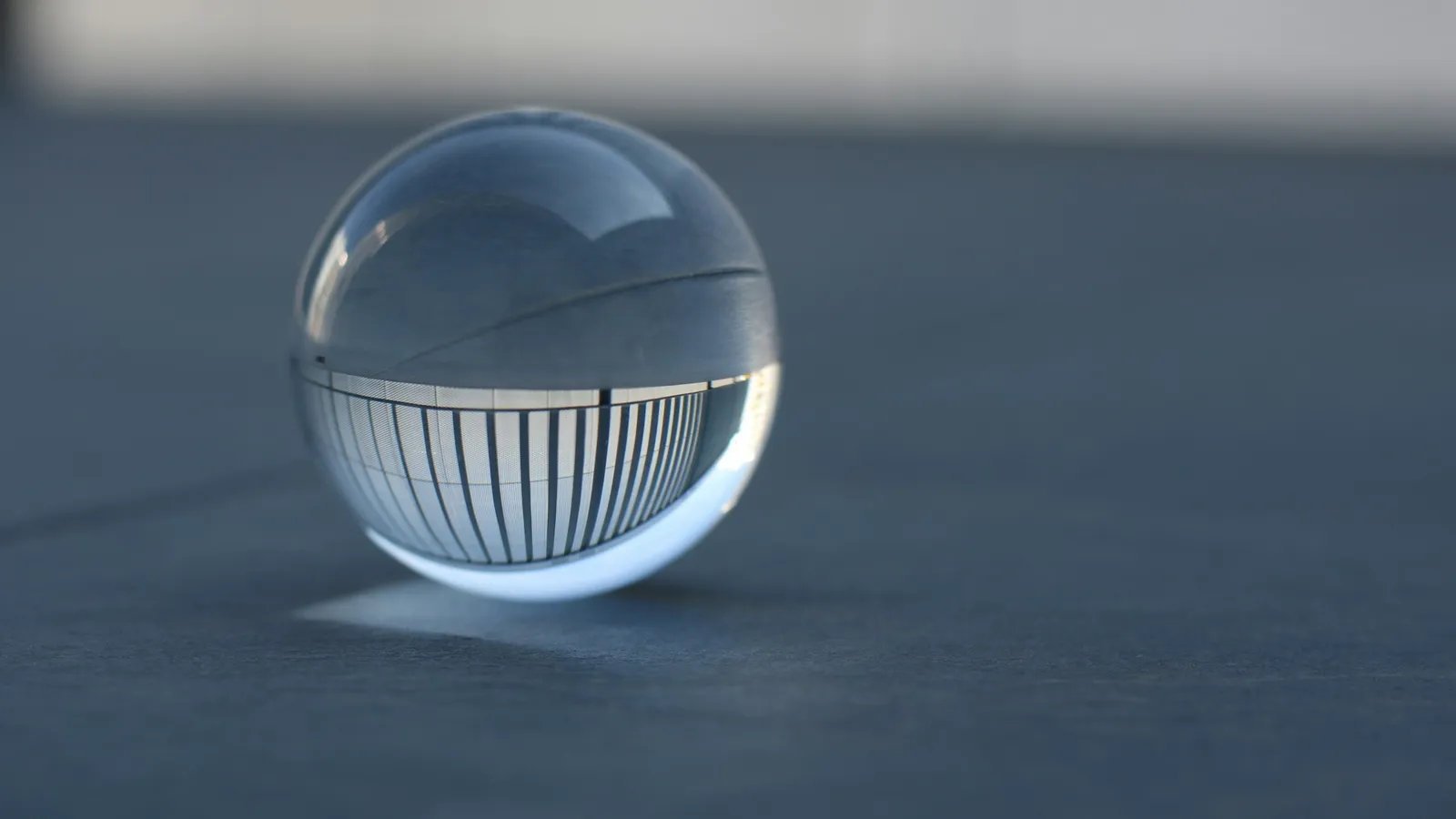
A glass marble, a water drop and a crystal ball all form images, but none is a thin lens: a sphere is as thick as it is wide. Sphere problems test whether you can use the single-surface formula twice and keep track of where you measure from. This post gives the two-step method, worked examples, a shortcut that checks the answer, and the slips that cost marks.
Is this topic still in the syllabus?
Yes. The current NCERT Class 12 Physics Part II chapter, Ray Optics and Optical Instruments (2026-27 reprint), derives refraction at a single spherical surface in Section 9.5.1 as n2/v − n1/u = (n2 − n1)/R (Eq. 9.16), and then builds the thin lens by applying it to two surfaces in turn. The JEE (Main) 2026 syllabus lists "refraction of light at plane and spherical surfaces", and the NEET (UG) 2026 syllabus has the same line. NCERT does not work a full sphere, so treat it as an application of Eq. 9.16. Check your exam year's syllabus.
For single-surface cases such as a bubble in a ball, see our guide to refraction at a single spherical surface. Here the light goes all the way through.
How do you image through two surfaces?
Use the Cartesian convention: light travels left to right, distances are measured from the surface you are working on, and R is positive when the centre of curvature lies on the side the light is going to.
First surface (air to glass). n1 = 1, n2 = n, R = +R. Find the first image distance v1 from the front surface.
Shift the origin. The back surface is a full diameter, 2R, further on. The first image becomes the object for the second surface, at u2 = v1 − 2R.
Second surface (glass to air). n1 = n, n2 = 1, and now the centre lies behind the light, so the radius is −R.
If u2 is positive, the rays are still converging at the back surface: a virtual object, and the positive sign is correct.
Worked example 1: an object in front of a glass ball
A small object is 30 cm in front of a glass sphere of radius 10 cm and refractive index 1.5. Where is the final image?
First surface: 1.5/v1 − 1/(−30) = 0.5/10, so 1.5/v1 = 0.05 − 0.0333 = 0.0167 and v1 = +90 cm.
Shift: u2 = 90 − 20 = +70 cm, a virtual object.
Second surface: 1/v2 − 1.5/70 = (1 − 1.5)/(−10) = 0.05, so 1/v2 = 0.05 + 0.0214 = 0.0714 and v2 = +14 cm.
The final image is real, 14 cm beyond the back surface. Magnification at each surface is m = (n1 v)/(n2 u): m1 = (1 × 90)/(1.5 × −30) = −2, and m2 = (1.5 × 14)/(1 × 70) = 0.3. The total is −0.6, so the image is inverted and 0.6 times the size of the object.
Where does a glass ball focus parallel light?
Send in parallel rays (u = −∞) with the same sphere.
First surface: 1.5/v1 = 0.5/10, so v1 = +30 cm.
Shift: u2 = 30 − 20 = +10 cm.
Second surface: 1/v2 − 1.5/10 = 0.05, so 1/v2 = 0.2 and v2 = +5 cm.
The focus is 5 cm beyond the back surface, which is 15 cm from the centre. Doing the same algebra with symbols gives a compact result for a ball in air: the focal length, measured from the centre, is f = nR/[2(n − 1)]. For n = 1.5 that is 1.5R, so 15 cm here.
A shortcut that checks example 1
Because a sphere is symmetric, you can treat it as a lens of focal length 15 cm with all distances measured from the centre. In example 1 the object is 30 + 10 = 40 cm from the centre. Using 1/v − 1/u = 1/f with u = −40 cm: 1/v = 1/15 − 1/40 = 5/120, so v = +24 cm from the centre. That is 24 − 10 = 14 cm beyond the back surface, matching the two-step answer. Use it to check, but show the two-step method in written answers.
Worked example 2: drops, beads and n = 2
The same formula explains three results often asked as one-liners, all with R = 10 cm:
Water drop, n = 4/3: f = (4/3)(10)/(2/3) = 20 cm from the centre, so the focus is one radius, 10 cm, beyond the drop.
Glass, n = 1.5: 15 cm from the centre, 5 cm beyond the ball, as above.
n = 2: f = 2 × 10/2 = 10 cm, exactly on the back surface. Parallel light focuses on the glass itself, so a mirror coating there would send it straight back the way it came.
Which mistakes cost marks?
Forgetting the shift. Using v1 directly as the object distance for the back surface ignores the 2R of glass in between.
Keeping R positive. The back surface curves the other way relative to the light, so its radius is −R.
Flipping the sign of a virtual object. When v1 is beyond the back surface, u2 is positive. Do not force it negative.
Using the thin lens formula from a surface. A sphere is thick; the lens shortcut only works with distances from the centre.
If the sign rules themselves are shaky, the Fermi Concept Library covers every concept in physics, chemistry, biology, mathematics and computing, so you can revise refraction at one surface before stacking two.
A practice routine
Redo example 1 with the object 15 cm in front of the sphere. Check: v1 = −90 cm (a virtual first image on the object's side), u2 = −110 cm, and the final image is 27.5 cm beyond the back surface, or 37.5 cm from the centre, as the shortcut gives.
Repeat example 2 for a glass hemisphere with light entering the flat face, and compare.
Solve three past questions on spheres, listing n1, n2, u and R for each surface before any algebra.
Tonight, solve example 1 again from a blank page and confirm the shortcut gives 14 cm.


