

On this page
A sticker on a pair of sunglasses says "UV400". It sounds like a model number, but it is a statement about wavelengths, and once you can read it you can check a pair's UV label in seconds.
What does UV400 mean on sunglasses?
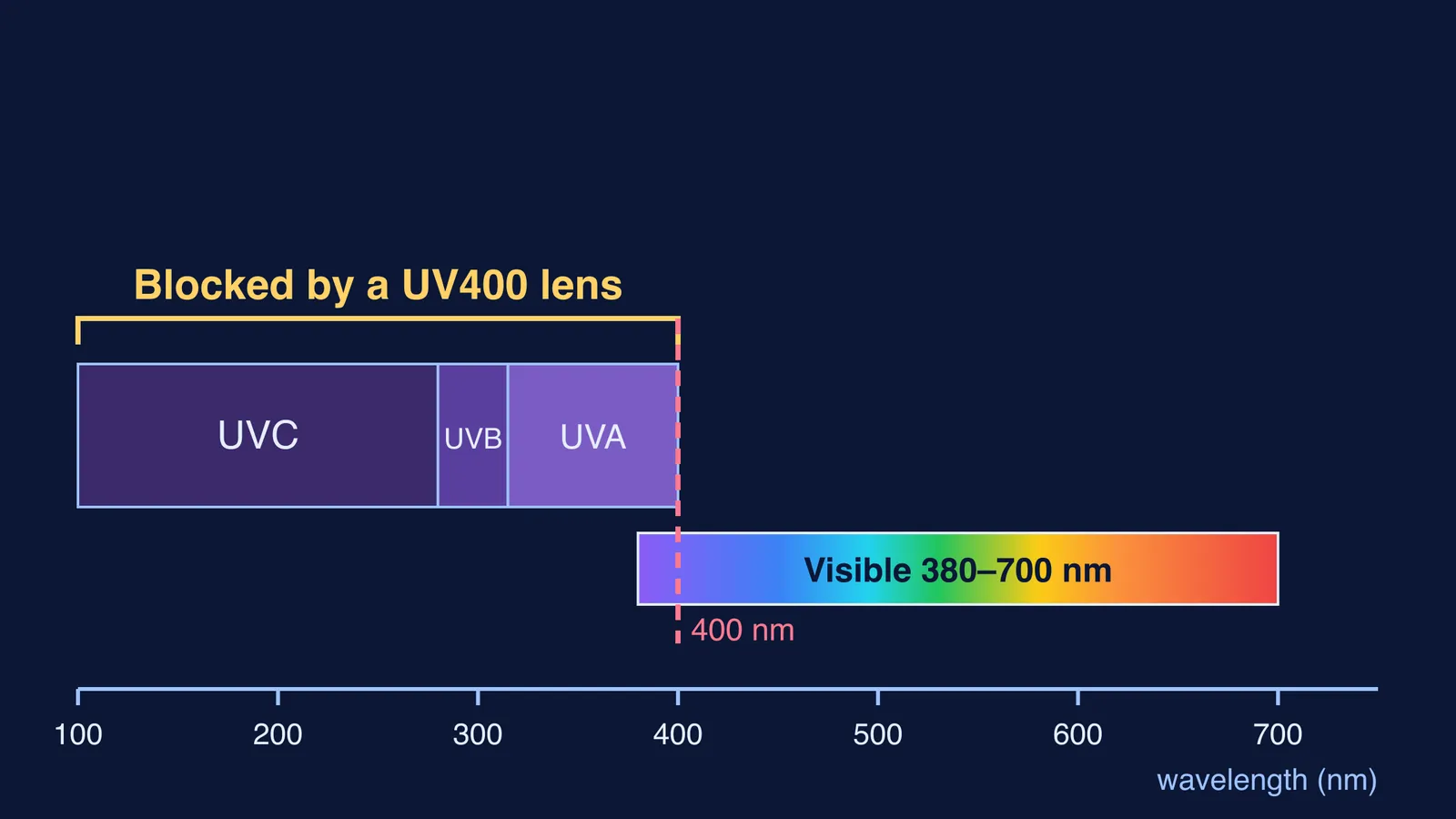
UV400 means the lenses are meant to block ultraviolet light at every wavelength up to 400 nanometres (nm), a nanometre being a billionth of a metre.
The American Academy of Ophthalmology's guide to choosing sunglasses says to look for a sticker or tag promising 100% UV protection, and that a label reading "UV absorption up to 400nm" is also acceptable. So by the AAO's standard, a UV400 label and a "100% UV protection" label both pass.
Why stop at 400? Because that is where ultraviolet ends. The World Health Organization's UV radiation Q&A) splits UV into three bands:
UVA: 315 to 400 nm
UVB: 280 to 315 nm
UVC: 100 to 280 nm
The same WHO page says all UVC and most UVB is absorbed by ozone, water vapour, oxygen and carbon dioxide as sunlight passes through the atmosphere. So the UV reaching your eyes is mostly UVA plus some UVB, and a lens that blocks everything up to 400 nm covers both.
Where does 400 nm sit on the electromagnetic spectrum?
Light is one small slice of the electromagnetic spectrum; our explainer on the electromagnetic spectrum from radio to gamma rays walks through it band by band.
NASA's visible light page says the human eye can typically detect wavelengths from 380 to 700 nm, with violet at the short end and red at the long end. Put that next to the WHO bands and you see why 400 nm is a natural cut-off: it is the top of the UVA band, and it sits at the violet edge of what you can see. The ranges overlap between 380 and 400 nm, so a UV400 lens also trims the deepest violet but passes almost all of the visible rainbow.
A worked example for your notebook. A handy shortcut from Class 12 physics is E (in eV) ≈ 1240 / λ (in nm).
Green light at 550 nm: 1240 / 550 ≈ 2.25 eV per photon.
The UV400 cut-off at 400 nm: 1240 / 400 = 3.1 eV per photon.
The UVA/UVB boundary at 315 nm: 1240 / 315 ≈ 3.94 eV per photon.
So a photon at the UVB edge carries roughly 1.75 times the energy of a green one. The lens stops the more energetic photons and passes the ones you need to see.
Are darker sunglasses more protective?
Not necessarily. Tint and UV blocking are separate properties. Tint cuts visible light; UV protection depends on what the lens material or coating absorbs below 400 nm. The AAO guide warns readers: "Don't be fooled into thinking the darker the lens, the more they'll protect your eyes from the sun."
A common claim is that dark lenses without UV protection are worse than none, because your pupils widen behind them. A 2024 study in Scientific Reports by Mauro Masili, Fernanda Duarte and Liliane Ventura tested that explanation by calculating UV reaching the eye through 214 sunglass lenses. They found pupil dilation did not play an important role; the field of view (how much you squint, which changes with brightness) mattered far more. Even so, they report that lenses with UV-A protection below 86% may have a slight potential to increase the hazard compared with wearing no sunglasses. A dark lens that does not block UV is not a safe lens.
Polarised lenses do a different job again, cutting glare from roads and water; our post on why polarised sunglasses cut glare shows how that works. The AAO guide adds that polarisation by itself does not provide UV protection.
How can you check a pair before you buy?
Use this four-step check in any shop, based on the AAO's advice:
Read the label. Look for "UV400", "100% UV protection" or "UV absorption up to 400nm".
Ignore the colour as a UV test. Dark grey, brown or mirrored lenses can be UV400, and a dark lens can have no UV protection at all. The label decides, not the tint.
Check the size and shape. The AAO notes that larger lenses protect more, and wraparound frames help stop UV getting in from the sides.
When a pair has no label, ask an optician or optometrist to check it, or choose a labelled pair.
Your skin needs a filter too; our explainer on how sunscreen blocks UV rays covers the chemistry.
How can you see this for yourself?
The Fermi Simulation Lab has interactive simulations for the ideas that are easier to see than to read. If a term like wavelength or photon energy still feels shaky, the Fermi Concept Library gives each concept its own lesson.
Next time you pick up a pair of shades, check the sticker for "400", then do the 1240 / λ sum in your head.


