

On this page
When sunlight reaches your skin, it brings a continuous stream of electromagnetic radiation. While we can see the visible light and feel the infrared radiation as warmth, the ultraviolet (UV) portion of the spectrum carries enough energy to damage cells. Sunscreen is designed to intercept this radiation before it can harm your skin, but the way it works is often misunderstood.
What is the difference between UVA and UVB?
The ultraviolet spectrum is divided into bands based on wavelength. The two that reach the Earth's surface are UVA and UVB.
UVB rays carry more energy per photon. They are the primary cause of erythema, or sunburn, and directly damage DNA in the outer layers of the skin. UVA rays have longer wavelengths and lower energy, allowing them to penetrate deeper into the skin. While they do not cause sunburn as quickly as UVB, UVA rays contribute to long-term skin aging and skin cancer. A complete sun protection strategy must account for both bands of the energy density and intensity of an EM wave.
How do chemical sunscreens work?
Organic, or "chemical," sunscreen filters are made of carbon-based molecules such as avobenzone and octocrylene. According to a 2024 review in *Cureus*, these ingredients are highly stable and effectively absorb UV radiation.
When a UV photon strikes an organic sunscreen molecule, the molecule absorbs the photon's energy, exciting its electrons to a higher state. As the molecule returns to its ground state, it releases that extra energy as harmless heat. The sunscreen effectively acts as an energy sink, harmlessly dissipating the radiation. If you are studying how light interacts with matter, the Fermi Simulation Lab offers interactive simulations for the ideas that are easier to see than to read, including photon absorption.
Do mineral sunscreens reflect UV rays?
It is a common myth that mineral filters—specifically zinc oxide and titanium dioxide—act as a physical shield, bouncing UV rays away from the skin like tiny mirrors.
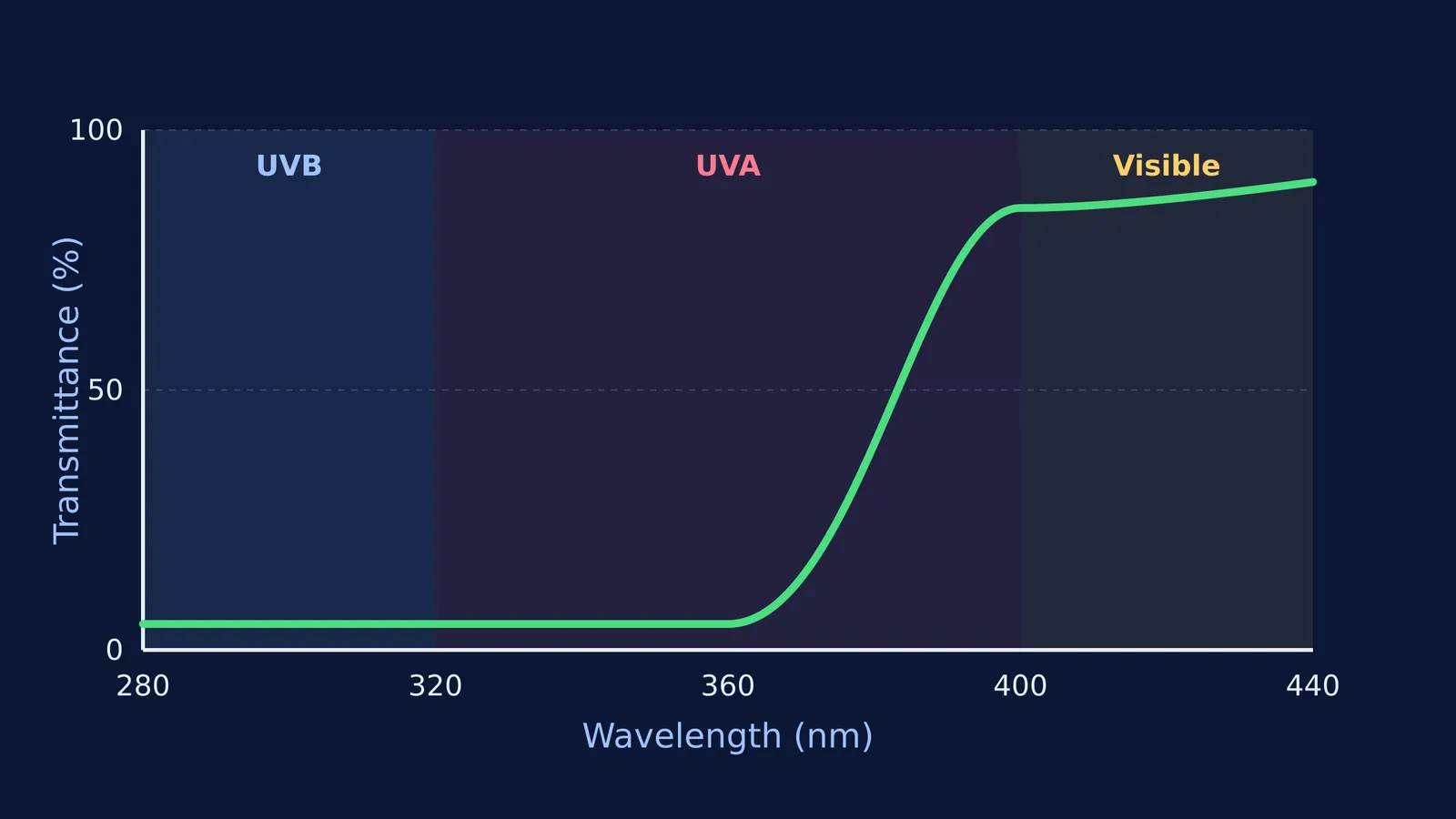
In reality, mineral sunscreens act as semiconductors. Their molecular band gap matches the energy of UV photons. A 2016 study published in *Photodermatology, Photoimmunology & Photomedicine* measured the transmission and reflectance of these minerals. The researchers found that reflection accounts for only 4 to 5% of the UV protection they provide. The remaining protection comes from absorbing UV photons, exactly like chemical filters do.
In the visible light spectrum, the energy of the photons drops below the semiconductor band gap. At these longer wavelengths, the minerals stop absorbing and start scattering light, which is why thick mineral sunscreens often leave a white cast on the skin.
What does SPF actually mean?
The Sun Protection Factor (SPF) printed on a bottle of sunscreen specifically measures protection against UVB rays, which cause erythema (sunburn). It is calculated as the ratio of the UV dose required to produce sunburn on skin protected by the sunscreen compared to unprotected skin.
For example, if it requires a significantly higher number of photons emitted per second to cause a sunburn on protected skin, the SPF reflects this ratio. Because SPF is based on sunburn protection, a high SPF does not guarantee that the product absorbs UVA rays. This is why dermatologists recommend "broad-spectrum" sunscreens, which are formulated to ensure they absorb radiation across the entire UVA and UVB range.
A checklist for sun protection
Applying the physics of sunscreen to everyday life requires a few practical steps. When preparing to spend time outdoors, follow this checklist:
Check the label: Choose a sunscreen that explicitly says "broad spectrum" to ensure both UVA and UVB absorption.
Look at the SPF: Select a product with a high SPF for adequate protection.
Apply early: Put sunscreen on before going outside to allow it to form an even film on your skin.
Use enough: Most people apply less than the amount used in laboratory testing. Apply a generous layer over the entire body.
Reapply regularly: Sunscreen films break down over time. Reapply often, and immediately after swimming or heavy sweating.


