On this page
A dairy pasteuriser heats cold milk to about 72 °C, holds it there for a few seconds, then chills it back to about 4 °C. Done naively, you pay for the heat twice: once to warm the milk and once to remove that same heat in the chiller. Real plants avoid most of that cost with one trick. The hot milk on its way out warms the cold milk on its way in, through thin steel plates, and the two streams run in opposite directions. This post works out how much energy that saves, and why the direction of flow decides whether it works at all.
What does a pasteuriser actually do to the milk?
The Tetra Pak Dairy Processing Handbook, a standard industry reference, describes the usual programme for milk: chilled milk is heated from about 4 °C to 72 °C, held for 15 seconds, then chilled to 4 °C again. It lists high-temperature short-time (HTST) settings of 72 to 75 °C for 15 to 20 seconds. The exact settings a dairy must use are set by food-safety rules, not by physics; this post only follows the heat.
The plate heat exchanger has three main sections:
Regeneration: cold raw milk is warmed by hot pasteurised milk, which is cooled at the same time.
Heating: hot water lifts the milk the last few degrees to 72 °C, then it passes through a holding tube.
Cooling: chilled water takes the outgoing milk down to 4 °C.
The handbook calls the first step regenerative heat exchange, or heat recovery, and says that as much as 94 to 95% of the heat content of the pasteurised milk can be recycled.
How much power does it take without heat recovery?
Work it out with Q = mcΔT per second, using mass flow, not volume.
Worked example: a 10,000 L/h pasteuriser
Data (typical milk values from the same handbook): density 1,020 kg/m³, specific heat 3.95 kJ/kg K.
Mass flow. 10,000 L/h = 10 m³/h = 2.78 × 10⁻³ m³/s. Times 1,020 kg/m³ gives ṁ = 2.83 kg/s.
Heat capacity rate. C = ṁc = 2.83 × 3,950 = 11,190 W/K. Every kelvin of temperature change costs about 11.2 kW.
Heating with no recovery. ΔT = 72 − 4 = 68 K, so P = 11,190 × 68 ≈ 761 kW.
Cooling with no recovery. The chiller must remove the same 761 kW to bring the milk back to 4 °C.
That is about 1.5 MW of heating and refrigeration for one modest line.
How does regeneration cut that bill?
The handbook defines regeneration efficiency as the share of the total temperature rise that comes from the outgoing milk:
R = (t_r − t_i) / (t_p − t_i)
where t_i is the raw milk inlet temperature, t_r its temperature after the regeneration section, and t_p the pasteurisation temperature. Its own example, 4 °C raw milk reaching 68 °C before a 72 °C pasteurisation, gives R = 64/68 = 94%.
Take a round illustrative value of R = 90%, a little below the handbook's upper figure, and carry on with the worked example:
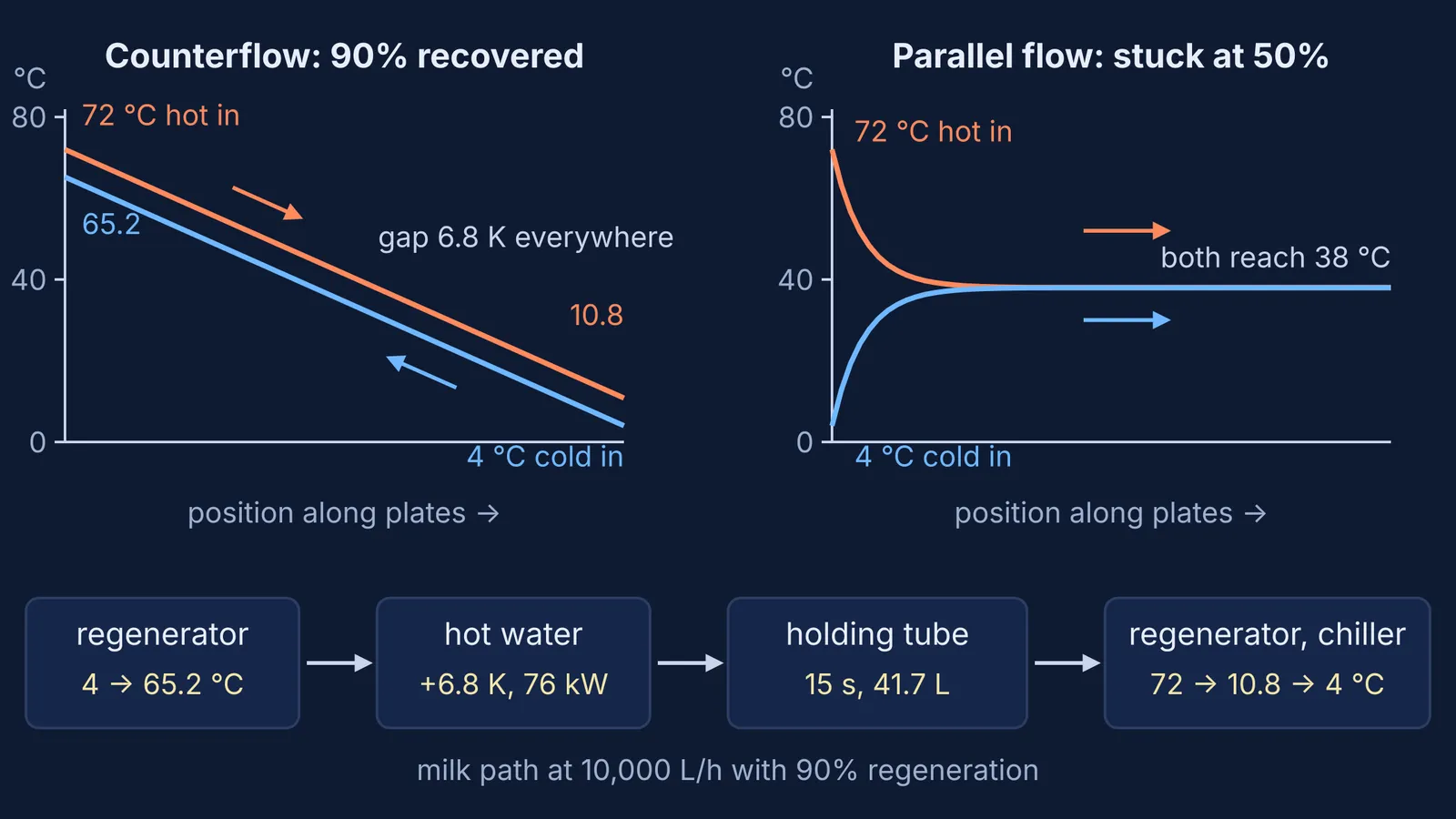
Cold milk after regeneration. t_r = 4 + 0.9 × 68 = 65.2 °C.
Hot milk after regeneration. Both streams have the same flow and specific heat, so heat lost = heat gained means equal temperature changes. The hot milk falls by 61.2 K, from 72 °C to 10.8 °C.
Heating section. Only 72 − 65.2 = 6.8 K is left: 11,190 × 6.8 ≈ 76 kW.
Cooling section. Only 10.8 − 4 = 6.8 K to remove: again about 76 kW.
Saving. 761 − 76 ≈ 685 kW on the heating side, and the same on the chilling side.
The balance used in step 2 is the same heat lost = heat gained you use for mixing problems, covered in calorimetry: mixing, melting and conduction. The only difference is that here the two liquids never mix; heat crosses a steel plate.
Why does counterflow beat parallel flow?
Suppose the two milk streams ran in the same direction (parallel flow). Hot milk at 72 °C and cold milk at 4 °C enter together. As they move along, the hot one cools and the cold one warms, and the gap between them shrinks. With equal heat capacity rates, the most they can do is meet in the middle at (72 + 4)/2 = 38 °C. That is R = 34/68 = 50%, and no amount of extra plate area beats it.
In counterflow, the cold milk enters at the end where the hot milk is leaving, and flows the other way. Each part of the cold stream always meets hot milk that is a little hotter than itself. With equal flows, the temperature gap is the same all along the exchanger: 72 − 65.2 = 6.8 K at one end and 10.8 − 4 = 6.8 K at the other. The handbook makes the same point: the temperature difference between the two liquids is put to most use when they flow in opposite directions.
How much plate area does 90% need? Exchanger designers use the number of transfer units, NTU = UA/C. For counterflow with equal heat capacity rates, R = NTU/(1 + NTU), so 90% needs NTU = 9. With an illustrative overall heat transfer coefficient of U = 4,000 W/m² K for a plate exchanger, the area is A = 9 × 11,190 / 4,000 ≈ 25 m². Check: Q = UAΔT = 4,000 × 25.2 × 6.8 ≈ 685 kW, the same as step 5. Give that same 25 m² to a parallel-flow layout and R stays at 50.0%; the two streams have already met at 38 °C within the first quarter of the plates.
Heat flow across each plate follows Q/t = kAΔT/d, the conduction formula worked through in heat lost through window glass per second. Thin steel and a large area are what make a small ΔT enough.
How long is the holding tube?
At 10,000 L/h, 15 seconds of flow is 10,000 × 15 / 3,600 ≈ 41.7 L. Milk in the centre of a pipe moves faster than the average, so the handbook sizes the tube with an efficiency factor of about 0.85: 41.7/0.85 ≈ 49 L, which with its 48.5 mm bore pipe works out to about 26.5 m of tube. That way even the fastest milk spends the full holding time at temperature.
A Stirling engine also has a part called a regenerator, but it stores heat in a mesh and gives it back to the same gas later in the cycle; see how a Stirling engine's regenerator works. A pasteuriser's regenerator passes heat between two streams at the same moment.
For more heat-balance numericals like this one, the Fermi Problem Library has a step-by-step solver that explains the reasoning.
Quick checklist
Use mass flow (kg/s) in Q = ṁcΔT, not litres per hour.
Equal flows and equal c: the temperature drop of one stream equals the rise of the other.
Regeneration R = (t_r − t_i)/(t_p − t_i).
Parallel flow with equal flows tops out at 50%; counterflow can approach 100% with enough area.
Counterflow with equal flows keeps the same ΔT all along.
The second law is about local heat flow, which is always hot to cold.