

On this page
You are sitting in an air-conditioned room in May. Outside it is 40 °C, inside 25 °C, and the only thing between you and the heat is a sheet of glass a few millimetres thick. How many joules come through every second? It is a standard Class 11 conduction numerical, and it hides a lesson most solutions skip.
How much heat is lost through window glass per second?
For steady conduction through a flat slab, the rate of heat flow is Q/t = kAΔT/d, where k is the thermal conductivity, A the area, ΔT the temperature difference across the slab and d its thickness. Building engineers use the same idea as thermal resistance: each layer's resistance is its thickness divided by its conductivity (Designing Buildings Wiki on U-values).
You need two material numbers. Ordinary glass has a thermal conductivity of about 0.8 to 0.93 W/m·K (list of thermal conductivities). Air near room temperature is about 0.024 to 0.025 W/m·K, roughly 30 to 40 times lower, according to the same table.
How do you solve the numerical step by step?
Take a window 1.5 m wide and 1.0 m tall, with glass 4 mm thick, outside at 40 °C and inside at 25 °C. Use k = 0.8 W/m·K, the lower end of the range in the thermal conductivity table.
Area: A = 1.5 × 1.0 = 1.5 m².
Thickness in metres: d = 4 mm = 0.004 m.
Temperature difference: ΔT = 40 − 25 = 15 °C, which is also 15 K.
Substitute: Q/t = 0.8 × 1.5 × 15 / 0.004.
The numerator is 18, so Q/t = 18 / 0.004 = 4,500 W.
That is the answer an exam expects: 4,500 joules per second flowing in.
Why is the textbook answer so much bigger than a real window's?
Real clear single glazing has a U-value of around 5.7 W/m²K (Wikipedia on window insulation). For our window that means 5.7 × 1.5 × 15 ≈ 128 W, about 35 times less than the textbook answer.
The difference comes from what the simple formula leaves out. Engineers add an inside and an outside surface resistance to the layer resistances, so U = 1/(ΣR + Ri + Ro) (Designing Buildings Wiki on U-values). Those surface terms stand for the thin layers of slow-moving air that cling to each face of the glass. The glass itself contributes only 0.004/0.8 = 0.005 m²K/W. Working backwards from U = 5.7, the whole window's resistance is about 1/5.7 ≈ 0.175 m²K/W, so the glass is under 3% of it. The air films do almost all the work.
So the exam formula is right about what it assumes: the two faces of the glass sit at exactly 40 °C and 25 °C. In a real room they do not. The same three routes, conduction, convection and radiation, explain why a tandoor cooks rotis so fast and how a lid cuts heat loss from a pot.
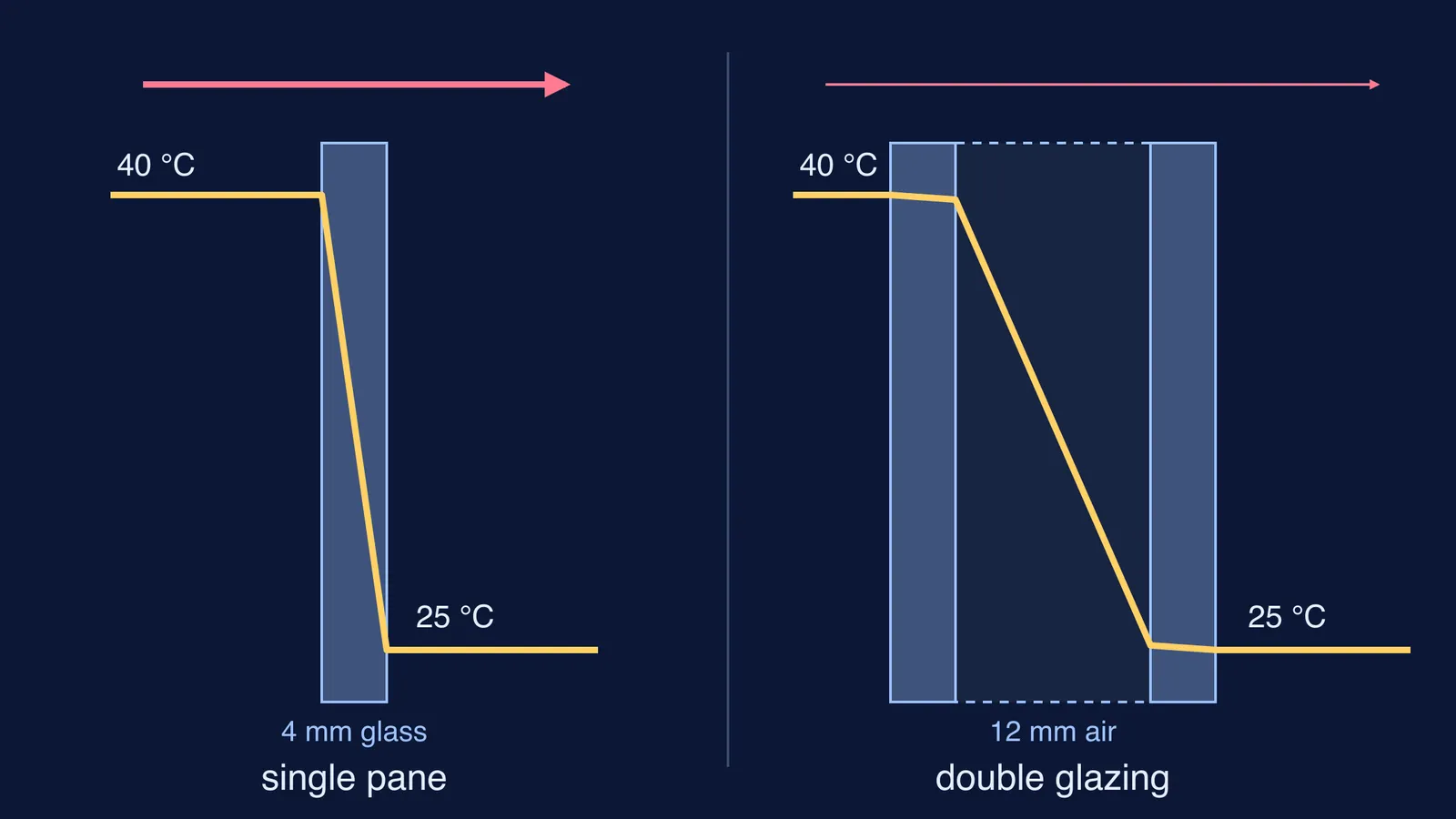
Why does double glazing cut heat flow?
Double glazing seals two panes around a cavity, typically 6 to 20 mm wide, filled with air or a gas such as argon (Designing Buildings Wiki on double glazing). Air conducts heat roughly 30 to 40 times worse than glass (thermal conductivity table), so even a thin trapped layer adds a large resistance.
Layers in series behave like resistors in series: add the d/k values, then Q/t = AΔT / Σ(d/k). For two 4 mm panes and a 12 mm air gap with k = 0.025 W/m·K:
Each pane: 0.004 / 0.8 = 0.005 m²K/W, so 0.010 for both.
Air gap: 0.012 / 0.025 = 0.48 m²K/W.
Total: 0.49 m²K/W.
Q/t = 1.5 × 15 / 0.49 ≈ 46 W.
On paper, that is about 98 times less than 4,500 W. Real windows improve less. Clear double glazing has a U-value between 1.8 and 3 W/m²K (Wikipedia on window insulation), so our window would pass roughly 41 to 68 W instead of about 128 W: a third to a half. The same article notes that for argon the best gap is about 13 mm; a wider or narrower gap degrades performance.
What mistakes cost marks in this numerical?
Wrong ΔT: use the difference across the slab, not one temperature.
Needless kelvin conversion: a 15 °C difference is already 15 K.
Adding conductivities for layers in series: add the d/k resistances instead.
Area in cm²: 150 cm by 100 cm is 1.5 m².
Stopping at watts when the question asks for energy: multiply by the time in seconds.
If you pick the right formula but land on the wrong number, practise similar problems in the Fermi Problem Library, where the step-by-step solver explains the reasoning rather than printing an answer. If conduction itself feels shaky, the Fermi Concept Library gives every physics concept its own lesson.


