

On this page
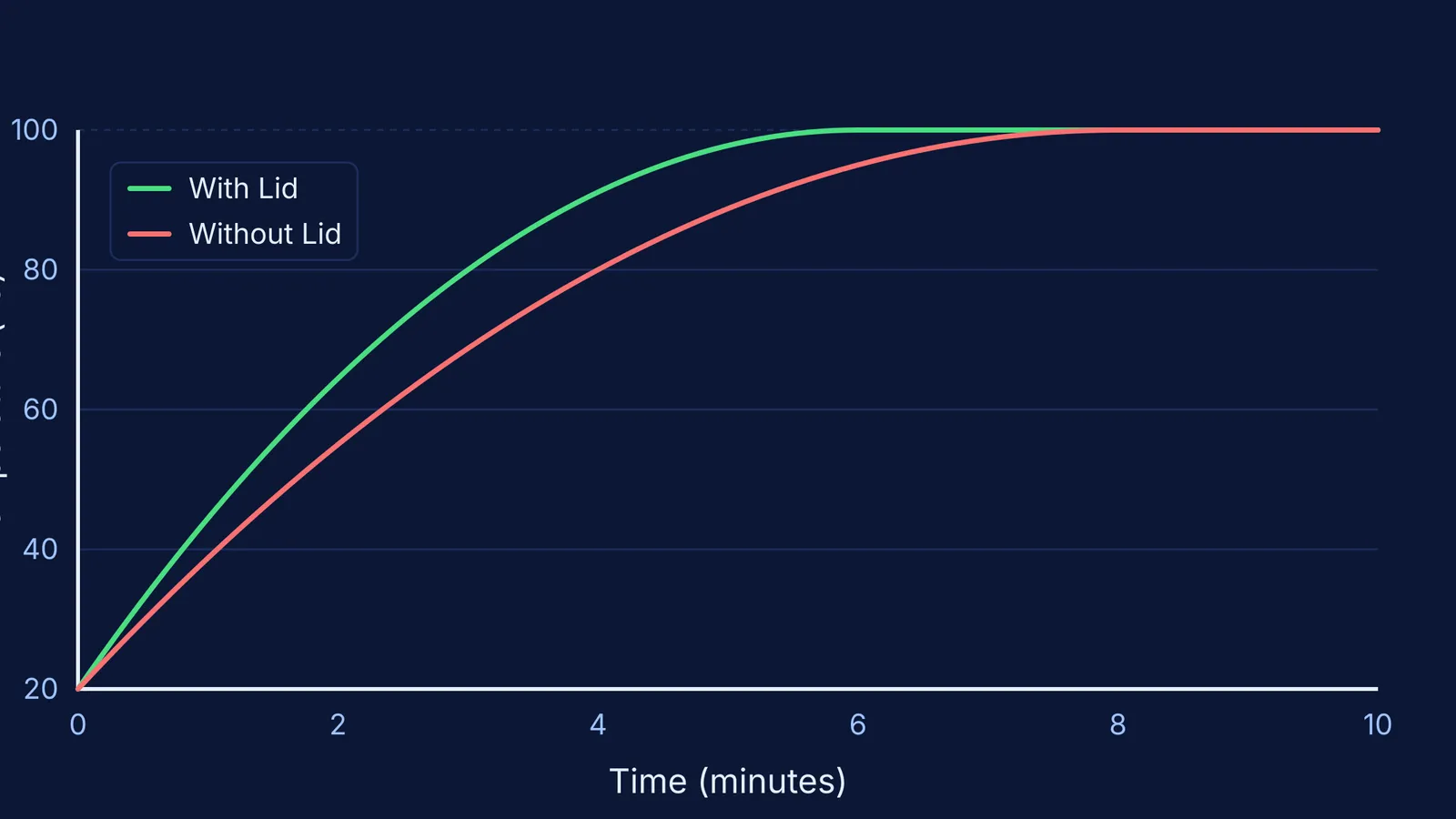
Every day, we put a pot of water on the stove and wait for it to boil. Does putting a lid on really make a difference? The short answer is yes. A lid significantly reduces both the time it takes to reach a boil and the energy lost to the room.
The science comes down to one phase change: evaporation. Here is why an open pot wastes heat, and how you can test the physics of energy loss yourself at home.
How much time does a lid save?
When you heat water, the stove transfers thermal energy to the liquid. If you trap that heat, the water reaches the boiling point faster.
While the exact time saved depends on your stove and the size of the pot, tests consistently show that covering the pot noticeably reduces the boiling time. Because the lid prevents hot vapour from escaping, the water retains more of the heat being supplied by the burner.
Why does evaporation cause massive energy loss?
The real cost of boiling water without a lid is not just time, but the energy lost to the environment.
When water gets hot, the most energetic molecules at the surface escape into the air as water vapour. This process is called evaporation, and it is a powerful form of cooling. (This is exactly why we sweat when we exercise: evaporating water removes heat from the body.) Every molecule that turns into steam carries away a large amount of latent heat of vaporisation, leaving the remaining water slightly cooler.
To put this into perspective, it takes exactly 4.18 joules of energy to heat one gram of water by one degree Celsius. But it takes a staggering 2,260 joules to turn that same gram of water at the boiling point into steam (source). This massive difference is the latent heat of vaporisation. Because of this high latent heat, boiling away even a small amount of water takes an enormous amount of energy. When you boil water without a lid, you are constantly pouring energy into the water just to replace the heat carried away by the escaping steam. In contrast, heating the liquid water itself from room temperature to boiling is relatively cheap in terms of energy.
When a pot is simmering, evaporation is the single largest source of energy loss. Most of the heat lost from an open pot is carried away by water vapour, while the rest is lost through convection and radiation from the sides of the pot.
Putting a lid on changes the system entirely. It traps the steam, creating a layer of hot, saturated air above the water. Because the air cannot hold any more vapour, evaporation slows to a halt—this is the same principle behind why clothes take so long to dry in the monsoon. The steam condenses on the cooler lid and drops back into the pot, returning its heat to the water rather than letting it escape into the kitchen.
Does a lid make water boil faster by raising pressure?
You might wonder if a lid acts like a pressure cooker. Does a lid make water boil faster by increasing the pressure inside the pot?
No. A standard pot lid does not create a tight seal. While it traps steam, the pressure inside remains very close to atmospheric pressure. The water still boils at the standard boiling point. The lid speeds up the boiling solely by preventing heat from escaping, not by altering the boiling temperature.
How can you test the physics of heat loss at home?
If you are preparing for physics exams, boiling water is a great way to observe calorimetry and phase changes in real life. Here is a simple experiment to test heat loss.
Measure one litre of water at room temperature and pour it into a pot.
Turn your stove to its highest setting and start a stopwatch. Record the exact time the water reaches a rolling boil, then turn off the stove.
Let the pot cool completely and measure one litre of fresh water to ensure starting conditions are identical.
Repeat the experiment with a tight-fitting lid. You will see the time drop noticeably.
When you read about latent heat and thermodynamics in a textbook, it can feel abstract. This is where the Simulation Lab comes in. It provides interactive simulations for the ideas that are easier to see than to read, letting you interact with the variables to see how they change the outcome.
If you struggle to picture why evaporation takes away heat, Fermi's AI tutor can work through the kinetic theory of gases alongside you. You can ask "what if" questions, such as "what happens to the boiling point if we go to a higher altitude?" and get a reasoned explanation that builds your intuition.
Understanding the everyday world makes physics much easier to learn. The next time you make tea, put the lid on—and think about the energy you are saving.


