
On this page
If you have ever watched a chef make tandoori rotis, the speed is astonishing. They slap a flat disc of raw dough onto the vertical, curved wall of a clay oven. Within a minute, they reach in with a metal skewer and peel off a fully baked, puffed bread with a charred base.
Why does a tandoor cook so much faster than a standard home oven? The answer lies in the physics of thermodynamics and how the oven's unique shape delivers heat.
How hot does a tandoor get?
A traditional clay tandoor creates an extreme thermal environment. According to historical and culinary records, temperatures inside a tandoor can reach up to 480 °C (900 °F).
By comparison, most standard home ovens operate at much lower temperatures. The bell-shaped design of the tandoor is crucial to maintaining this intense heat: it traps the energy generated by burning charcoal or wood at the base. The thick clay walls are excellent thermal insulators. They absorb the heat and hold it steady for hours, radiating it inward rather than letting it escape into the kitchen. When the dough enters this environment, it faces a massive, continuous transfer of thermal energy.
Why does a tandoor cook rotis so fast?
A tandoor cooks quickly because it uses three distinct modes of heat transfer simultaneously. In 1995, researchers D.C. Saxena, P. Haridas Rao, and K.S.M.S. Raghava Rao published a detailed study00057-g) in the *Journal of Food Engineering* quantifying exactly how this energy reaches the bread.
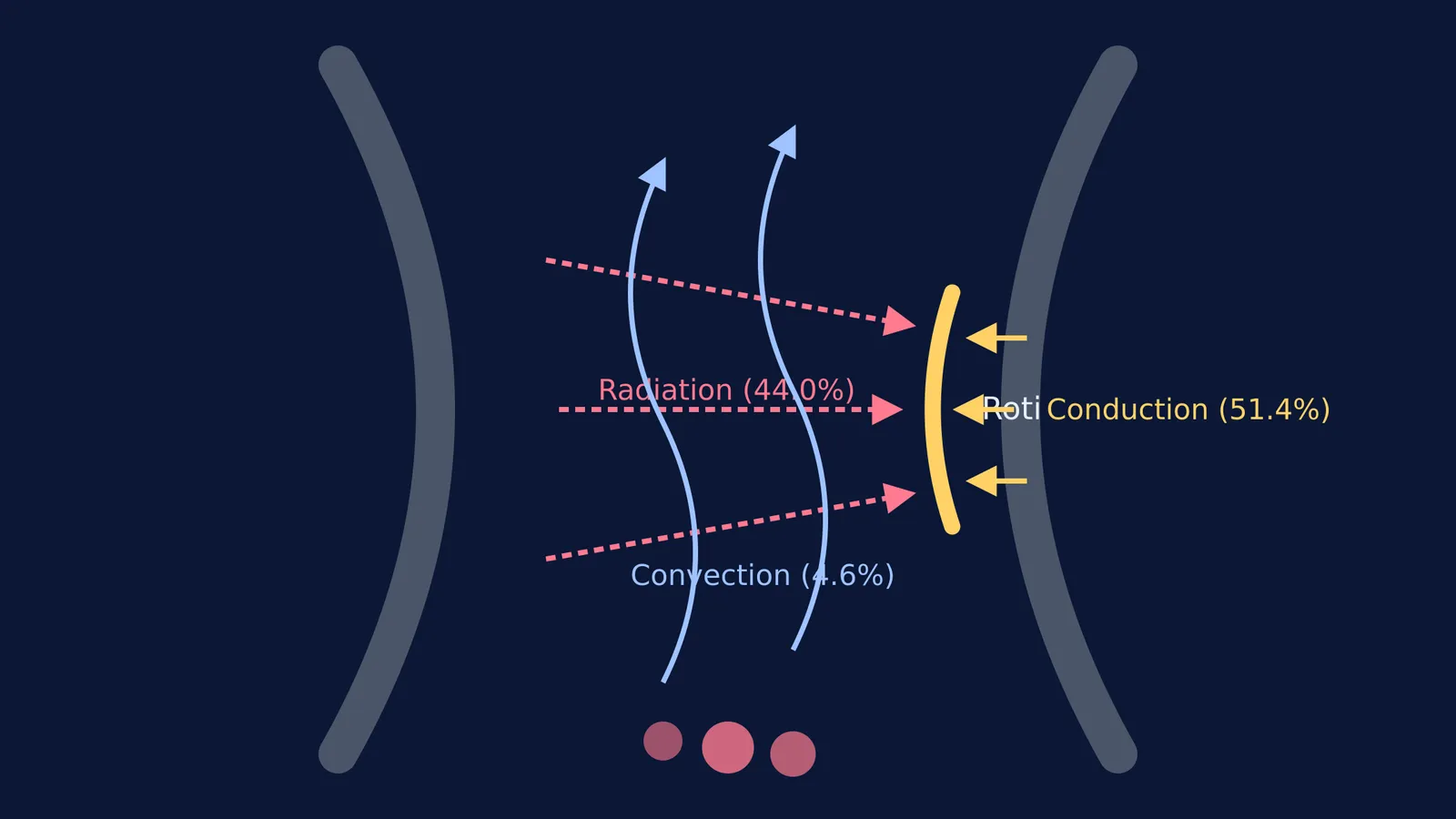
Their analysis found that the bread receives heat through conduction, radiation, and convection in very specific proportions:
Conduction (51.4%): Conduction from the clay wall provides 51.4% of the total heat. When the dough is pressed onto the clay wall, heat flows directly from the solid wall into the dough. Because the clay acts as a massive thermal reservoir, it rapidly sears the bottom of the roti. This immediate transfer of kinetic energy between the molecules of the clay and the dough creates the characteristic charred spots and seals in moisture.
Radiation (44.0%): Radiation from the curved surface supplies 44.0% of the total heat. While the bottom cooks by direct contact, the top of the roti faces the opposite walls of the tandoor and the burning coals below. These curved, superheated walls glow with infrared energy. Electromagnetic waves radiate across the air gap and strike the exposed dough. This intense radiant heat bakes the top of the bread and causes it to puff up almost instantly.
Convection (4.6%): Convection from rising hot air accounts for the remaining 4.6% of the heat. While the circulation of hot air helps maintain the overall internal temperature of the oven, convection plays a relatively minor role in the actual baking of the bread.
This dual attack—massive conduction on one side and intense radiation on the other—is why the process is so fast. The high percentage of conduction is what separates a tandoor from a standard convection oven, which relies almost entirely on circulating hot air to transfer heat. Because air is a poor conductor of heat compared to solid clay, a standard oven takes significantly longer to bake bread.
Learning heat transfer at home
Understanding heat transfer is a core part of physics and chemistry. Whether you are studying why rapid processes are adiabatic or investigating why you sweat when you exercise, the concepts of conduction, convection, and radiation apply everywhere. Master these, and you will understand everything from how engines cool to how the Earth's atmosphere circulates.
If you are a student preparing for exams like the JEE or NEET-UG, simply reading about thermal conductivity is rarely enough to master it. If you want to visualise how heat radiates and conducts across different materials, try the Fermi Simulation Lab. It allows you to run interactive models to see how energy moves, helping you build an intuition for thermodynamics without having to touch a superheated clay wall.
When you encounter a difficult numerical problem on thermal resistance or Stefan's law of radiation, you can bring it to Fermi's AI tutor. Instead of just giving you the final answer, the tutor will write on a shared board and work through the reasoning step by step, ensuring you understand the physics behind the formula. It helps you find the logic when you are stuck.
The next time you eat a tandoori roti, remember the physics at play. That perfect combination of a crisp base and a soft, puffed centre is the result of thousands of years of applied thermodynamics.