

On this page
If you pump a bicycle tyre quickly, the barrel of the pump gets hot in your hands. But if you push the same plunger down very slowly, the barrel stays at room temperature. Both actions compress the air inside, but the speed of the compression changes everything about how the gas behaves.
In thermodynamics, we classify these extreme boundary cases as adiabatic and isothermal. The difference between them often comes down to the simple factor of time, and understanding this relationship is key to solving complex thermodynamic problems. But why exactly does the speed of a process dictate its thermodynamic path?
Why are rapid processes adiabatic?
Heat is the transfer of energy between a system and its surroundings due to a temperature difference. However, this transfer is never instantaneous. Heat transfer mechanisms like conduction, convection and radiation all require time for energy to flow across a physical boundary.
When a process is carried out very rapidly—like the sudden compression in a diesel engine cylinder, or a pressurised tyre suddenly bursting—the system simply does not have enough time to exchange a significant amount of heat with its environment. Because the heat transfer (Q) is approximately zero, this rapid process is classified as adiabatic. During a rapid adiabatic compression, all the mechanical work done on the gas goes directly into increasing its internal energy, which causes its temperature to spike. During a rapid adiabatic expansion, the gas must use its own internal energy to do the work, leading to sudden cooling.
Why are slow processes isothermal?
Conversely, if a process happens very slowly, it is considered quasi-static. In this scenario, there is ample time for heat to flow into or out of the system. As you slowly compress a gas in an uninsulated container, the gas releases heat to the surroundings just fast enough to keep its own temperature from rising.
Because the change in temperature (ΔT) is zero, the slow process is isothermal. The system stays in continuous thermal equilibrium with its environment throughout the entire compression or expansion. Phase changes, like ice slowly melting in a room, are also classic examples of isothermal processes because the temperature remains constant while heat is gradually absorbed.
How did this solve the speed of sound?
This exact distinction between fast and slow processes famously resolved a major crisis in 19th-century physics.
In 1687, Sir Isaac Newton derived the first theoretical formula for the speed of sound. He assumed that the alternating compressions and rarefactions of sound waves in air happened slowly enough to be isothermal. Using this isothermal assumption, Newton calculated the speed of sound in air as 280 m/s (IIT Kanpur). However, experimental measurements at the time showed the real speed was approximately 332 m/s, leaving a glaring 16% error.
The problem lay entirely in the time scale. Over a century later, Pierre-Simon Laplace corrected Newton by arguing that sound waves vibrate so rapidly that there is no time for heat to escape the compressed layers. Laplace treated the process as adiabatic, introducing the adiabatic index (γ, which is about 1.4 for air) into the formula. This adiabatic correction yielded a calculated speed of approximately 331 m/s, matching experiments almost perfectly.
How do you identify them in exam problems?
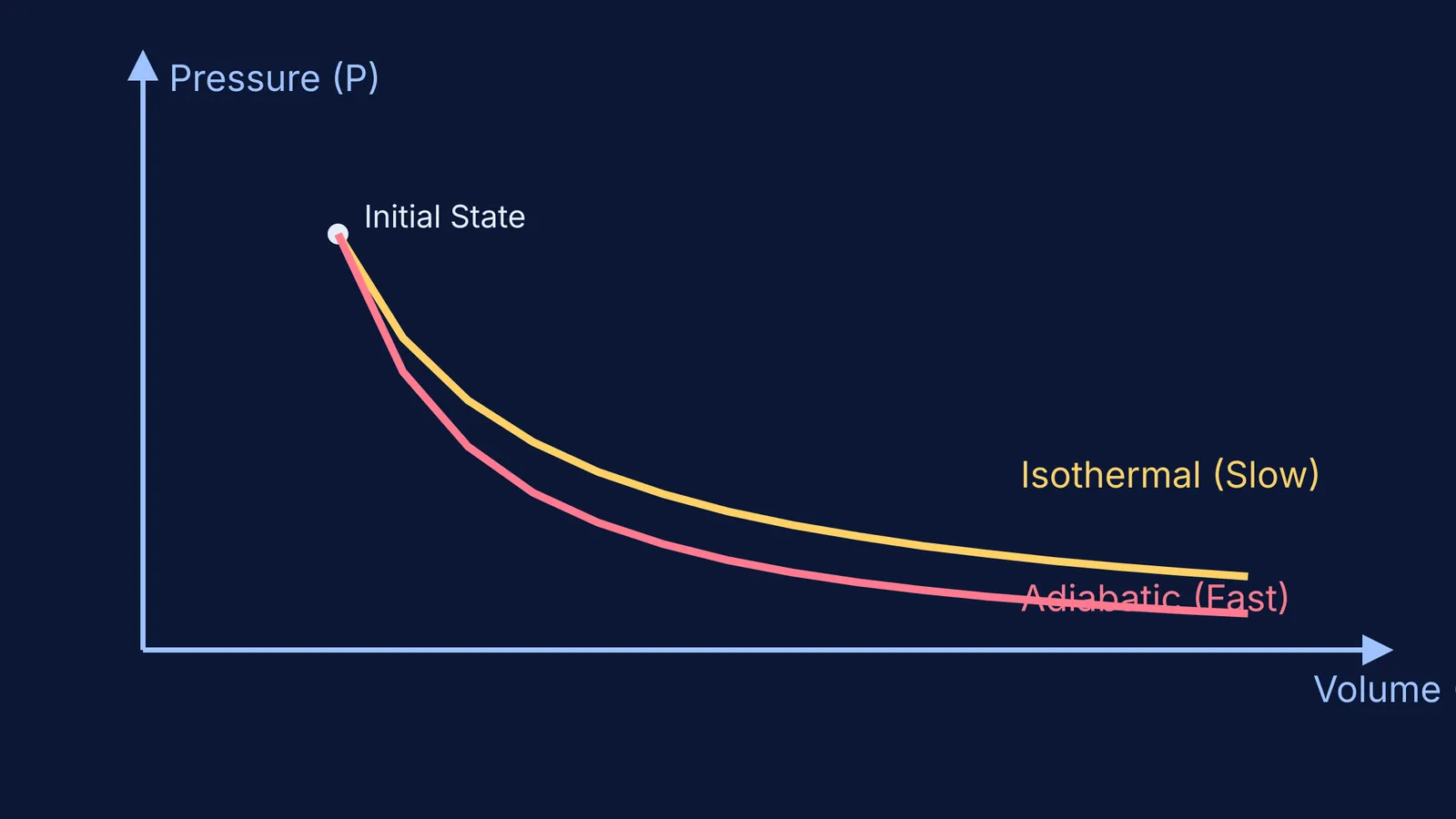
In exam problems, you will often need to trace these processes on a Pressure-Volume (PV) indicator diagram. If a gas expands from the same initial state, the adiabatic curve will always be steeper than the isothermal curve.
Mathematically, the slope of an isothermal curve (PV = constant) is −P/V. The slope of an adiabatic curve (PV^γ = constant) is −γ(P/V). Because γ is always greater than 1, the adiabatic slope is steeper by a factor of γ.
During an isothermal expansion, the gas absorbs heat from its surroundings to maintain its temperature, keeping the pressure relatively high. During an adiabatic expansion, no heat enters, causing the pressure to drop much faster as the gas cools.
If you find this abstract, the Fermi Concept Library contains every concept in physics, chemistry, biology, mathematics and computing, each with its own lesson and its place in the map. If you are stuck on why the curves differ, the AI tutor teaches — it holds a line of reasoning across a whole session, notices where a student is stuck, and decides whether to explain, ask, or show.
When reading a physics or chemistry question, look for the hidden keywords that tell you the time scale:
"Suddenly", "quickly", "bursts", "insulated" or "rapidly": Treat the process as adiabatic. Use PV^γ = constant.
"Slowly", "gradually", "uninsulated", "in a water bath" or "quasi-static": Treat the process as isothermal. Use PV = constant.
For more on how to navigate the work done during expansion, read our guide on Free expansion of an ideal gas: why work and ΔU are both zero. To learn how to move between different indicator diagrams, see Converting PV, PT and VT graphs of ideal gas processes.


