On this page
Our post on making paracetamol from phenol ends with an acetylation: p-aminophenol plus acetic anhydride gives paracetamol. The pharmacopoeia assay for pure paracetamol runs that step backwards. It boils the drug with acid to strip off the acetyl group, then titrates the p-aminophenol it gets back with cerium(IV). Two NCERT ideas meet here: amide hydrolysis, and Ce⁴⁺ as a strong oxidant. This post covers the analytical chemistry only.
Why can't you titrate paracetamol directly?
Paracetamol, HO–C₆H₄–NHCOCH₃ (M = 151.16 g/mol), has two groups you might hope to titrate.
The phenol –OH. It is a very weak acid, pKa about 9.5, so Ka is about 3 × 10⁻¹⁰. In a titration flask at about 0.02 M, C × Ka is about 6 × 10⁻¹², far below the rough 10⁻⁸ needed for a sharp end point. NaOH gives a drawn-out curve, not a clean jump.
The amide –NHCOCH₃. The nitrogen lone pair is spread onto the C=O, so the amide is neither a useful base nor a clean reducing agent.
So the assay changes the molecule into one that reacts quickly and with a fixed number of electrons. That molecule is p-aminophenol.
What does the acid hydrolysis do?
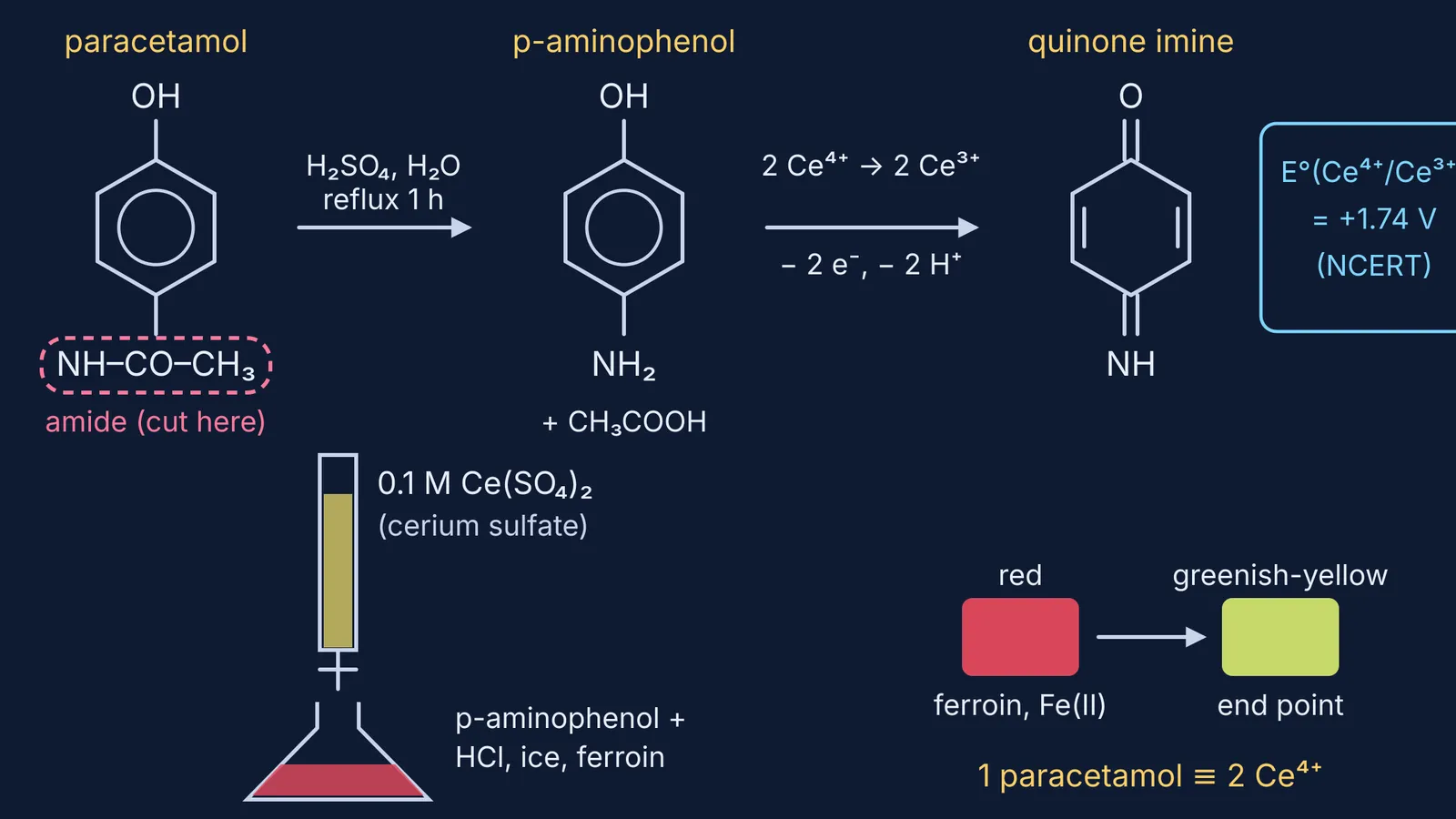
The British Pharmacopoeia monograph for paracetamol (the same text as Ph. Eur. 0049) dissolves 0.300 g in 10 mL of water and 30 mL of dilute sulphuric acid and boils it under reflux for 1 hour. This is ordinary acid hydrolysis of an amide, the reverse of the acetylation step:
HO–C₆H₄–NHCOCH₃ + H₂O + H⁺ → HO–C₆H₄–NH₃⁺ + CH₃COOH
Check it: the left side has 8 C, 12 H, 1 N, 3 O and charge +1. The right side, C₆H₈NO⁺ plus C₂H₄O₂, has the same.
The hour of reflux is not optional. Amides hydrolyse slowly, and any paracetamol left intact is not counted properly by the titration. A short boil gives a low result.
The acetic acid made here does nothing in the next step. Ce⁴⁺ does not oxidise it under these conditions, so only the p-aminophenol is counted.
How does Ce⁴⁺ oxidise p-aminophenol, and why 2 Ce⁴⁺?
After cooling, the solution is made up to 100.0 mL. A 20.0 mL portion gets 40 mL of water, 40 g of ice, 15 mL of dilute hydrochloric acid and 0.1 mL of ferroin, and is titrated with 0.1 M cerium sulphate. The ice keeps the flask cold, which slows unwanted side reactions.
p-Aminophenol loses two electrons and two protons and becomes a quinone imine, O=C₆H₄=NH:
HO–C₆H₄–NH₂ + 2Ce⁴⁺ → O=C₆H₄=NH + 2Ce³⁺ + 2H⁺
Atoms: 6 C, 7 H, 1 N, 1 O on each side. Charge: +8 on the left, 6 + 2 = +8 on the right. Each Ce⁴⁺ takes exactly one electron (Ce⁴⁺ + e⁻ → Ce³⁺), so 1 paracetamol ≡ 1 p-aminophenol ≡ 2 Ce⁴⁺. In n-factor language, the n-factor of paracetamol here is 2 and that of Ce(SO₄)₂ is 1.
Why Ce⁴⁺ wants that electron is in why Ce⁴⁺ is oxidising and Eu²⁺ is reducing: the +3 state is the stable one for every lanthanoid. NCERT quotes E°(Ce⁴⁺/Ce³⁺) = +1.74 V (other tables give about 1.72 V). In a real flask the useful number is lower, because sulphate binds Ce(IV) more strongly than Ce(III). The formal potential is about 1.44 V in 1 M H₂SO₄ and about 1.28 V in 1 M HCl, both approximate. That is still far above what p-aminophenol needs.
One naming point. The quinone imine here is not NAPQI. NAPQI is the N-acetyl quinone imine formed from paracetamol in the liver. In the assay the acetyl group has already been removed by the hydrolysis.
How does ferroin show the end point?
Ferroin is [Fe(phen)₃]²⁺, iron(II) held by three 1,10-phenanthroline ligands. It is deep red. Its oxidised form, [Fe(phen)₃]³⁺ (ferriin), is pale blue. The switch happens at about +1.1 V (approximate, it depends on the acid).
While p-aminophenol remains, it reduces anything above that potential, so the indicator stays red. One drop of Ce⁴⁺ past the equivalence point raises the potential, ferroin is oxidised, and the red disappears. The monograph describes the end point as greenish-yellow: the pale blue of ferriin mixed with the yellow of the small excess of Ce(IV). A blank titration corrects for the indicator and reagents.
Worked example: how pure is this paracetamol sample?
These are teaching numbers, following the monograph's method.
Data. 0.3000 g of paracetamol is hydrolysed and made up to 100.0 mL. A 20.0 mL portion needs 7.95 mL of 0.1000 M Ce(IV); the blank needs 0.05 mL.
Corrected titre. 7.95 − 0.05 = 7.90 mL.
Moles of Ce⁴⁺. 7.90 mL × 0.1000 M = 0.790 mmol.
Moles of paracetamol in the portion. 0.790 ÷ 2 = 0.395 mmol.
Mass in the portion. 0.395 mmol × 151.16 mg/mmol = 59.7 mg.
Mass in the whole sample. 59.7 × (100.0 ÷ 20.0) = 298.5 mg.
Purity. 298.5 ÷ 300.0 × 100 = 99.5%.
The monograph's limit for the pure substance is 99.0 to 101.0% (on the dried substance), so this sample passes.
Where 7.56 mg comes from. The monograph says 1 mL of 0.1 M cerium sulphate is equivalent to 7.56 mg of paracetamol. Derive it: 1 mL of 0.1 M Ce⁴⁺ is 0.1 mmol, which oxidises 0.1 ÷ 2 = 0.05 mmol of paracetamol, and 0.05 × 151.16 = 7.56 mg. With the factor, steps 2 to 4 shrink to one line: 7.90 × 7.56 = 59.7 mg.
This assay is for the pure drug substance. Finished tablets are now usually measured by UV absorbance or HPLC, so check the current Indian Pharmacopoeia or BP edition for the official tablet method. The same "how much drug is really there" question, answered by acid–base back titration, is the subject of our aspirin tablet assay post.
If n-factor and aliquot steps keep tripping you up, the Fermi Problem Library has a step-by-step solver that explains the reasoning at each line.
Why ceric sulphate and not KMnO₄?
Look at the flask again: it contains hydrochloric acid. Permanganate cannot be used in HCl. MnO₄⁻ (E° = +1.51 V) is strong enough to oxidise Cl⁻ to Cl₂ (E° = +1.36 V), and in practice that side reaction does happen, so the titre comes out too high. The details are in why dilute H₂SO₄ is used in KMnO₄ titrations, not HCl.
Ce(IV) gets away with it for two reasons:
Its working potential in HCl is lower. At about 1.28 V in 1 M HCl it sits below the Cl₂/Cl⁻ couple, and in a cold solution it does not oxidise chloride at a useful rate.
It is a one-electron oxidant with one product. Ce⁴⁺ goes only to Ce³⁺. Permanganate passes through Mn(VI), Mn(IV) and Mn(III) on its way to Mn²⁺, which is where side reactions with chloride get in.
Quick checklist
Boil with dilute H₂SO₄ under reflux for 1 hour first: the amide must be fully hydrolysed to p-aminophenol.
p-Aminophenol → quinone imine + 2H⁺ + 2e⁻, so 1 paracetamol ≡ 2 Ce⁴⁺.
1 mL of 0.1 M Ce(IV) ≡ 151.16 ÷ 2 ÷ 10 = 7.56 mg of paracetamol.
Ferroin: red Fe(II) to pale blue Fe(III) near 1.1 V; the end point looks greenish-yellow.
E°(Ce⁴⁺/Ce³⁺) is +1.74 V in NCERT; the working value is lower in H₂SO₄ or HCl.
Ce(IV) can be used in HCl; KMnO₄ cannot.