On this page
Play a heavy game on a phone for twenty minutes and it gets warm, then the frame rate drops. The phone has not broken. It has deliberately lowered its clock speed and its supply voltage to make less heat. The reason both are lowered, and not just the clock, comes from one line of capacitor physics: a chip's switching power grows as V²f. This post derives that formula and works out how much power a phone saves when it throttles.
Why does every logic gate use energy?
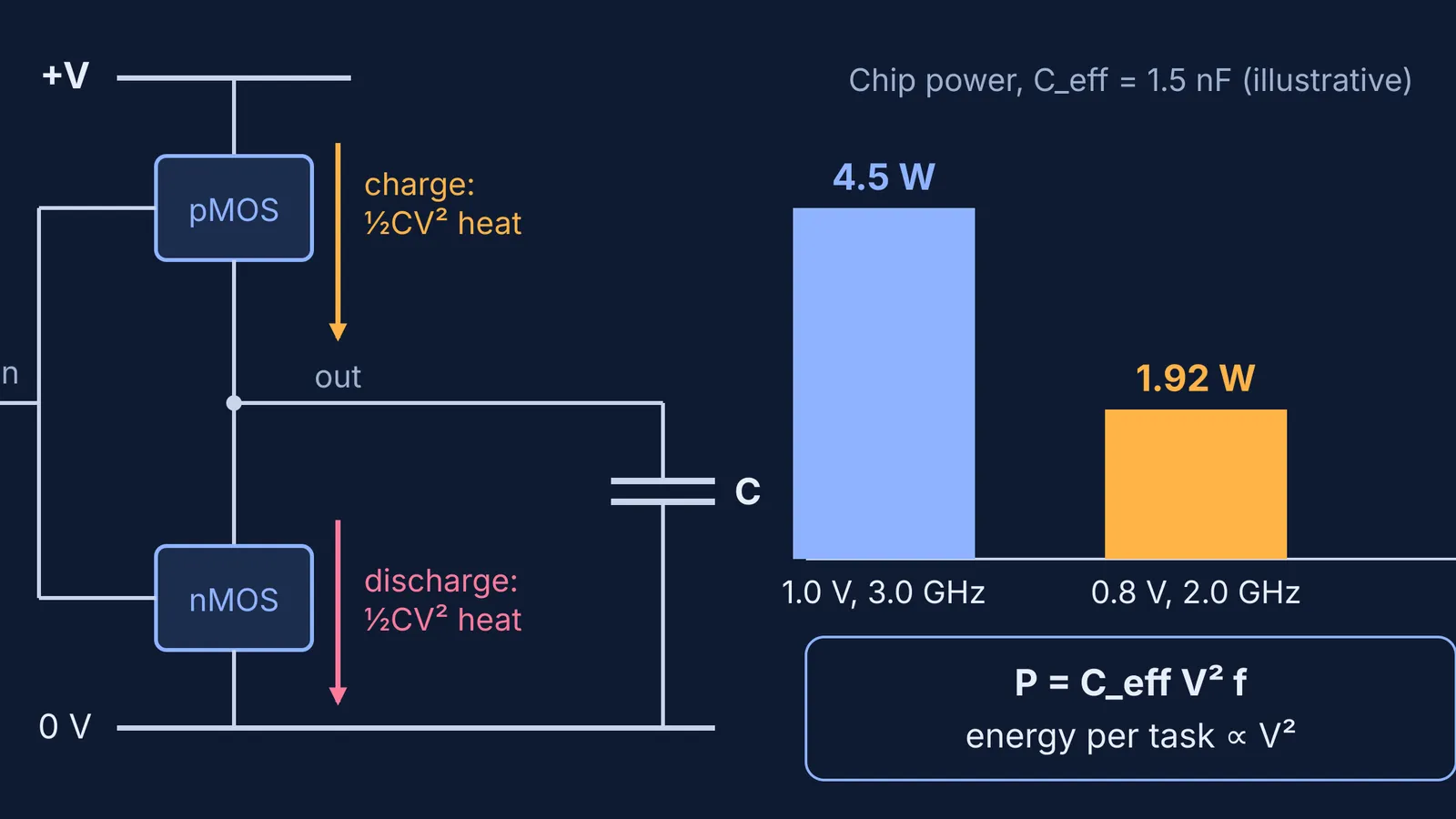
A processor is built from billions of CMOS logic gates. The output of each gate is wired to the inputs of other gates and to tiny wires, and together these behave like a small capacitor C to ground. To switch the output from 0 to 1, the gate connects that capacitor to the supply voltage V through a transistor. To switch back to 0, it connects the capacitor to ground through another transistor.
Charging a capacitor from a fixed supply V draws a charge Q = CV, so the supply delivers energy QV = CV². Only half of it, ½CV², ends up stored in the capacitor. The other half is turned into heat in the transistor and wires during charging, whatever their resistance. This is the same result as in why half the energy is lost when charging a capacitor.
When the gate switches back to 0, the stored ½CV² flows to ground through the lower transistor, and that becomes heat too. So each full charge and discharge cycle costs CV², all of it ending up as heat.
Where does P = C V² f come from?
If a capacitor goes through f cycles every second, the power is energy per cycle times cycles per second:
P = C V² f
For a whole chip, not every gate switches on every clock tick. Engineers lump the total capacitance and the fraction that switches each cycle into one number, the effective switched capacitance C_eff. So the chip's dynamic power is:
P = C_eff V² f
Check the units: farad × volt² = coulomb × volt = joule, and joule × (1/second) = watt.
Worked example: a phone chip throttling
The values below are round illustrative numbers, not the specification of any real phone chip.
One gate. Take C = 1 fF (10⁻¹⁵ F) and V = 0.8 V. Energy per cycle = CV² = 10⁻¹⁵ × 0.64 = 6.4 × 10⁻¹⁶ J, or 0.64 fJ. Tiny, but a chip has billions of gates switching billions of times a second.
Whole chip at full speed. Take C_eff = 1.5 nF, V = 1.0 V and f = 3.0 GHz. P = 1.5 × 10⁻⁹ × 1.0² × 3.0 × 10⁹ = 4.5 W.
Throttled. The phone drops to V = 0.8 V and f = 2.0 GHz. P = 1.5 × 10⁻⁹ × 0.64 × 2.0 × 10⁹ = 1.92 W.
Compare. 1.92/4.5 = 0.43. The chip now makes 43% of the heat while running at 2.0/3.0 = 67% of the speed.
Energy per task. A task that needs a fixed number of cycles N costs N × C_eff V². Only V matters, so the energy falls to 0.8² = 0.64 of what it was. For N = 3 × 10¹⁰ cycles, that is 45 J at full speed (taking 10 s) against 28.8 J throttled (taking 15 s).
Now compare a phone that lowered only the clock, keeping 1.0 V. Halving f to 1.5 GHz halves the power to 2.25 W, but the task takes twice as long, so the energy per task stays at 45 J. Lowering V is what saves energy; lowering f mostly spreads the same heat over a longer time.
Why do phones lower the voltage and the clock together?
A transistor drives current faster when its gate voltage is well above its threshold voltage. At a lower supply voltage, each gate charges its load more slowly, so the chip can no longer run at its top clock speed. The two settings are tied: every clock speed needs at least a certain voltage. So the chip keeps a table of safe voltage and frequency pairs and steps down through it when it needs less heat. This is called dynamic voltage and frequency scaling (DVFS).
The voltage cannot be lowered forever. As V approaches the threshold voltage (a few tenths of a volt in modern transistors), the gates become very slow, and the speed falls much faster than the power does. That sets a floor on how far throttling can go.
Why does a hot chip need throttling at all?
Every chip has a maximum junction temperature, the hottest the silicon itself is allowed to get. Intel, for example, states that its processors start cutting power and frequency at a limit that usually lies between 100 °C and 110 °C, depending on the model. A laptop can push heat away with a fan, as in why laptops need cooling fans. A phone has no fan, its case is in your hand, and it can only lose heat from its surface by conduction, convection and radiation. Once the heat produced exceeds what the case can shed, the temperature keeps rising, and the only control left is to make less heat with a lower V and f.
There is a second loss our model leaves out. Transistors leak a small current even when they are not switching. This leakage (static) power grows as the chip gets hotter, which is one more reason a hot chip has to cut back. P = C_eff V² f covers only the switching (dynamic) part.
Shrinking transistors, the trend described in Gordon Moore's 1965 prediction, lowered C per gate and let V fall for years. That is how chips added transistors without melting.
To see a capacitor charge through a resistor and where the energy goes, the Simulation Lab has interactive simulations that make the ½CV² split easier to see than to read.
Quick checklist
Each switching cycle of a gate costs CV²: half lost on charging, half on discharging.
Chip dynamic power: P = C_eff V² f.
C_eff includes the fraction of gates that switch each cycle.
Energy for a fixed task goes as V², not f.
Throttling lowers V and f together because lower V means slower gates.
Leakage power is separate and grows with temperature.
Check units: F × V² × Hz = W.