On this page
Measuring the thermal conductivity of a metal is easy: heat flows through a metal bar fast enough to measure. Cardboard, glass, ebonite and other poor conductors are harder. So little heat gets through them that you need a different trick, and Lee's disc method is the classic one. It is a short experiment with one easy-to-miss step. Skip that step and your answer for k comes out about 73% too high. This post explains the setup, works through a full set of illustrative readings, and shows where that factor comes from.
Why can't you use a long bar for a poor conductor?
Heat flow through a slab is H = kAΔT/d. For a metal bar (as in Searle's method) k is large, so a long, thin bar still carries a measurable heat current. For cardboard, k is a few thousand times smaller than for copper. A cardboard bar 1 cm² in cross-section and 10 cm long, with a 10 K difference across it, would carry H = 0.11 × 10⁻⁴ × 10 / 0.1 ≈ 1 mW. That is hopeless to measure.
The fix is to change the shape. Make the specimen thin (small d) and wide (large A). A disc of cardboard 2 mm thick and 11 cm across carries thousands of times more heat for the same ΔT. If you need a refresher on what k means and why its unit is W/(m K), see thermal conductivity: what k means and its SI unit.
How is Lee's disc apparatus set up?
From top to bottom:
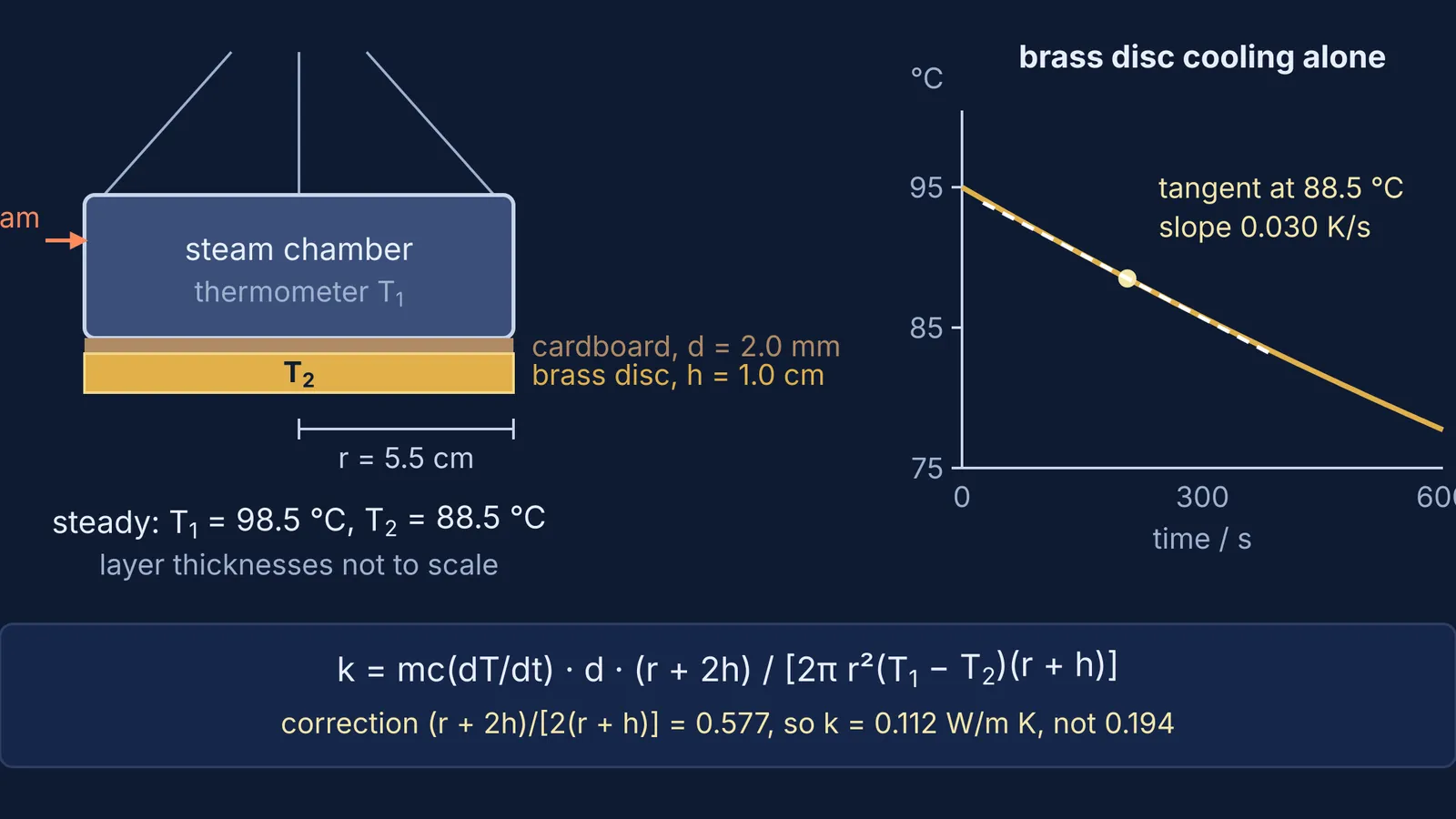
Steam chamber. A hollow metal box with steam flowing through it. Its base sits at about the steam temperature. A thermometer in it reads T₁.
Specimen. The thin cardboard disc, the same diameter as the brass disc, sandwiched between the steam chamber and the brass disc.
Brass disc. A thick brass disc with a thermometer in it reading T₂. The whole stack hangs from three threads so that the brass disc loses heat to the room by convection and radiation.
Heat flows down from the steam chamber, through the cardboard, into the brass disc. At first T₂ rises. After some time it stops changing. That is steady state: the brass disc now loses heat to the room exactly as fast as heat arrives through the cardboard.
The trouble is that nothing measures that heat flow directly. So a second step is needed.
How does the cooling curve give the heat flow?
Remove the steam chamber and the cardboard. Heat the brass disc on its own to a few degrees above T₂, hang it up again, and record its temperature every 30 s or so as it cools. Plot T against t. Then draw the tangent to the curve at T = T₂ and read its slope, dT/dt.
At T₂ the disc loses heat at the rate mc(dT/dt). This is the same Newton's law of cooling behaviour covered in Newton's law of cooling: the exact law and the average shortcut. Notice that you need the slope at T₂ itself, not an average slope over the whole curve, because the rate of cooling depends on how hot the disc is.
Why do you need the area correction factor?
Here is the step people skip. While the disc cools on its own, heat leaves from its top, bottom and curved side: an area of 2πr² + 2πrh. In the steady-state run, its top was pressed against the cardboard, so it lost heat to the room only from its bottom and side: πr² + 2πrh.
If heat loss per unit area is the same at the same temperature, the steady-state heat flow is
H = mc(dT/dt) × (πr² + 2πrh) / (2πr² + 2πrh) = mc(dT/dt) × (r + 2h) / [2(r + h)]
Putting H = kπr²(T₁ − T₂)/d and solving:
k = mc(dT/dt) · d · (r + 2h) / [2πr²(T₁ − T₂)(r + h)]
Lab manuals differ here. Some cool the brass disc with the specimen still lying on top of it, so that its exposed area matches the steady-state run, and then no correction factor is needed. Always state which procedure you used.
Worked example: cardboard with illustrative readings
These readings are illustrative, chosen to be realistic for a school lab.
Cardboard: thickness d = 2.0 mm = 2.0 × 10⁻³ m.
Brass disc: radius r = 5.5 cm = 0.055 m, thickness h = 1.0 cm = 0.010 m, mass m = 0.81 kg (brass at about 8,500 kg/m³), specific heat c = 380 J/kg K.
Steady readings: T₁ = 98.5 °C, T₂ = 88.5 °C, so T₁ − T₂ = 10.0 K.
Cooling curve: tangent slope at 88.5 °C, dT/dt = 0.030 K/s.
Heat loss rate of the bare disc at T₂. mc(dT/dt) = 0.81 × 380 × 0.030 = 9.23 W.
Specimen area. A = πr² = π × (0.055)² = 9.50 × 10⁻³ m².
Simple formula (no correction). k = H·d/(AΔT) = 9.23 × 2.0 × 10⁻³ / (9.50 × 10⁻³ × 10.0) = 0.194 W/m K.
Correction factor. (r + 2h)/[2(r + h)] = (0.055 + 0.020)/(2 × 0.065) = 0.075/0.130 = 0.577.
Corrected heat flow. H = 9.23 × 0.577 = 5.33 W.
Corrected k. k = 0.194 × 0.577 = 0.112 W/m K.
Units check. W × m / (m² × K) = W/(m K). Correct.
Skipping step 4 gives 0.194 instead of 0.112, which is 1/0.577 − 1 = 73% too high. That error depends only on r and h, not on the material: any disc with r = 5.5 cm and h = 1.0 cm gives the same 73%.
Is 0.112 W/m K sensible? Measurements on cardboard packaging materials by Čekon and colleagues (Journal of Renewable Materials, 2017) found values from 0.05 to 0.12 W/m K, depending on the structure of the board. Dense, solid board sits towards the top of that range, as here.
What else affects the result?
Thin specimen edges. A thin, wide disc loses very little heat from its own rim, which is why the method assumes all the heat goes straight through.
Air gaps. Poor contact between the discs adds a thin air layer, which has a very low k and makes the cardboard look worse than it is. Flat, clean surfaces pressed firmly together help.
Thermometer lag. Wait until T₁ and T₂ stay the same for several minutes before you take steady readings.
Safety. The steam chamber and brass disc are hot enough to scald. Handle them with tongs.
For more practice on heat conduction numericals like this, the Fermi Problem Library has a step-by-step solver that explains the reasoning. The same H = kAΔT/d run forwards, to find heat lost through a pane, is in heat lost through window glass per second.
Quick checklist
Poor conductor: thin, wide specimen, not a long bar.
Steady state: heat in through the specimen = heat lost by the brass disc.
Get that heat loss from the cooling curve's tangent at T₂.
Correct for area if the disc cooled with its top uncovered: × (r + 2h)/[2(r + h)].
k = mc(dT/dt) · d · (r + 2h) / [2πr²(T₁ − T₂)(r + h)].
d is the specimen's thickness; r and h are the brass disc's.