On this page
Water rushing down a dam's spillway arrives at the bottom very fast. If it hit the river bed like that, it would scour the bed and could undermine the dam's own foundations. So spillways end in a concrete stilling basin, where the fast, shallow sheet of water suddenly jumps up into slow, deep, churning water. This step is called a hydraulic jump, and it throws away more than half of the water's mechanical energy in a few metres. The physics is momentum conservation, the same tool you use for collisions, applied to flowing water.
What is a hydraulic jump?
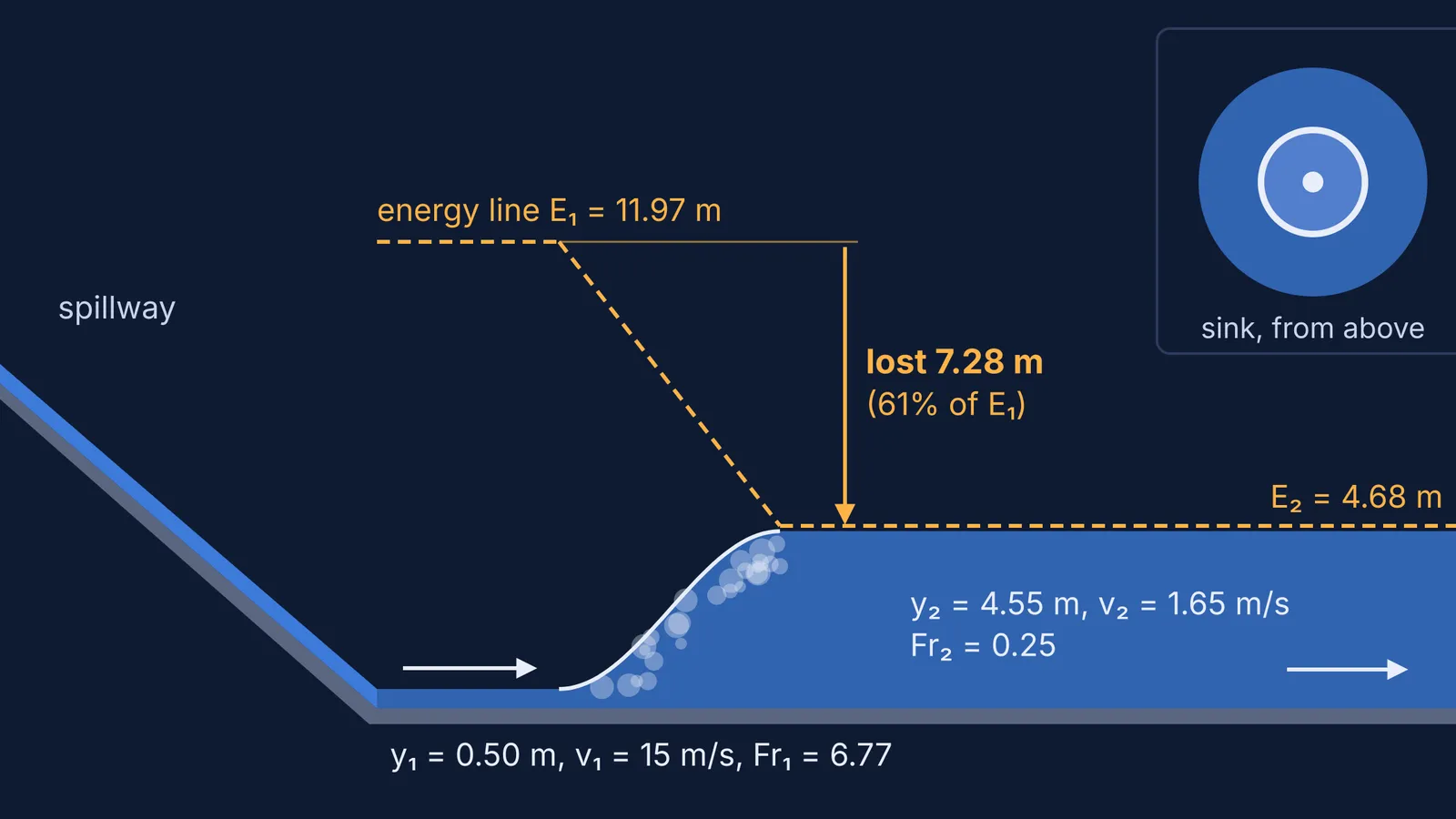
A hydraulic jump is a sudden rise in the water surface where fast, shallow flow changes to slow, deep flow. Across the jump the water tumbles over itself in a turbulent roller full of air bubbles. You do not need a dam to see one. Open a kitchen tap onto a flat sink: the water spreads out in a thin, glassy disc, and then, at a certain radius, it thickens suddenly into a ring. That ring is a circular hydraulic jump.
What does the Froude number tell you?
Small surface waves on water of depth y travel at a speed √(gy). This is the same shallow-water wave speed that makes tsunamis slow down and grow near the coast. Compare the water's own speed v with that wave speed:
Fr = v/√(gy)
Fr > 1: the flow is faster than its own surface waves (called supercritical). A disturbance cannot travel upstream.
Fr < 1: the flow is slower than its waves (subcritical). Disturbances can travel upstream.
A hydraulic jump always goes from Fr > 1 to Fr < 1. Fast water arriving from the spillway cannot "hear" the deep river ahead of it, so the change happens abruptly instead of gradually.
Note that this Froude number uses the water depth. The version used for ships, described in how William Froude used scale models to predict ship drag, uses the ship's length instead. The idea, speed compared with a wave speed, is the same.
How do you find the depth after a hydraulic jump?
Take a slice of channel 1 m wide, around the jump. Work per metre of width throughout, with q = vy the flow per metre width (m³/s per m).
Bernoulli's equation does not work here, because the turbulent roller turns mechanical energy into heat. Momentum does work. Over the short length of the jump, friction on the floor is small, so the only horizontal forces are the hydrostatic pressure forces on the two ends, ½ρgy² per metre of width. The net force equals the rate of change of momentum:
½ρgy₁² − ½ρgy₂² = ρq(v₂ − v₁)
Put v = q/y and solve. The result is the sequent depth equation:
y₂ = (y₁/2)(√(1 + 8Fr₁²) − 1)
The energy (head) lost in the jump comes out as:
ΔE = (y₂ − y₁)³/(4y₁y₂)
Here E = y + v²/2g is the specific energy, the mechanical energy per unit weight of water, measured in metres. The US Bureau of Reclamation's report on the performance of Type III stilling basins treats the depths before and after the jump, linked by this momentum relation, as basic design parameters for a basin.
Worked example: a stilling basin below a spillway
The values are illustrative round numbers, not those of any named dam. Take g = 9.81 m/s².
Water enters the basin 0.50 m deep at 15 m/s.
Flow per metre width. q = 15 × 0.50 = 7.5 m³/s per metre.
Froude number before. Fr₁ = 15 ÷ √(9.81 × 0.50) = 15 ÷ 2.215 = 6.77. Strongly supercritical.
Depth after. y₂ = (0.50/2)(√(1 + 8 × 6.77²) − 1) = 0.25 × (19.18 − 1) = 4.55 m.
Speed after. v₂ = 7.5 ÷ 4.55 = 1.65 m/s. Fr₂ = 1.65 ÷ √(9.81 × 4.55) = 0.25, now subcritical.
Energy before. E₁ = 0.50 + 15² ÷ (2 × 9.81) = 0.50 + 11.47 = 11.97 m.
Energy after. E₂ = 4.55 + 1.65² ÷ (2 × 9.81) = 4.55 + 0.14 = 4.68 m.
Head lost. ΔE = (4.55 − 0.50)³ ÷ (4 × 0.50 × 4.55) = 7.28 m, which matches E₁ − E₂. That is 7.28 ÷ 11.97 = 61% of the energy.
Power dissipated. P = ρgqΔE = 1,000 × 9.81 × 7.5 × 7.28 = 536 kW per metre of basin width.
Check momentum per unit mass flux: q v + ½gy² is 7.5 × 15 + ½ × 9.81 × 0.50² = 113.7 m³/s² before and 7.5 × 1.65 + ½ × 9.81 × 4.55² = 113.7 m³/s² after. Momentum is conserved; energy is not.
A 536 kW loss per metre is why the jump is useful. In a basin 50 m wide that would be about 27 MW turned into turbulence and finally heat, inside a concrete box built to take it. Water leaving the basin at 1.65 m/s is gentle enough for the river bed. How the same falling water makes electricity when it goes through turbines instead is covered in how a dam makes electricity, Bhakra and Tehri worked out.
Why must the jump form inside the stilling basin?
The jump sits where the momentum of the incoming flow balances the depth of water downstream, called the tailwater. If the river downstream is too shallow, the jump moves downstream and can be swept out of the basin onto the unprotected river bed. The Reclamation report above studies exactly this "sweep-out" and how much tailwater is needed to prevent it. Engineers use baffle blocks, end sills and the floor level of the basin to hold the jump in place over a range of flows. Real basin sizes come from design codes and model tests, not from this one formula.
Can you see a hydraulic jump in a kitchen sink?
Yes. Suppose a tap gives 6 L/min (10⁻⁴ m³/s), and at 2 cm from the centre the sheet of water is about 0.8 mm deep (an illustrative value). The speed is v = Q ÷ (2πry) = 10⁻⁴ ÷ (2π × 0.02 × 0.0008) ≈ 1.0 m/s, and Fr = 1.0 ÷ √(9.81 × 0.0008) ≈ 11. The sheet is supercritical, so a jump has to happen somewhere further out. In such a thin layer, viscosity and surface tension also matter, so treat these numbers as a rough guide, not a precise prediction of where the ring forms.
To practise sequent-depth and energy-loss problems step by step, try the Fermi Problem Library, a step-by-step solver that explains the reasoning.
Quick checklist
Froude number for open channels: Fr = v/√(gy), using water depth.
A jump goes from Fr > 1 (fast, shallow) to Fr < 1 (slow, deep).
Momentum is conserved across the jump; energy is not.
Sequent depth: y₂ = (y₁/2)(√(1 + 8Fr₁²) − 1).
Head lost: ΔE = (y₂ − y₁)³/(4y₁y₂); power lost = ρgqΔE per metre width.
Stilling basins hold the jump on concrete so it does not scour the river bed.