On this page
Hydroelectricity from a dam starts as water held high behind a wall. India has two well-known examples: Bhakra on the Sutlej, a concrete gravity dam, and Tehri, an earth and rockfill dam. We use their real numbers to show how falling water becomes electricity.
How does a dam produce electricity?
The US Bureau of Reclamation's Hydroelectric Power guide describes the chain. The dam creates a “head”, a height from which water flows. A pipe called a penstock carries water from the reservoir to the turbine. The moving water pushes the turbine blades, which turn the rotor of a generator, and as coils on the rotor sweep past the stationary coil of the stator, electricity is produced.
The US Department of Energy puts the rule in one line: “The greater the flow and the higher the head, the more the electricity that can be generated.” If the generator is the fuzzy part, see our explainer on how a rotating coil makes a sine-wave EMF.
What are head and flow rate in hydropower?
Head is the vertical distance the water falls, as the Bureau of Reclamation guide defines it. Flow rate (Q, or discharge) is the volume of water passing the turbine each second, in cubic metres per second; Indian operators such as THDC write this as cumecs.
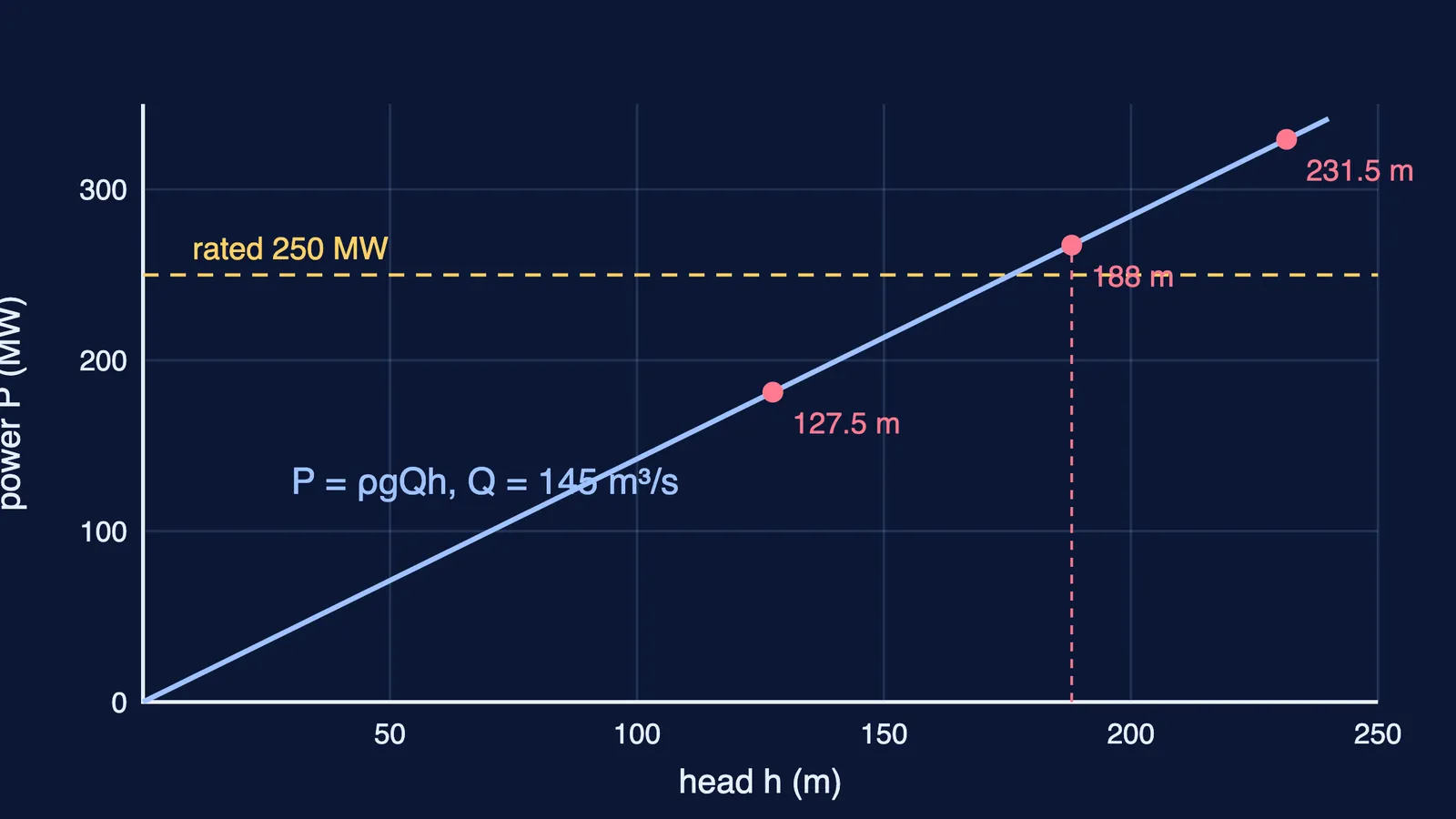
A mass m falling through height h gives up mgh. If Q cubic metres arrive each second, the mass per second is ρQ, where ρ is the density of water, 1000 kg per cubic metre. So the power available is P = ρgQh. It is the same bookkeeping as a slide, minus the friction we worked through in water slide physics.
How much power does one Tehri turbine make?
THDC India publishes the key technical features of the Tehri Hydro Power Plant: four Francis turbine units of 250 MW each, a design head of 188 m, and a rated discharge of 145 cumecs per unit. Take one unit.
Write what you know: ρ = 1000 kg/m³, g = 9.81 m/s², Q = 145 m³/s, h = 188 m.
Mass of water per second: ρQ = 145,000 kg/s.
Power: P = 1000 × 9.81 × 145 × 188 ≈ 267,400,000 W, or about 267 MW.
Compare with the rating: 250 MW ÷ 267 MW ≈ 0.93.
If the unit delivers its rating at design head and rated flow, it turns roughly 93% of the water's power into electricity. That fits the Bureau of Reclamation's statement that the efficiency of today's hydroelectric plant is about 90 percent. The rest is lost in the turbine and generator, and to friction in the water passages.
Can you estimate Bhakra's water flow the same way?
Bhakra has an installed capacity of 1,325 MW and stands 226 m high. We found no official rated head or discharge, so make a rough lower estimate. If the head were the full 226 m and efficiency 90%, Q = P ÷ (ρghη) = 1,325,000,000 ÷ (1000 × 9.81 × 226 × 0.9) ≈ 660 m³/s. The real head is less than the dam's full height, so at full output the plant needs more water than that.
Gravity dam or rock-fill dam: what is the difference?
-Gravity dam (Bhakra). A gravity dam is built of concrete or stone masonry and holds back water using only its own weight and its resistance against the foundation. Its cross-section is roughly triangular, and it generally needs stiff rock beneath it. Bhakra is a concrete gravity dam about 191 m wide at the base and 9.1 m wide at the crest.
Rock-fill dam (Tehri). An embankment dam is a compacted mound of earth or rock, and most have an impermeable core of clay, concrete or asphalt concrete to stop water seeping through. They suit wide valleys, can be built on hard rock or softer soils, and can use local material. Tehri is an earth and rockfill dam 260.5 m high.
How do you solve a dam numerical in five steps?
Board and JEE questions test the same moves.
Convert everything to SI: head in metres, flow in m³/s, power in watts.
Find mass flow first (ρQ).
Multiply by g and h for the ideal power.
Multiply by efficiency if given; the answer must come out below the ideal.
Sanity-check the size against THDC's figures: one large unit is 250 MW.
If you mix up which head or efficiency to use, the Fermi Problem Library has worked problems with a step-by-step solver that explains the reasoning rather than printing an answer. If energy conversion as a whole feels shaky, Fermi's AI tutor works out what you already know and builds a plan for the session.
To compare hydro with a fuel-burning plant, read how a gas turbine power plant runs the Brayton cycle.