

On this page
A gas turbine power plant runs on an idea from Class 11 thermodynamics: squeeze air, heat it, let it expand. The squeeze costs work, the expansion gives back more, and the difference turns a generator.
How does a gas turbine power plant work?
The US Department of Energy's explainer, How Gas Turbine Power Plants Work, splits the machine into three parts:
Compressor. It draws air in, pressurises it and feeds it to the combustion chamber.
Combustor. Fuel burns in that air at more than 2000 °F (about 1,090 °C).
Turbine. The hot gas expands through rows of blades and spins them. The blades drive the compressor and a generator at the same time.
Part of the turbine's work drives the compressor on the same shaft; only the rest reaches the generator. Gas in a typical power plant turbine can be as hot as 2300 °F, while some critical turbine metals withstand only 1500 to 1700 °F, the same DOE page says. Materials, not ideas, cap how hot the cycle can run.
What is the Brayton cycle, in Class 11 terms?
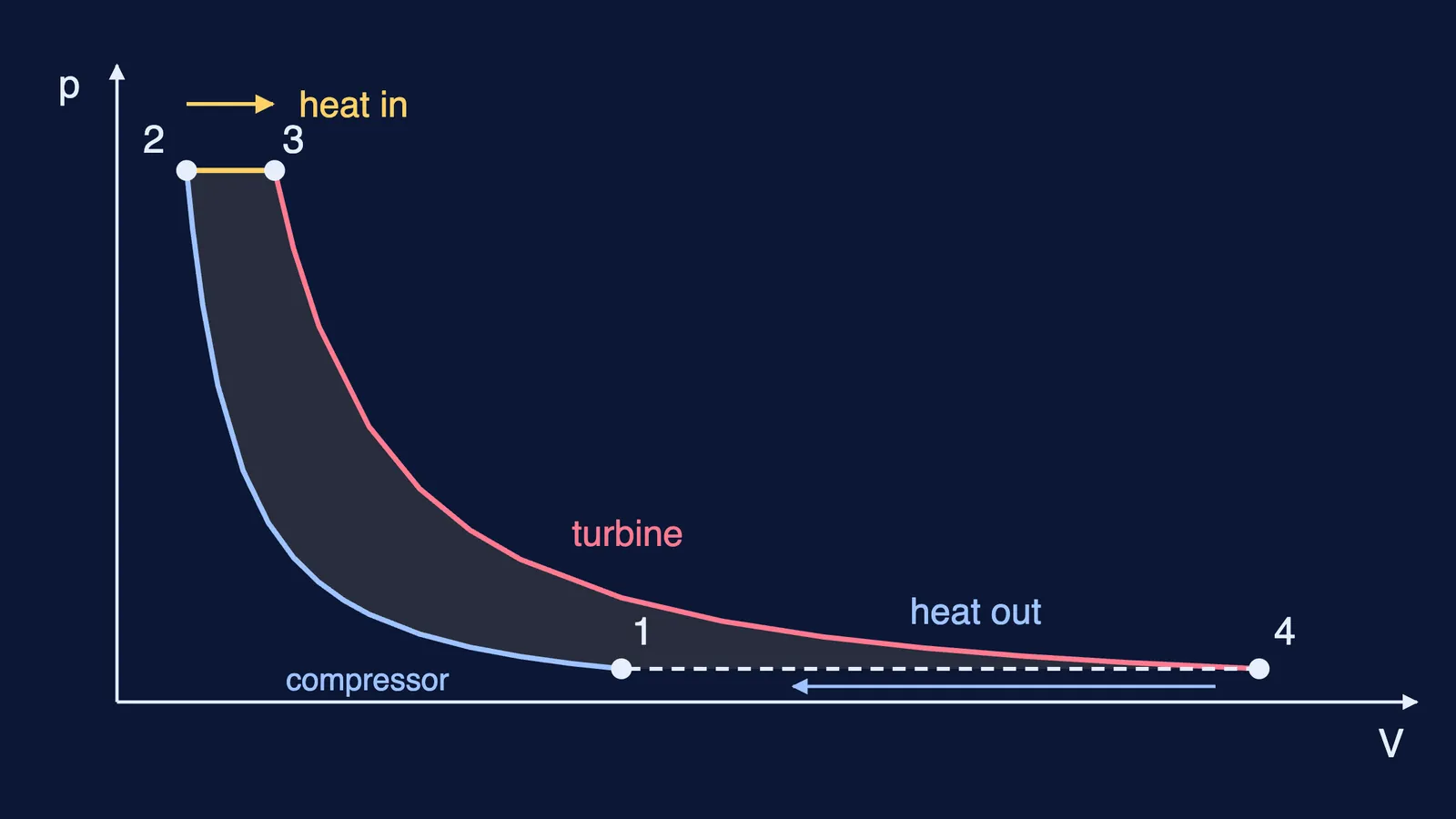
The Brayton cycle is the ideal cycle of a gas turbine: two adiabatic processes and two constant-pressure processes, as set out in MIT's 16.Unified thermodynamics notes. With the states numbered as in the diagram above:
1 to 2, adiabatic compression. Pressure and temperature rise with no heat exchanged, the reverse of why air from a burst tyre feels cold.
2 to 3, heat added at constant pressure. Fuel burns in the combustor.
3 to 4, adiabatic expansion. The gas does work on the turbine and cools.
4 to 1, heat rejected at constant pressure. A real plant swaps exhaust for fresh air; the ideal cycle treats this as cooling.
The area enclosed by the loop on a p–V diagram is the net work per cycle, the same rule you use for any cyclic process.
The ideal Brayton efficiency is η = 1 − 1/r^((γ−1)/γ), where r is the compressor pressure ratio, according to the MIT notes. For air, γ = 1.4 at standard conditions, according to NASA Glenn's page on specific heats. The fuel never appears: ideal efficiency depends only on how hard you squeeze.
Worked example: pressure ratio 16.
Exponent: (γ − 1)/γ = 0.4/1.4 ≈ 0.286.
Temperature ratio across the compressor: 16^0.286 ≈ 2.21, so air entering at 300 K leaves at about 662 K.
Efficiency: η = 1 − 1/2.21 ≈ 0.55, or 55%.
Repeat with r = 8 and you get about 45%; with r = 30, about 62%. That is why the MIT notes say the pressure ratio should be raised for high cycle efficiency.
Real machines fall well short. A simple-cycle gas turbine converts 20 to 35 percent of its fuel energy to electricity, the DOE says.
Why do combined-cycle plants reach high efficiency?
Look at state 4: the exhaust leaves the turbine still very hot, and a simple-cycle plant throws that heat away. A combined-cycle plant sends it through a heat recovery steam generator, which makes steam from the turbine exhaust heat, and that steam drives a second turbine, the DOE explainer says. The steam side runs on the Rankine cycle, covered in our post on how William Rankine's cycle makes electricity in steam plants.
Try a per-100 account. Say the gas turbine turns 35 of every 100 units of fuel energy into electricity, the top of the DOE range. Assume all of the other 65 units reach a steam cycle that converts 33% of its heat (an assumed figure). The steam side adds 0.33 × 65 ≈ 21 units, so the plant delivers about 56: 56% in this idealised case. In general, η(combined) = η(gas) + η(steam) × (1 − η(gas)).
US combined-cycle systems have an average operating heat rate of 7,146 Btu per kWh, against about 10,000 for simple-cycle systems based on 2020 averages, the US Energy Information Administration reported. (EIA's simple-cycle group also counts boilers and engines.) Heat rate is fuel in per kWh out, so lower is better; to turn it into efficiency, divide 3,412 Btu by it: about 48% for combined cycle and 34% for simple cycle. The best plants go further: in 2016 Guinness World Records confirmed 62.22% efficiency at a combined-cycle plant in Bouchain, France.
How should you revise the Brayton cycle for exams?
Try these without notes:
Draw the p–V loop and mark which two sides are adiabatic and which two are at constant pressure.
Say in one sentence why the compressor takes work and the turbine gives it.
Compute η for r = 8 and r = 16 using γ = 1.4.
Read who George Brayton was and how his cycle ended up in every jet engine for the story behind the name.
If the loop still feels abstract, the Fermi Simulation Lab has interactive simulations for ideas that are easier to see than to read. If you are unsure where thermodynamics revision should start, Fermi's AI tutor works out what you already know and builds a plan for the session.


