On this page
Most students learn the AC generator formula and still miss one question: where is the emf largest? The natural guess is "when the most field lines pass through the coil". It is the opposite, and a simulation where you turn the coil yourself shows why.
Why is emf maximum when flux is zero?
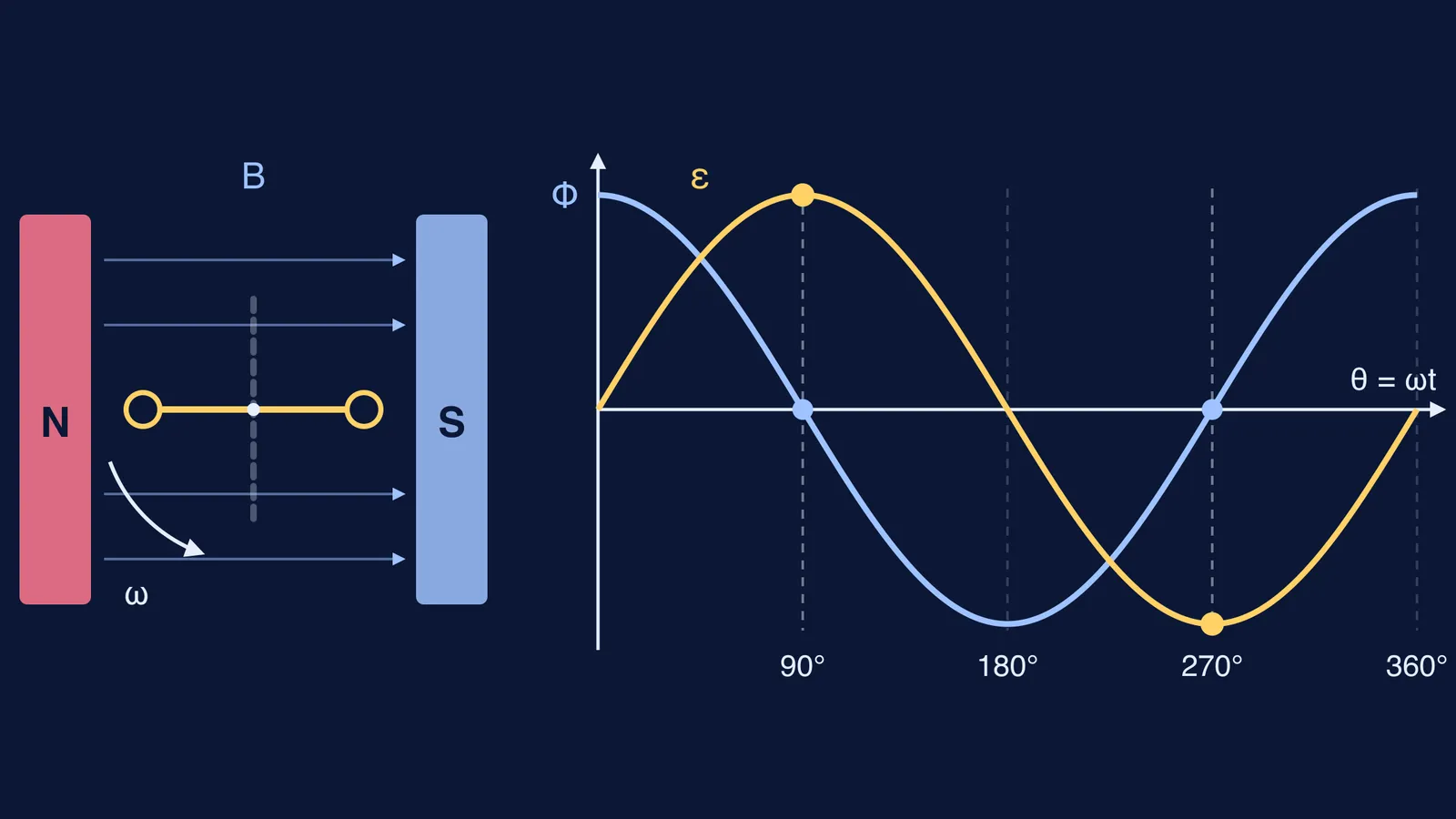
Faraday's law says the induced emf depends on how fast the flux changes, not on how much flux there is. In the NCERT Class 12 physics chapter on electromagnetic induction (Section 6.8, AC generator), the flux through a coil turning at angular speed ω is Φ = BA cos θ = BA cos ωt, where θ = ωt is the angle between the field B and the coil's area vector, taking θ = 0 at t = 0.
At θ = 0 the coil faces the field squarely, so the flux is at its largest. But the cosine curve is flat at its top, so for a moment the flux is hardly changing and the emf is zero.
At θ = 90° the plane of the coil lies along the field, so no field lines pass through it and the flux is zero. Here the cosine curve crosses zero at its steepest. The same NCERT chapter notes that the emf reaches its extreme values at θ = 90° and θ = 270°, "as the change of flux is greatest at these points".
You can also see it from the wires. At 90°, the two long sides of the coil move straight across the field lines, cutting them as fast as they can. At 0°, they move along the field lines and cut none.
To practise reading slopes, see induced emf from a flux-time graph.
How does a rotating coil give a sine wave?
Differentiate the flux and the sine appears. For a coil of N turns, NCERT derives ε = NBAω sin ωt and calls NBAω the maximum emf, ε₀ (NCERT, Eq. 6.19 and 6.20). Flux goes as a cosine, emf goes as a sine, and the two are a quarter turn apart, so every emf peak lines up with a flux zero.
Because ω = 2πν, where ν is the number of turns per second, the emf repeats once per turn of the coil. NCERT gives the frequency of rotation as 50 Hz in India and 60 Hz in certain countries such as the USA (NCERT Class 12 Physics, Chapter 6). For the full algebra, see our derivation of emf in an AC generator, step by step, and for the cos θ part, magnetic flux through a coil at an angle.
Worked example: one coil through one turn
Take N = 50 turns, A = 0.02 m² and B = 0.2 T, turning at 50 Hz. These are practice numbers, using the formulas from NCERT Section 6.8.
ω = 2π × 50 ≈ 314 rad/s.
Peak emf ε₀ = NBAω = 50 × 0.2 × 0.02 × 314 ≈ 62.8 V.
Flux through one turn at θ = 0 is BA = 0.004 Wb.
Now walk the coil round (flux per turn, emf across the coil):
θ = 0°: flux 0.004 Wb (maximum), emf 0 V.
θ = 30°: flux about 0.0035 Wb, emf 62.8 × sin 30° ≈ 31.4 V.
θ = 60°: flux 0.002 Wb, emf about 54.4 V.
θ = 90°: flux 0 Wb, emf 62.8 V (maximum).
θ = 180°: flux −0.004 Wb, emf 0 V.
θ = 270°: flux 0 Wb, emf −62.8 V.
At 50 Hz one turn takes 20 ms, so the emf goes from zero to its peak in 5 ms. Between 0° and 30° the flux drops only a little, but the emf jumps to half its peak. That is the flat top of the cosine against the steep start of the sine.
What should you try in an AC generator simulation?
Predict before you press play, then check.
Watch the moment the coil's face points straight at the poles. Predict the emf. (Zero, even though the flux is at its maximum.)
Watch the coil pass 90°. Predict where the emf graph is. (At its peak.)
Double the speed. Predict the peak emf and the number of waves per second. (Both double, because ε₀ = NBAω and ω = 2πν.)
Double the number of turns at the same speed. Predict the frequency. (Unchanged. Only the height doubles.)
Reverse the rotation. Predict the sign of the emf as the coil passes 90°. (Flipped: the sides now cut the field the other way.)
The Fermi Simulation Lab has interactive simulations for ideas that are easier to see than to read. If you get stuck on why the peaks and zeros swap, Fermi's AI tutor can run the simulation with you and check your understanding as it goes.
Try the five predictions, then explain to someone at home why the emf is largest exactly when no field lines pass through the coil.