

On this page
The AC generator derivation is one of the shortest in Class 12 electromagnetic induction, and an easy one to lose marks on. It is three lines long: write the flux, differentiate it, read off the peak. The usual slips are skipping the first line or getting the angle wrong.
What happens to the flux as the coil rotates?
Take a flat coil of N turns, each of area A, in a uniform magnetic field B. Let θ be the angle between the field and the normal to the coil (the arrow perpendicular to its face). The flux through one turn is Φ = BA cos θ, as OpenStax University Physics, section 13.6 sets out for a rotating coil.
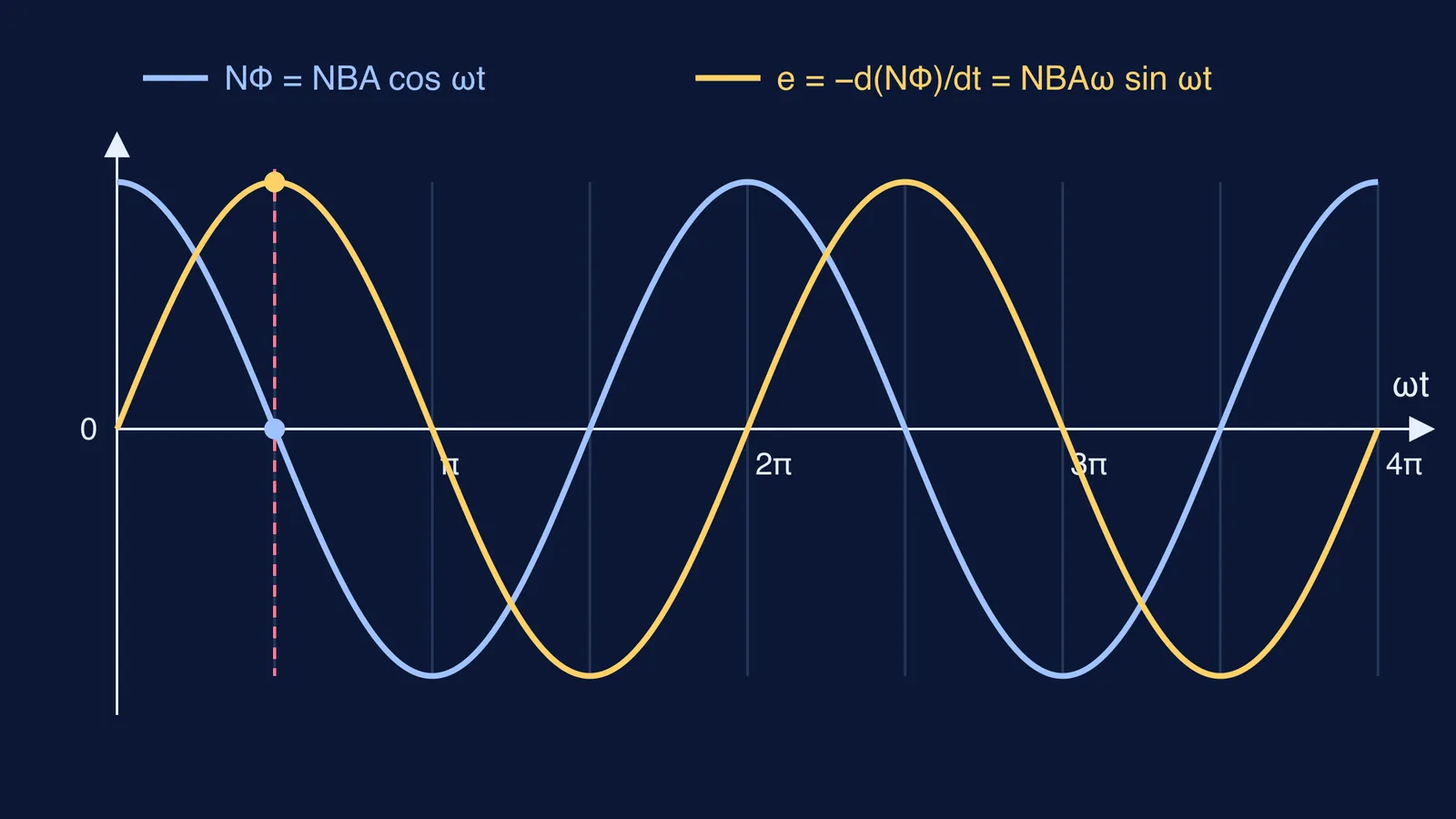
If the coil turns at a steady angular speed ω and starts with its face square to the field (θ = 0 at t = 0), then θ = ωt. Multiply by the number of turns and you have the flux linkage:
NΦ = NBA cos ωt
Write this line first in an exam; everything else follows from it.
How do you derive e = NBAω sin ωt?
Faraday's law says the induced emf equals minus the rate of change of flux linkage: e = −d(NΦ)/dt. N, B and A stay constant while the coil turns, so only the cosine changes:
Start from NΦ = NBA cos ωt.
Differentiate: d(NΦ)/dt = NBA × (−ω sin ωt) = −NBAω sin ωt.
Apply the minus sign: e = −(−NBAω sin ωt) = NBAω sin ωt.
Since sin ωt can be at most 1, the peak emf is e₀ = NBAω, so e = e₀ sin ωt.
OpenStax reaches the same result: the emf of a rotating generator coil is ε = NBAω sin ωt, with peak value ε₀ = NABω (OpenStax, section 13.6).
The minus sign is Lenz's law: the induced current opposes the change that drives it. Here is why Lenz's law follows from conservation of energy.
When is the emf maximum, and why is that surprising?
The emf peaks when sin ωt = 1, at ωt = 90°. At that moment cos ωt = 0, so the flux through the coil is zero exactly when the emf is largest. The coil's plane is parallel to the field.
Emf depends on how fast the flux is changing, not how big it is. When the coil faces the field square-on, the flux is at its largest but momentarily flat, so the emf is zero. Edge-on, the flux passes through zero and changes fastest.
Because ω appears in e₀ = NBAω, spinning the coil faster raises both the peak voltage and the frequency. See how generator rotation speed sets AC frequency.
Worked example: a coil turning at 50 Hz
India's national reference grid frequency is 50 Hz, as the Central Electricity Regulatory Commission declared in March 2017 (Powerline report on the CERC decision). Take a classroom-sized coil turning at that frequency:
N = 100 turns
A = 10 cm × 10 cm = 0.01 m²
B = 0.5 T
f = 50 Hz, so ω = 2πf = 100π ≈ 314 rad/s
Peak emf: e₀ = NBAω = 100 × 0.5 × 0.01 × 314 ≈ 157 V.
At t = 1/600 s, ωt = 100π/600 = π/6, or 30°. So e = 157 × sin 30° ≈ 78.5 V.
Now check it without calculus. Over a quarter turn (T/4 = 5 ms), the flux linkage falls from NBA = 0.5 Wb to zero. The average emf is 0.5 ÷ 0.005 = 100 V. The average of a sine over a quarter cycle is 2/π times its peak, and (2/π) × 157 ≈ 100 V. The two answers match. Note that 157 V is a peak value; here is how RMS and peak AC voltage differ.
What mistakes cost marks in this derivation?
Run through this checklist before you move on:
Did you define θ as the angle between B and the normal, and say θ = ωt?
Did you write the flux linkage NΦ = NBA cos ωt before differentiating?
Did you keep the minus sign from Faraday's law and show it cancelling the minus from differentiating cos?
Did you name e₀ = NBAω as the peak value?
Can you say in one sentence why the emf is largest when the flux is zero?
If the differentiation step trips you up, try generator problems in the Fermi Problem Library, where the step-by-step solver explains the reasoning rather than printing an answer. If the rotating picture is the hard part, the Fermi Simulation Lab has interactive simulations for ideas that are easier to see than to read.
Then cover the page and write the three lines from memory.


