

On this page
In short The frequency of alternating current from a generator depends directly on how fast it spins and how many magnetic poles it contains. For a simple two-pole generator, making 50 Hz power requires the engine to turn at exactly 3,000 revolutions per minute (RPM).
If you look inside an electrical generator, you will find a magnetic field and coils of wire. Whether the magnets spin inside the coils or the coils spin inside the magnets, the physical movement of the machine is what creates alternating current (AC). But how does the physical spinning translate into the electrical frequency we use in our homes?
How does rotation create alternating current?
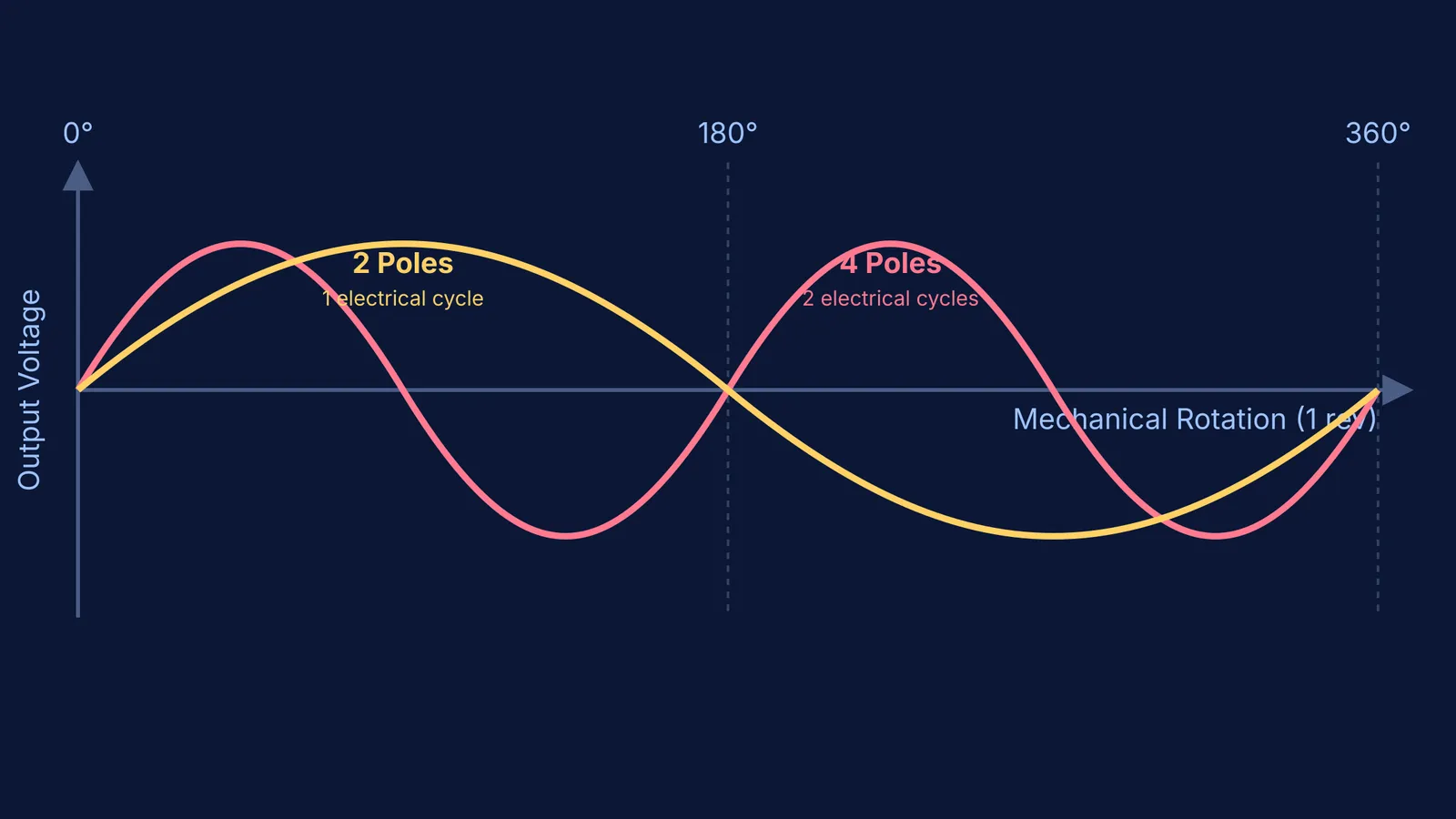
Electricity is generated when a wire moves through a magnetic field. In a basic two-pole generator, there is one North pole and one South pole. As the spinning rotor brings the North pole past a coil of wire, it pushes electrons in one direction. Half a turn later, the South pole passes the same coil, pulling the electrons in the opposite direction.
This single rotation—one push and one pull—creates one complete cycle of alternating current. If the generator spins faster, the cycles happen more often, and the electrical frequency goes up. If you build a generator with four poles (North, South, North, South) instead of two, each full physical rotation will push and pull the electrons twice, creating two electrical cycles per revolution (All About Circuits).
You can explore the fundamental physics behind this, including Faraday's law for a changing magnetic field, in the Fermi Concept Library.
What is the formula for AC frequency?
Engineers use a standard equation to link the mechanical speed of the machine to its electrical output. The formula for the frequency of a synchronous generator is f = (P × N) / 120, where f is the frequency in Hertz, P is the number of poles, and N is the rotation speed in RPM (All About Circuits).
The constant 120 in the denominator handles two conversions at once. First, it converts the speed from minutes to seconds (dividing by 60). Second, it accounts for the fact that it takes two poles to make one full wave (dividing by 2). Combining these gives 60 × 2 = 120.
Why do 50 Hz generators run at 3,000 RPM?
The power grid in India operates at a frequency of 50 Hz, while the grid in the United States runs at 60 Hz (Wikipedia). Because the power grid requires a perfectly stable frequency to keep clocks and electronics working properly, power plant generators are not allowed to speed up or slow down.
If we rearrange the frequency formula to solve for speed, we get N = (120 × f) / P (All About Circuits). For a standard two-pole generator on a 50 Hz grid, the required speed is (120 × 50) / 2, which equals 3,000 RPM. If the same generator were shipped to the US for a 60 Hz grid, its engine would have to be tuned to run at 3,600 RPM.
When you turn on a heavy appliance, it draws more current and puts a physical drag on the generator. If the engine slows down, the frequency will drop below 50 Hz. To prevent this, generators use governors that immediately add more fuel to the engine when the load increases, holding the speed strictly at 3,000 RPM.
What if a generator uses more poles?
Spinning a heavy machine at such high speeds causes significant wear and tear on bearings and moving parts. For large diesel generators or massive hydroelectric turbines, engineers prefer engines that run more slowly.
By increasing the number of magnetic poles, the generator can produce the same 50 Hz frequency at a much lower speed (All About Circuits). For example, a four-pole generator will produce two cycles per revolution, meaning it only needs to spin at 1,500 RPM to reach 50 Hz. An eight-pole generator can run comfortably at just 750 RPM. If you are solving exam questions about the magnetic moment of spinning charges, remembering this relationship between speed and poles is a quick way to check if your answers make physical sense.
When you get stuck on a textbook problem involving AC circuits or rotating machines, the Fermi Problem Library has worked problems with a step-by-step solver that explains the reasoning rather than printing an answer. If you don't know where to start, Fermi's AI tutor can work out what you already know and build a plan for the session, so you sit down to a clear next step.


