

On this page
You have a tilted coil of N turns in a uniform magnetic field. The flux through it depends on the field strength, the coil's area and the angle. The only hard part is picking the right angle.
What is the formula for magnetic flux through a coil at an angle?
For one flat loop of area A in a uniform field B, the NCERT Class 12 Physics textbook (Section 6.3) gives the flux as Φ = B · A = BA cos θ, where θ is the angle between B and the area vector A (NCERT Physics Part I, Chapter 6). The same section says the SI unit of magnetic flux is the weber (Wb), or tesla metre squared (T m²), and that flux is a scalar quantity.
In a coil, each turn has the same flux through it, so the net flux through the coil is N times the flux through one turn (OpenStax University Physics Volume 2, Section 13.1). That gives the formula this post is about:
Φ = N B A cos θ
Check whether a question wants the flux through one turn or the whole coil. NCERT's Equation 6.4 writes the emf in a closely wound coil of N turns as ε = −N dΦ/dt, with Φ the flux through each turn.
The SI Brochure defines the weber as one volt second and the tesla as one weber per square metre (BIPM SI Brochure, 9th edition, Table 4), so tesla times square metres gives webers.
Which angle is θ: the plane of the coil or the normal?
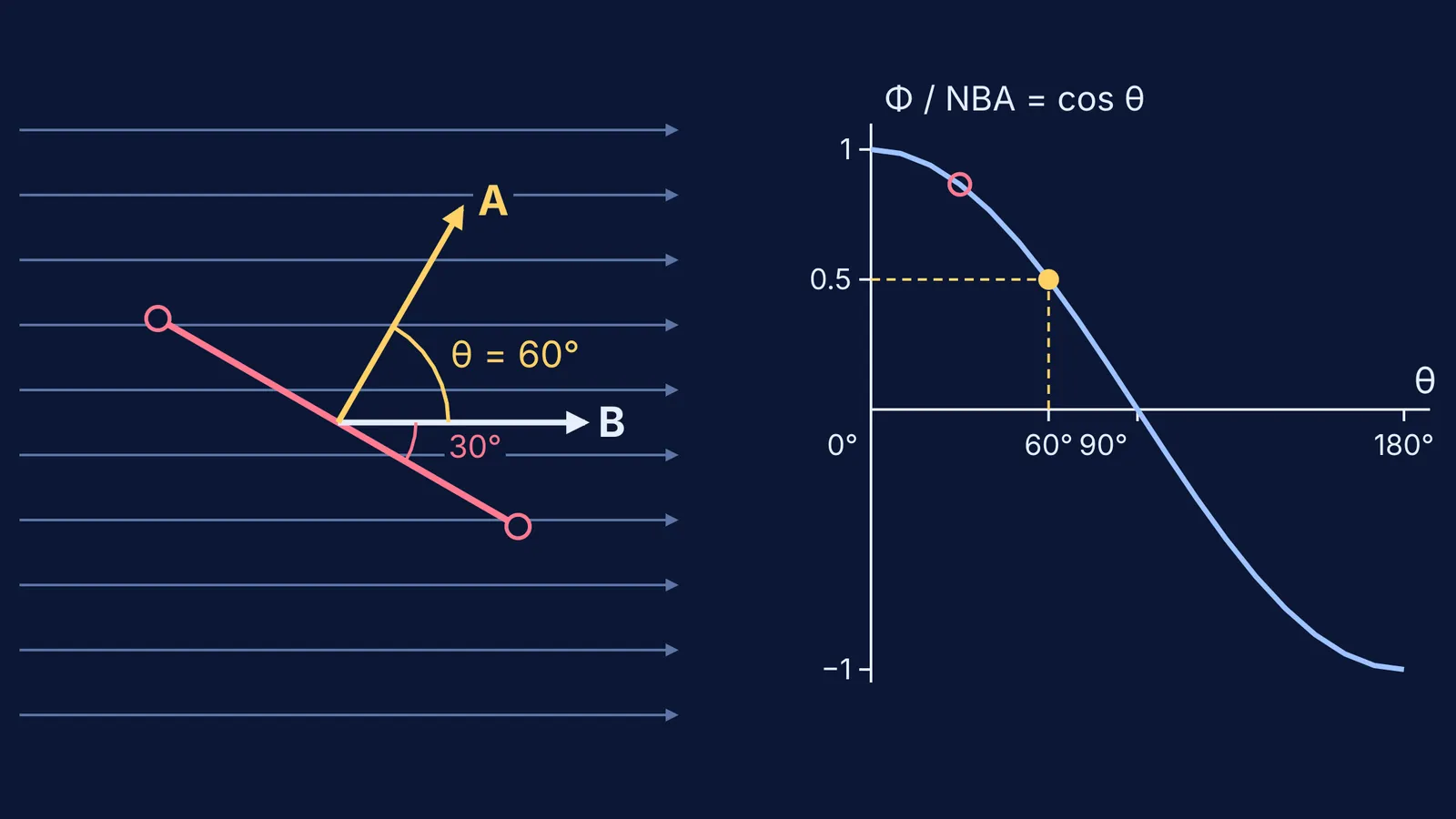
The area vector points straight out of the coil's face, at 90° to its plane. θ is measured from that normal, not from the coil's surface.
Field along the normal (coil face-on to the field): θ = 0°, cos θ = 1, and the flux is the largest it can be, NBA.
Field lying in the plane of the coil (coil edge-on): θ = 90°, cos θ = 0, and the flux is zero.
Question gives the angle α between B and the plane: θ = 90° − α, so Φ = NBA sin α.
Worked example: a 200-turn coil tilted at 30° to the field
A rectangular coil of 200 turns measures 10 cm by 5 cm. It sits in a uniform field of 0.40 T, with the plane of the coil at 30° to the field. Find the flux through the coil.
Convert the area to SI units: A = 0.10 m × 0.05 m = 5.0 × 10⁻³ m².
Find θ. The 30° is measured from the plane, so the angle with the normal is θ = 90° − 30° = 60°.
Flux through one turn: BA cos θ = 0.40 × 5.0 × 10⁻³ × 0.5 = 1.0 × 10⁻³ Wb.
Flux through the coil: Φ = 200 × 1.0 × 10⁻³ = 0.20 Wb.
The trap answer, about 0.35 Wb, comes from putting cos 30° = 0.866 straight into the formula. In NCERT's Example 6.2, the field makes 45° with a square loop's area vector, so the flux is BA cos 45°.
How does flux change as the coil rotates from 0° to 180°?
Keep the same coil and field, so NBA = 0.40 Wb, and turn the coil. The flux follows cos θ (values rounded):
θ = 0°: 0.40 Wb
θ = 30°: 0.35 Wb
θ = 45°: 0.28 Wb
θ = 60°: 0.20 Wb
θ = 90°: 0 Wb
θ = 180°: −0.40 Wb
The minus sign at 180° matters. Half a rotation reverses the flux, so the change in flux is 2NBA, not zero. NCERT's Example 6.3 does this for a 500-turn coil turned through 180°, taking the initial flux as BA cos 0° and the final flux as BA cos 180°.
We work through the emf from that half turn in average EMF in a coil rotating through half a rotation, and the charge that flows in charge flow from a change in flux, Q = ΔΦ/R. If field and flux still blur together for you, start with the difference between magnetic field and magnetic flux.
What should you check before writing the answer?
Is the area in m², not cm²? (1 cm² = 10⁻⁴ m².)
Is θ measured from the normal? If the question says "plane", use sin.
Does the question want flux per turn, or N times that for the whole coil?
Is the unit Wb (T m²)?
If the coil turned past 90°, did you keep the minus sign?
If a problem stalls at "which angle?", the Fermi Problem Library has worked problems with a step-by-step solver that explains the reasoning rather than printing an answer. If the area vector itself feels shaky, the Fermi Concept Library gives every physics concept its own lesson and its place in the map.
Next time a coil is tilted, find the normal first; after that, the formula is quick.


