

On this page
When a coil with N turns and area A rotates at a constant angular speed ω in a uniform magnetic field B, the magnetic flux Φ through it changes continuously. According to Faraday's law, this changing flux induces an alternating electromotive force (EMF). The instantaneous EMF follows a sine wave equation: ε = NBAω sin(ωt).
However, exam questions in JEE and NEET rarely ask for just the instantaneous value. They often ask for the average EMF over a specific time period. The answer depends entirely on whether you are looking at a full rotation or a half rotation.
Why is the full-turn average EMF zero?
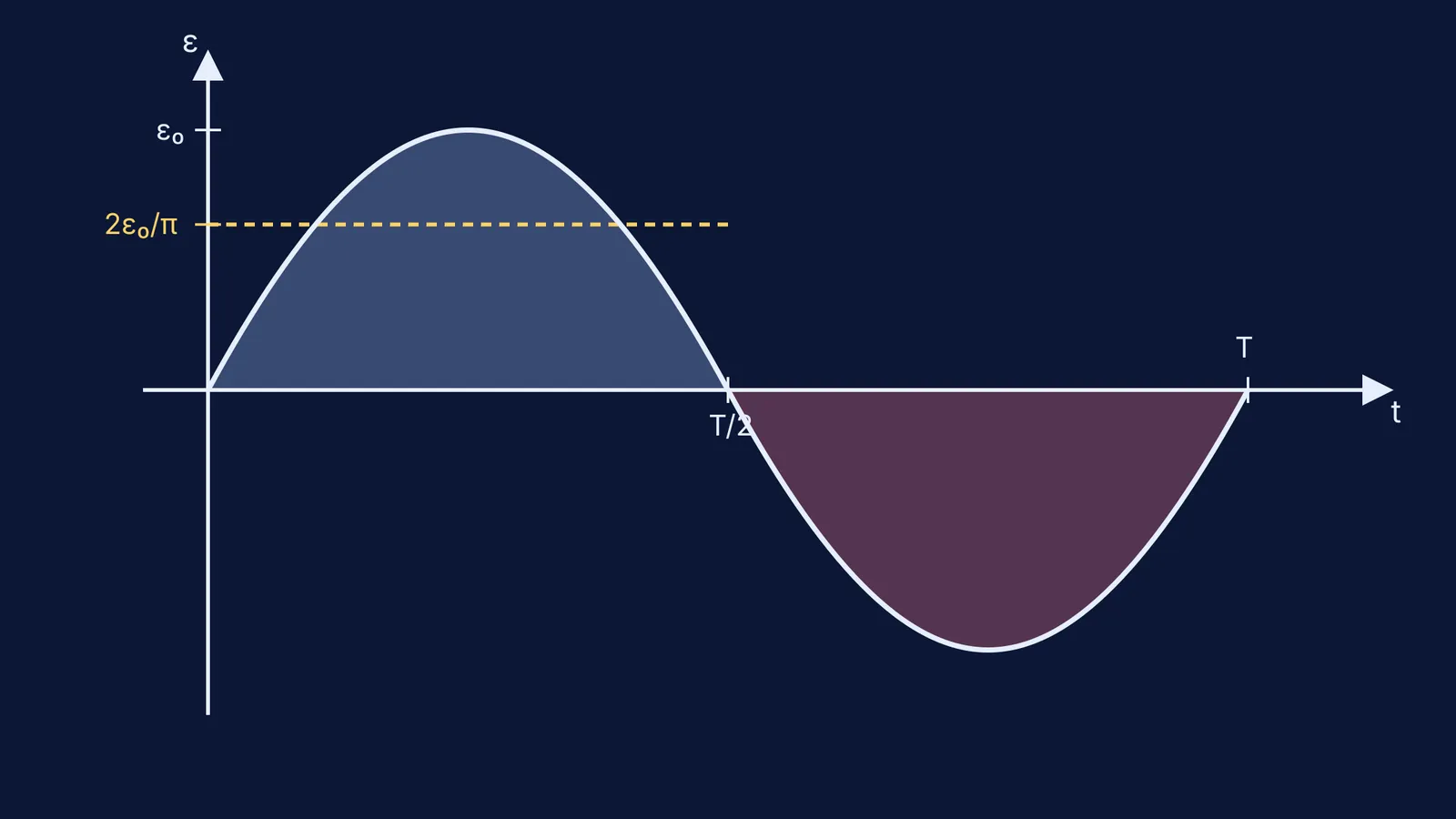
For a complete 360° turn, the coil spends half its time generating a positive EMF and the other half generating a negative EMF. Because a sine wave is perfectly symmetrical, integrating it over a full time period T always gives zero. The positive and negative areas under the curve cancel out, leaving a full-turn average of 0 V.
This complete cancellation is why electrical engineers use RMS (root-mean-square) values, rather than simple averages, to measure real-world alternating current.
How do you find the average EMF in a half rotation?
Because the full-turn average is zero, it is useless for describing the actual voltage push of the coil. Instead, we look at the average EMF over just one half-rotation (180°). This is the period from t = 0 to t = T/2, where the sine wave stays entirely positive.
The fastest way to derive this is to look at the total change in magnetic flux.
The coil starts perpendicular to the magnetic field, meaning the initial flux is at its maximum: Φ_i = NBA.
After a half rotation, the coil is perpendicular again but flipped, making the final flux Φ_f = -NBA.
The total change in flux is ΔΦ = -NBA - NBA = -2NBA.
The time taken for this half-turn is Δt = T/2. Since the period T = 2π/ω, we get Δt = π/ω.
By Faraday's law, the average induced EMF is the magnitude of the rate of change of flux: ε_avg = |ΔΦ / Δt| = 2NBA / (π/ω) = (2NBAω) / π.
Since the peak EMF is ε₀ = NBAω, the average simplifies to ε_avg = 2ε₀/π. This proves that the average EMF is roughly 0.637 times the peak value.
Worked Example: Imagine a coil spinning to produce a peak voltage of 100 V. What is the average EMF over a positive half cycle? Instead of performing the calculus from scratch, you can use the factor directly: ε_avg = 2(100) / π = 200 / 3.1415 = 63.66 V.
Where does the 2/π factor come from mathematically?
If you prefer calculus, you can find the average by integrating the EMF equation over the half-period and dividing by the time interval: ε_avg = (1 / (T/2)) × ∫ ε₀ sin(ωt) dt (from 0 to T/2)
When you evaluate the integral of sin(ωt) from 0 to π/ω, the result is 2/ω. Multiply that by ω/π (which is 1 / (T/2)) and the peak value ε₀ at the front. The ω cancels out, leaving exactly 2ε₀/π.
Using the Fermi AI tutor
If you drop a negative sign in the flux step, or mistake a half-cycle for a quarter-cycle, you might end up with the wrong average. The Fermi Problem Library has worked problems with a step-by-step solver that explains the reasoning rather than printing an answer. If you get stuck on the limits of integration or Faraday's law, Fermi's AI tutor will walk you through the math.
You can also explore the theory of alternating currents further in the Fermi Concept Library.


