

On this page
Why could engineers not simply scale up a model ship's drag?
During the mid-nineteenth century, steam navigation was transforming global trade, but naval architecture remained largely guesswork. When ships grew in size, builders had no reliable way to determine how much engine power was needed for a target speed. Early attempts to tow miniature hulls in ponds failed: if an engineer towed a model built to one-sixteenth scale and multiplied measured drag by sixteen cubed, the predicted engine power was wildly wrong, because scaling laws diverge between gravity and friction as outlined in hydrodynamic similitude principles.
The root of this error lay in fluid mechanics: water resistance consists of two distinct physical processes that obey conflicting scaling laws. A moving hull produces surface waves against gravity, and it drags a thin layer of fluid against viscosity. Wave creation depends on gravitational acceleration, while viscous shear depends on fluid viscosity and inertia. As demonstrated in Osborne Reynolds's flow experiments, matching both laws in the same fluid is impossible: a small model must move slower than the ship to match waves, but faster to match viscosity.
How did the Torquay towing tank measure hull resistance?
The solution came from English civil engineer William Froude, who graduated with first-class mathematics honours from Oriel College, Oxford, in 1832. After assisting Isambard Kingdom Brunel on the railways, Froude turned his analytical focus to ships. In December 1868, supported by Chief Constructor Sir Edward James Reed, Froude submitted a memorandum proposing systematic scale-model testing in an artificial channel.
In 1870, the British Admiralty granted £2,000 to construct the world's first official hydrodynamic testing facility at Froude's home in Torquay, as recorded in William Froude's biographical records. Completed in 1872, the Torquay tank measured 278 feet (85 metres) long, 36 feet wide, and 10 feet deep. An overhead carriage pulled by a steam engine towed paraffin wax models shaped by an automated cutting machine. A sensitive clockwork dynamometer recorded drag against time on a moving paper drum.
By towing flat planks up to 50 feet long, Froude proved that average frictional drag per square foot decreases as length increases, because water dragged along the bow reduces relative velocity further aft—anticipating Ludwig Prandtl's boundary layer theory.
How does Froude's law of comparison split friction from waves?
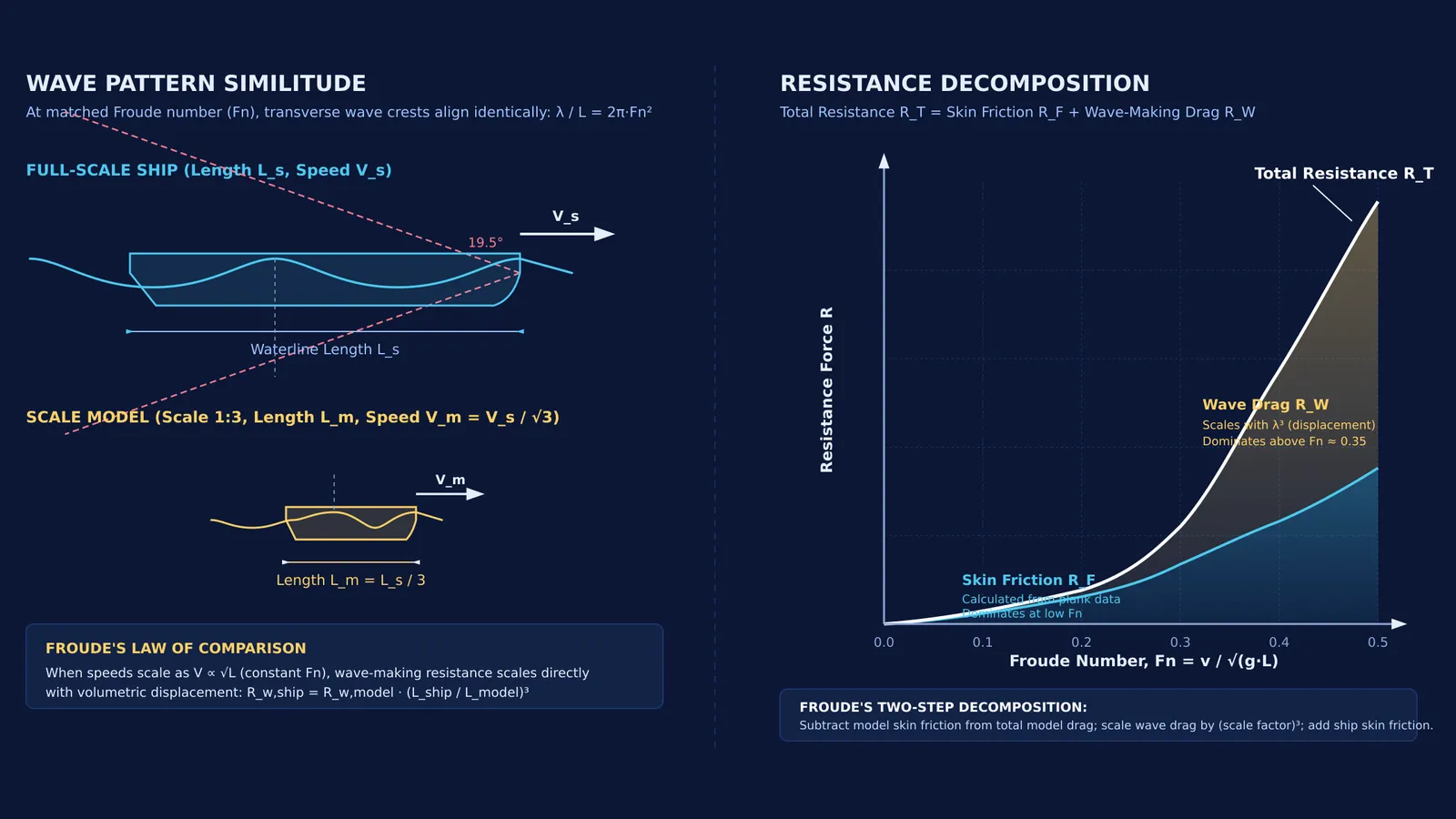
Froude showed that total hull drag splits into two additive terms: skin friction, calculated from plank data, and residuary resistance, which is dominated by gravity-driven waves, as documented in Britannica's analysis of Froude's experiments.
For wave patterns to remain geometrically similar between model and ship, wave crests must occur at identical relative positions along the hull. Because gravity waves have wavelength proportional to speed squared (λ ∝ v² / g), keeping the ratio λ / L constant requires that speed scales with the square root of waterline length. Froude stated that "corresponding speeds" require v / √(L) to stay constant. Today, this ratio forms the dimensionless Froude number, Fn = v / √(g L), named by Moritz Weber in 1919 and documented in hydrodynamic analyses of the Froude number.
At equal Froude numbers, residuary wave drag scales directly with displaced volume, proportional to the cube of the scale factor (λ³). Naval architects test the model, subtract calculated model friction, scale the remaining wave drag by λ³, and add full-scale ship friction. To visualize how wave crests evolve as speed changes, the Fermi Simulation Lab provides interactive simulations for ideas that are easier to see than to read.
What happened during the 1871 HMS Greyhound towing trials?
The Admiralty demanded full-scale proof before adopting the method. In August and September 1871, trials took place with the 160-foot, 1,160-ton wooden sloop HMS Greyhound, detailed in naval records of the Greyhound-class sloop.
The corvette HMS Active towed Greyhound across speeds from 3 knots to nearly 13 knots using a 45-foot outrigger to avoid propeller wash. A dynamometer on Greyhound recorded towing pull. When Froude compared the measured resistance against predictions from his one-sixteenth scale (10-foot) wax model, the results agreed within 10%. His 1874 paper to the Institution of Naval Architects proved the reliability of towing tanks.
How do you calculate corresponding speed using the Froude number?
Following dimensional similitude standards, Froude scaling connects model tests to full hulls through unit conversions and dimensional analysis. Suppose an engineering team designs a 64-metre patrol vessel with a cruise speed of 8 metres per second (about 15.5 knots), using a 1:16 scale model with a waterline length of 4 metres.
Find the scale ratio: λ = 64 / 4 = 16.
Find corresponding model speed: v_model = v_ship / √(λ) = 8 / √(16) = 2 metres per second.
Check the Froude number:
Ship: Fn = 8 / √(9.81 × 64) ≈ 0.319.
Model: Fn = 2 / √(9.81 × 4) ≈ 0.319.
Scale residuary drag: If the model's measured residuary drag in freshwater is 15 newtons, the ship's residuary drag in seawater (density ratio 1.025) is: R_r,ship = 15 × (16)³ × 1.025 ≈ 63,000 newtons (63 kilonewtons).
Adding separately computed full-scale friction gives total hull drag. When students encounter dynamic similitude in competitive physics, setting up scaling ratios can feel counter-intuitive. The Fermi Problem Library includes worked problems with a step-by-step solver that explains the reasoning rather than printing an answer.


