On this page
In Class 12 you learn diazotisation as the first step of a synthesis: aniline, sodium nitrite and HCl in the cold give a diazonium salt, which you then turn into a phenol, a halide or an azo dye. Pharmacopoeias use the same reaction for a different job. Because one primary aromatic amine group uses exactly one nitrite ion, and fast, a sulpha drug can be titrated with standard sodium nitrite.
What is a sodium nitrite (diazotisation) titration?
It is a titration in which the analyte is a primary aromatic amine, ArNH₂, and the titrant is a standard solution of sodium nitrite in excess hydrochloric acid. In the flask, nitrite becomes nitrous acid and diazotises the amine:
ArNH₂ + NaNO₂ + 2HCl → ArN₂⁺Cl⁻ + NaCl + 2H₂O
Atoms and charge balance. The ratio that matters is 1 ArNH₂ : 1 NaNO₂.
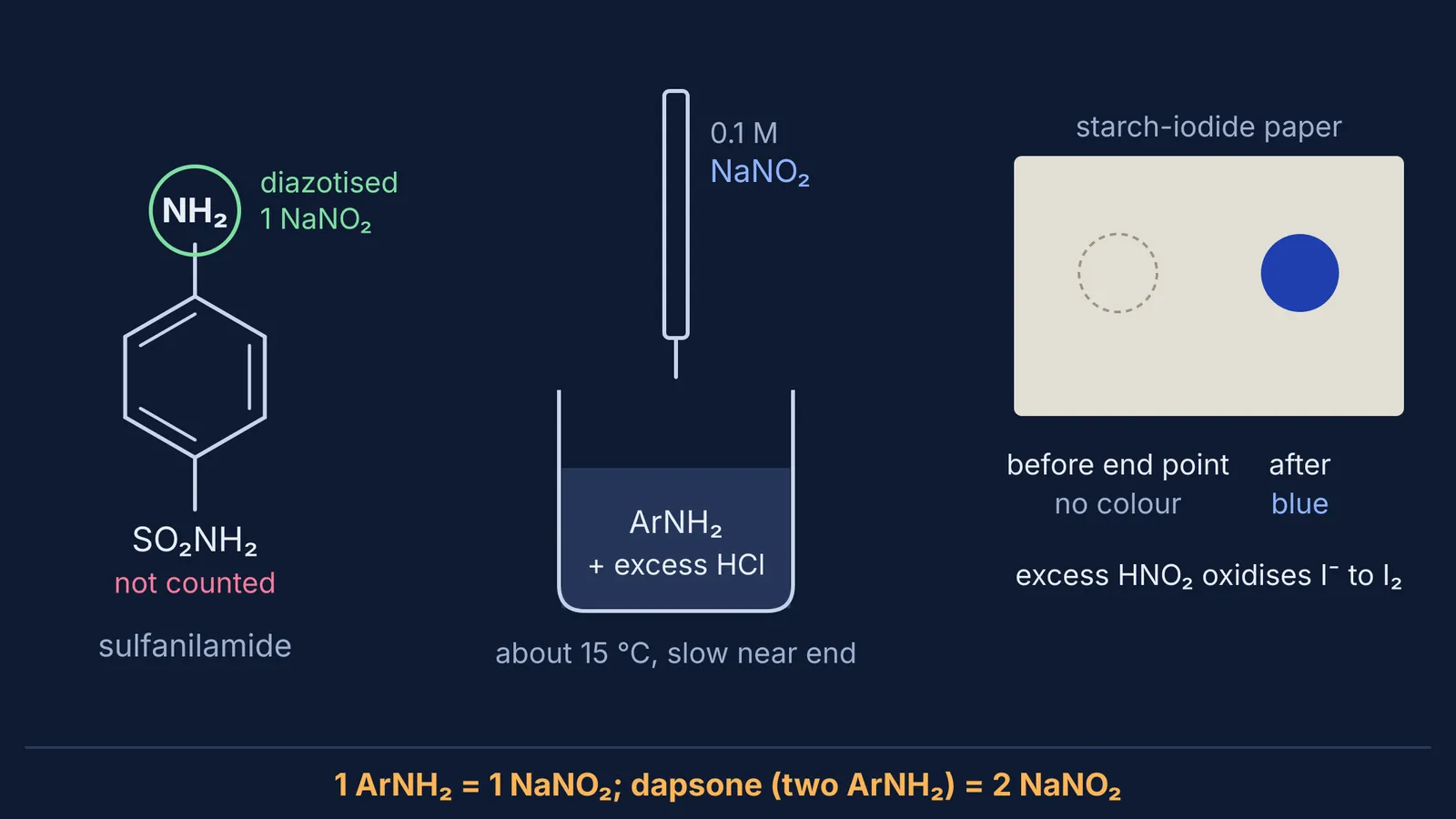
The United States Pharmacopeia describes the general method in its chapter on nitrite titration (USP 35, chapter 451): about 500 mg of a sulfonamide is dissolved in 20 mL of hydrochloric acid and 50 mL of water, cooled to about 15 °C and titrated slowly with 0.1 M sodium nitrite. The nitrite itself is standardised against a sulfanilamide reference standard. Its sulfamethoxazole monograph uses this method and states that each mL of 0.1 M sodium nitrite is equivalent to 25.33 mg of sulfamethoxazole (USP 35, sulfamethoxazole). Some pharmacopoeias now assay tablets by HPLC instead, but the nitrite titration is still the classic method for the pure drug substance.
Why does only the aromatic –NH₂ group count?
A sulpha drug has two kinds of nitrogen, and only one reacts.
The aromatic –NH₂ (the "N4" amine). A primary amine on a benzene ring forms a diazonium ion that is stable for the minutes a titration takes, because the positive charge is spread into the ring. This group uses one nitrite.
The sulphonamide nitrogen, –SO₂NH– or –SO₂NH₂. Its lone pair is pulled towards the strongly electron-withdrawing SO₂ group, so it is not diazotised under these conditions. It does not count.
Sulfanilamide, H₂N–C₆H₄–SO₂NH₂ (172.20 g/mol), and sulfamethoxazole (253.28 g/mol) each have one aromatic amine, so both titrate 1 : 1. That is why the sulfamethoxazole factor is 253.28 / 10 = 25.33 mg per mL of 0.1 M nitrite.
Other amines are not "free" to use with this ratio. Aliphatic primary amines also react with nitrous acid, but their diazonium ions lose N₂ at once and give a mixture of products. Secondary amines form N-nitroso compounds and also take up nitrite. The method works because the monograph applies it to a known, pure compound. An amide such as paracetamol does not react at all until it has been hydrolysed to p-aminophenol, which is why paracetamol is assayed by a different route.
For the background on why aromatic diazonium salts survive, see why diazotisation needs 0 to 5 °C. Note the difference: a synthesis keeps the diazonium salt for a while, so it is kept at 0 to 5 °C. A titration only needs it to last until the end point, and the USP method runs at about 15 °C, where the reaction is faster.
Why is so much hydrochloric acid used?
The equation needs 2 HCl per amine, but the method uses a large excess, for two reasons:
To make nitrous acid. NO₂⁻ + H⁺ → HNO₂, and in strong acid this gives the nitrosating species, written as the nitrosonium ion NO⁺, that attacks the amine.
To stop side reactions. A diazonium ion can couple with an unreacted amine to give a diazoamino compound, which would use up product and spoil the 1 : 1 ratio. In strong acid most of the free amine is protonated as ArNH₃⁺, which does not couple.
The reaction slows near the end. The USP tells the analyst to add 0.1 mL at a time near the end point, with at least one minute between additions, and to keep the burette tip below the surface so nitrous acid is not lost to the air. Some versions of the method add potassium bromide as a catalyst to speed it up.
How is the end point detected with starch-iodide paper?
While amine remains, every drop of nitrite is used up. The first lasting excess of nitrous acid marks the end point. The classic way to see it is an external indicator: touch a glass rod to the solution and spot it on starch-iodide paper. Nitrous acid oxidises iodide to iodine, and the iodine turns the starch blue:
2HNO₂ + 2I⁻ + 2H⁺ → I₂ + 2NO + 2H₂O
This is the same reaction as the starch-iodide test for nitrite in salt analysis, used here to find an end point instead of to identify an ion. A blue spot that appears straight away, and still appears a minute after the last addition, means excess nitrous acid. Modern methods, including the USP chapter, detect the same excess electrically with platinum electrodes.
The Griess test, named after the discoverer of diazonium salts, runs the idea the other way: it measures small amounts of nitrite by diazotising a known amine and coupling it to form a coloured azo dye.
Worked example: standardise the nitrite, then assay two drugs
Question. (a) 0.5000 g of dried sulfanilamide (172.20 g/mol) needs 28.85 mL of sodium nitrite. Find its molarity. (b) 0.5000 g of sulfamethoxazole (253.28 g/mol) needs 19.60 mL of the same nitrite. Find the purity. (c) 0.2500 g of dapsone (248.30 g/mol), which has two aromatic –NH₂ groups, needs 19.95 mL. Find the purity.
(a) Standardisation.
Moles of sulfanilamide: 500.0 mg / 172.20 = 2.904 mmol.
One –NH₂, so 2.904 mmol of nitrite.
Molarity: 2.904 / 28.85 = 0.1006 M.
Some pharmacopoeias and older textbooks standardise against dried sulphanilic acid instead, which has one aromatic amine and works the same way; see why sulphanilic acid forms a zwitterion.
(b) Sulfamethoxazole.
Nitrite used: 19.60 × 0.1006 = 1.972 mmol.
One aromatic amine, so 1.972 mmol of drug.
Mass: 1.972 × 253.28 = 499.4 mg.
Purity: 499.4 / 500.0 × 100 = 99.9%.
(c) Dapsone.
Nitrite used: 19.95 × 0.1006 = 2.007 mmol.
Two aromatic amines, both diazotised, so 1 dapsone uses 2 nitrite: 2.007 / 2 = 1.003 mmol.
Mass: 1.003 × 248.30 = 249.2 mg, which is 99.7% of 250.0 mg.
The factor is 248.30 / 2 / 10 = 12.42 mg per mL of 0.1 M nitrite. If you forgot to divide by 2 you would get 199%, an impossible answer that should make you recount the amines.
The Fermi Problem Library has more titration problems of this kind, with a step-by-step solver that explains the reasoning behind each ratio.
Quick checklist
ArNH₂ + NaNO₂ + 2HCl → ArN₂⁺Cl⁻ + NaCl + 2H₂O: 1 aromatic amine = 1 nitrite.
Excess HCl makes HNO₂ and keeps free amine protonated so it cannot couple.
The titration runs cold (USP: about 15 °C) and slowly near the end point.
End point = first lasting excess of HNO₂: starch-iodide paper turns blue, or an electrode signal.
Standardise the nitrite against a pure primary aromatic amine such as sulfanilamide.
Count amines: dapsone takes 2 nitrite, the sulphonamide nitrogen takes none.