

On this page
In systematic qualitative salt analysis, anions are sorted into groups based on their acid volatility. According to the NCERT Laboratory Manual for Chemistry (Class XI), the nitrite ion (NO₂⁻) belongs to the dilute acid group. Adding 1 to 2 mL of dilute sulphuric acid to a solid nitrite salt protonates nitrite into unstable nitrous acid:
NO₂⁻ + H⁺ → HNO₂
Nitrous acid decomposes via disproportionation reactions into nitric acid, water, and colourless nitric oxide gas:
3 HNO₂ → HNO₃ + 2 NO + H₂O
At the test tube mouth, nitric oxide meets atmospheric oxygen and oxidises into brown nitrogen dioxide:
2 NO + O₂ → 2 NO₂
How does the starch-iodide test confirm nitrite ions?
Because other anions can also release brown fumes under forcing conditions, qualitative analysis requires a selective confirmatory test. The starch-iodide test confirms nitrite by exploiting its moderate oxidising potential in weakly acidic solution. Adding potassium iodide and starch paste to an aqueous nitrite extract acidified with dilute acetic acid yields an immediate deep blue colour.
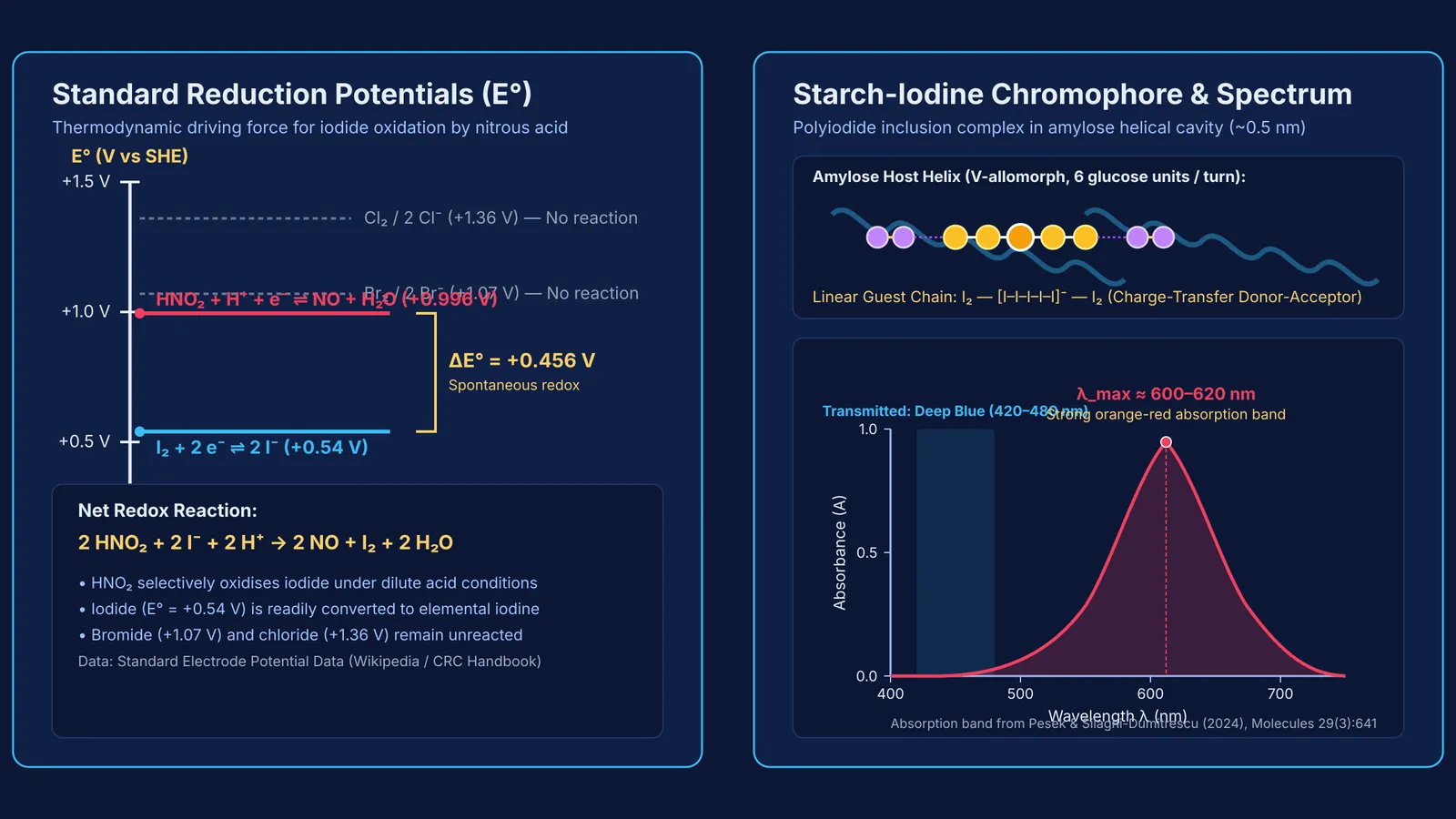
Under standard conditions at 298 K, the nitrous acid reduction couple has E° = +0.996 V (Wikipedia Standard Electrode Potential Data Page)):
HNO₂ + H⁺ + e⁻ → NO + H₂O
The reduction of elemental iodine to iodide has a standard potential of E° = +0.54 V:
I₂ + 2 e⁻ → 2 I⁻
Because the reduction potential of nitrous acid exceeds that of iodine by ΔE° = +0.456 V, iodide oxidation is spontaneous:
2 HNO₂ + 2 I⁻ + 2 H⁺ → 2 NO + I₂ + 2 H₂O
Students predicting redox reactions from standard reduction potentials can note that while nitrous acid oxidises iodide (E° = +0.54 V), it cannot oxidise bromide (E° = +1.07 V) or chloride (E° = +1.36 V). When balancing multi-step redox reactions or predicting spontaneous electron transfers, the Fermi Problem Library provides worked problems with a step-by-step solver that explains the reasoning rather than printing an answer.
The liberated iodine coordinates with excess iodide to form polyiodides inside the helical core of starch. In *Molecules*, Szilard Pesek and Radu Silaghi-Dumitrescu (2024) documented that amylose forms a left-handed helix with 6 glucose units per turn and a central channel measuring approximately 0.5 nm in diameter. Repeating linear polyiodide units, particularly I₂–I₅⁻–I₂ arrangements, align inside this cavity. Charge-transfer transitions produce a strong absorption band peaking between 600 nm and 620 nm in the orange-red spectrum, leaving complementary deep-blue light transmitted to the eye.
How do you distinguish nitrite from nitrate in the laboratory?
Differentiating nitrite (NO₂⁻) from nitrate (NO₃⁻) is a standard challenge in practical salt analysis. Both share common elements, but nitrogen sits in the +3 oxidation state in nitrite versus +5 in nitrate, resulting in distinct resonance structures of oxyanions and different reaction kinetics.
Three practical benchmarks separate the two ions:
Acid reactivity: Nitrite decomposes with dilute sulphuric acid in the cold without heating. Nitrate remains inert to dilute acid, requiring concentrated sulphuric acid with copper turnings and heat to evolve brown gas.
Starch-iodide oxidation: Nitrite liberates iodine from acidified potassium iodide at room temperature within seconds. Nitrate produces no colour change because its reduction has a high kinetic barrier in dilute acid.
Brown ring test conditions: Nitrite forms the brown complex [Fe(H₂O)₅(NO)]²⁺ in dilute acid throughout the bulk liquid. In contrast, nitrate forms its brown ring only at the liquid interface when concentrated sulphuric acid is layered below.
To connect qualitative spot tests with inorganic reaction trends across the periodic table, the Fermi Concept Library covers every concept in chemistry, each with its own lesson and its place in the map.
What is the laboratory procedure and viva checklist for nitrite?
To perform the test reliably according to the NCERT Laboratory Manual for Chemistry (Class XI), follow this three-step bench protocol:
Preliminary dilute acid test: Place 50 mg of solid salt in a test tube and add 1 mL of dilute sulphuric acid. Observe whether colourless effervescence appears and turns reddish-brown at the tube mouth.
Starch-iodide confirmation: Dissolve 50 mg of salt in 2 mL of distilled water. Add 0.5 mL of dilute acetic acid, 4 drops of potassium iodide solution, and 4 drops of fresh starch solution. A deep blue colour confirms nitrite.
Thermal reversibility check: Gently warm the blue mixture over a water bath; the colour discharges as heat disrupts the amylose helix. Cool under running water; the helix reforms and the blue colour reappears.
Viva examiners frequently probe three practical points:
Acetic acid versus mineral acid: Acetic acid avoids the auto-oxidation of potassium iodide by dissolved oxygen, which occurs in strong mineral acids and gives false-positive blue blanks.
Ring versus uniform colour: Nitrous acid generates nitric oxide readily in dilute acid throughout the solution, whereas nitrate reduction requires the concentrated acid layer at the bottom interface.
Moist test paper: Evolved nitrogen dioxide gas must dissolve in moisture to regenerate nitrous and nitric acids before it can oxidise iodide on starch paper.


