

On this page
When preparing aromatic diazonium salts in the lab, one detail stands out: the reaction must be kept ice-cold, between 0 and 5 °C (Wikipedia).
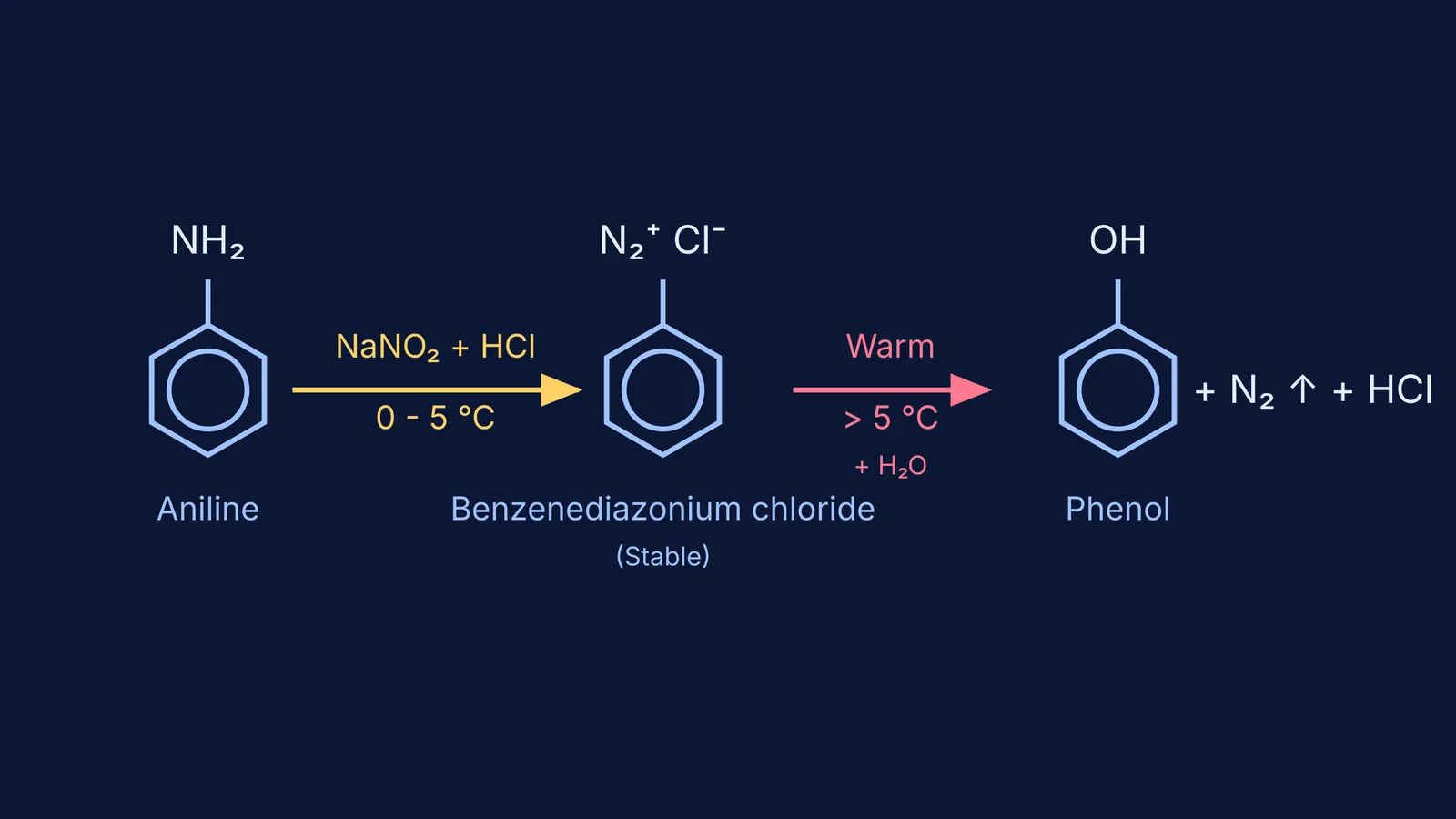
Diazotisation converts a primary aromatic amine, such as aniline, into a diazonium salt using sodium nitrite and hydrochloric acid. But why is the 0 to 5 °C temperature range so strict? The answer comes down to the thermal instability of the product and the reagents.
Why is diazotisation carried out at 0 to 5 degrees Celsius?
The primary reason for maintaining an ice bath is that benzenediazonium chloride is highly unstable and will decompose at higher temperatures. If the reaction mixture is allowed to warm above 5 °C, the diazonium group undergoes hydrolysis. It reacts with water to form phenol and releases nitrogen gas (Wikipedia):
C₆H₅N₂⁺Cl⁻ + H₂O → C₆H₅OH + N₂ ↑ + HCl
This decomposition ruins the yield of the diazonium salt. By keeping the temperature strictly between 0 and 5 °C (273–278 K), the salt remains stable in the aqueous solution long enough to be used in subsequent reactions.
Another factor is that the diazotisation reaction is highly exothermic. If not actively cooled in an ice bath, the heat generated by the reaction itself can cause the temperature to spike, triggering the rapid decomposition of the product.
The instability of nitrous acid
It is not just the final product that is sensitive to heat. The reagent responsible for diazotisation, nitrous acid (HNO₂), is also incredibly fragile.
Nitrous acid is too unstable to be stored in a bottle on a shelf. Instead, it must be generated *in situ*—right in the flask when you need it—by reacting sodium nitrite (NaNO₂) with dilute hydrochloric acid. At room temperature, nitrous acid rapidly disproportionates, breaking down into nitric oxide gas and nitric acid (Wikipedia).
To minimise this spontaneous decomposition, the nitrous acid must be generated and consumed at ice temperatures. The 0–5 °C window ensures that the nitrous acid survives long enough to react with the aniline.
What happens if the temperature drops below 0 degrees?
While warming destroys both the nitrous acid and the final product, dropping the temperature significantly below 0 °C creates a different problem: the aqueous solution can freeze. An ice-water bath naturally holds the mixture near 0 °C, which keeps the liquid moving.
If the mixture freezes, the salts can crystallize out of the solution. Because solid diazonium halides are dangerously explosive, they must be kept dissolved in water. The 0–5 °C window is the perfect balance: cold enough to prevent decomposition, but warm enough to keep the reaction liquid and safe.
How to use diazonium salts
Because they are so unstable, diazonium salts are rarely isolated as dry solids. In fact, many solid diazonium halides are dangerously explosive and shock-sensitive. Instead, they are prepared *in situ* and used immediately. They are incredibly versatile intermediates in organic synthesis.
Once formed at 0–5 °C, the cold solution can be poured directly into other reagents to synthesize a wide variety of compounds:
Aryl Halides: Using the Sandmeyer and Gattermann reactions, the diazo group is replaced by chlorine or bromine.
Fluorobenzene: Via the Balz-Schiemann reaction, using fluoroboric acid.
Azo Dyes: Through coupling reactions with phenols or amines, which produce brightly coloured dyes used in the textile industry.
If you are revising these mechanisms and finding it hard to remember which reagents go with which name reaction, Fermi Concept Library groups them logically. You can trace how one starting material like aniline branches out into different products (such as the carbylamine test for primary amines or diazotisation), making the patterns easier to see and remember.
Step-by-step laboratory procedure
To guarantee that the temperature never exceeds 5 °C, the reaction is carried out using a specific sequence of steps that controls the release of heat.
Prepare the amine solution: First, aniline is dissolved in an excess of dilute hydrochloric acid. This forms anilinium chloride, which is soluble in water. This flask is then partially submerged in an ice-water bath and allowed to cool completely.
Prepare the nitrite solution: Separately, an aqueous solution of sodium nitrite is prepared in a second flask and also placed in the ice bath. Both solutions must reach 0–5 °C before any mixing begins.
Slow addition: The cold sodium nitrite solution is added to the aniline solution drop by drop, often using a dropping funnel, while stirring constantly.
Monitor the temperature: Because the reaction is exothermic, adding the nitrite too quickly will cause the temperature to spike. A thermometer must be kept in the reaction flask at all times. If the temperature approaches 5 °C, the addition is paused until the ice bath can cool the mixture back down.
By controlling the rate of addition, the heat generated is dissipated by the ice bath, ensuring the diazonium salt is formed safely and successfully.
A quick checklist for the lab
Whether you are performing this in a school practical or an undergraduate lab, keep an eye on your flask:
At 0 to 5 °C: The solution remains clear. The benzenediazonium chloride is stable and ready for use.
Above 5 °C: You will see bubbles of N₂ gas appearing. The product is decomposing into phenol, and your yield will plummet.
Below 0 °C: The reaction stalls or freezes. This can leave unreacted starting materials or cause dangerous salts to precipitate.


