On this page
Boil an aryl methyl ether with HI and you get a phenol plus methyl iodide. Textbook questions usually stop at the products. In 1885 the Austrian chemist Simon Zeisel turned that same reaction into a way to count methoxy groups (–OCH₃) in a molecule. Collect the CH₃I, measure it, and you know how many OCH₃ groups the sample carried. Below: the chemistry, the sixfold titration trick added later, and three worked problems. HI and bromine are corrosive and toxic, so this is a lab method only, never something to try at home.
What is the Zeisel method?
It is a way to find the percentage of methoxyl (OCH₃) in an organic compound. The steps are:
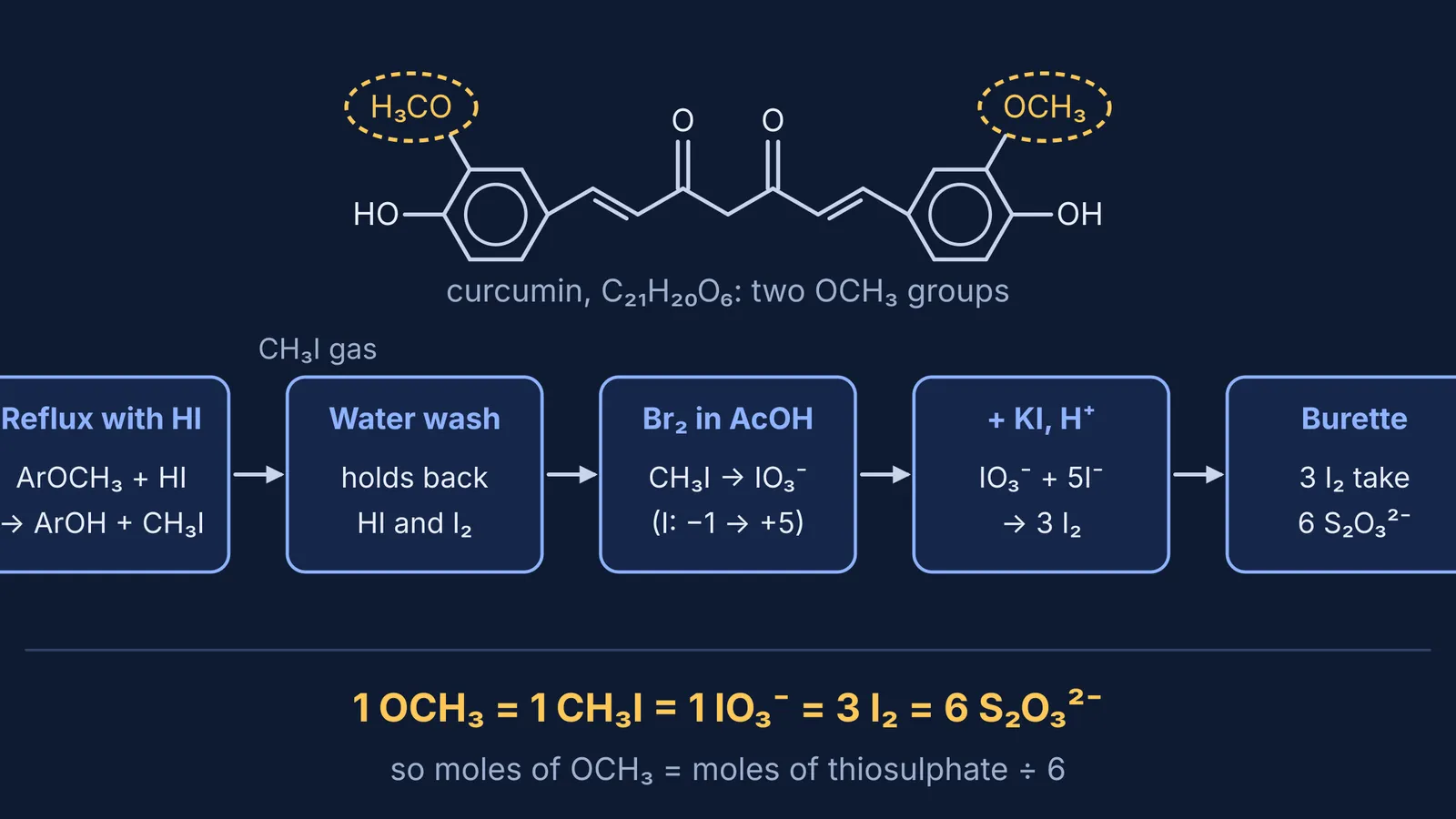
Cleave. Boil a weighed sample with concentrated HI. Each OCH₃ group gives one CH₃I.
Sweep and wash. CH₃I boils at about 42 °C, so a slow stream of nitrogen or CO₂ carries it out of the hot flask. On the way it bubbles through a water wash that holds back HI and iodine vapour.
Trap and convert. The gas then enters an absorber containing bromine in acetic acid, which turns the iodine of CH₃I into iodate.
Titrate. The iodate is made to release iodine, and the iodine is titrated with sodium thiosulphate.
Zeisel's original finish weighed silver iodide. The bromine-and-iodate finish in steps 3 and 4 came from Vieböck and Brecher in 1930. Pharmacopoeia methods still use it, because it makes small samples easy to measure.
Why does HI give CH₃I and a phenol, not methanol and iodobenzene?
This is the same rule as in our post on predicting the products when HI cleaves an ether. HI protonates the ether oxygen. Iodide then attacks the methyl carbon by SN2, because methyl is the least hindered carbon. The aryl–O bond does not break. The ring carbon is sp² and the C–O bond has partial double bond character, so iodide cannot substitute there.
For vanillin (4-hydroxy-3-methoxybenzaldehyde):
C₈H₈O₃ + HI → C₇H₆O₃ + CH₃I
The product is 3,4-dihydroxybenzaldehyde. Atoms balance: C 8, H 9, O 3, I 1 on each side. One OCH₃ gives one CH₃I, and the whole method rests on that.
How does one CH₃I become six thiosulphate?
Bromine in the absorber oxidises the iodine in CH₃I in two stages. First bromine swaps onto the carbon and pulls the iodine off as iodine monobromide:
CH₃I + Br₂ → CH₃Br + IBr
Then more bromine and water oxidise IBr to iodic acid:
IBr + 2Br₂ + 3H₂O → HIO₃ + 5HBr
Add them and you get the overall change:
CH₃I + 3Br₂ + 3H₂O → CH₃Br + HIO₃ + 5HBr
Check it: C 1, H 9, O 3, I 1 and Br 6 on both sides. Track the iodine. It is −1 in CH₃I (iodine is slightly more electronegative than carbon), +1 in IBr and +5 in HIO₃.
The absorber contents are then washed into a sodium acetate solution, which acts as a buffer. Formic acid is added drop by drop until the bromine colour disappears:
HCOOH + Br₂ → CO₂ + 2HBr
Leftover bromine would oxidise the KI added next and make the result too high. Next come potassium iodide and dilute sulphuric acid. Iodate and iodide comproportionate, exactly as in our post on measuring the iodine in iodised salt:
IO₃⁻ + 5I⁻ + 6H⁺ → 3I₂ + 3H₂O
Finally the iodine is titrated with thiosulphate, adding starch near the end point:
I₂ + 2S₂O₃²⁻ → 2I⁻ + S₄O₆²⁻
Chain them together:
1 OCH₃ = 1 CH₃I = 1 IO₃⁻ = 3 I₂ = 6 S₂O₃²⁻
So moles of OCH₃ = moles of thiosulphate ÷ 6. Each methoxy group costs six thiosulphate ions, so a tiny amount of CH₃I becomes a readable burette volume. With 0.1 M thiosulphate, 1 mL corresponds to 0.1 ÷ 6 = 0.0167 mmol of OCH₃, or about 0.517 mg.
How do you calculate % methoxyl? A worked example
Use OCH₃ = 31.03 g/mol (C 12.01, H 1.008, O 16.00).
(a) Theoretical methoxyl in vanillin. Vanillin, C₈H₈O₃, has a molar mass of 152.15 g/mol and one OCH₃.
% OCH₃ = 31.03 ÷ 152.15 × 100 = 20.4%
(b) A curcumin sample. 25.0 mg of a "curcumin" powder is run through the method. The final titration takes 15.9 mL of 0.0500 M thiosulphate.
Moles of thiosulphate = 15.9 × 0.0500 = 0.795 mmol.
Moles of OCH₃ = 0.795 ÷ 6 = 0.1325 mmol.
Mass of OCH₃ = 0.1325 × 31.03 = 4.11 mg.
% OCH₃ = 4.11 ÷ 25.0 × 100 = 16.4%.
Pure curcumin, C₂₁H₂₀O₆ (368.38 g/mol), has two OCH₃ groups, so its theoretical value is 2 × 31.03 ÷ 368.38 × 100 = 16.85%. The sample comes out at about 97.6% of that.
(c) An unknown aldehyde. An aromatic aldehyde C₉H₁₀O₃ (166.17 g/mol) gives 37.3% OCH₃. One OCH₃ would give 31.03 ÷ 166.17 × 100 = 18.7%. Two would give 37.35%. So n = 37.3 × 166.17 ÷ (100 × 31.03) = 2.00, and the molecule has two methoxy groups. A dimethoxybenzaldehyde fits, such as veratraldehyde (3,4-dimethoxybenzaldehyde), which is vanillin with its OH methylated. The method counts the groups; it does not say where on the ring they sit.
If you want more stoichiometry chains like this one, the Fermi Problem Library has a step-by-step solver that explains the reasoning at each link.
Why can a low methoxyl figure for curcumin be misleading?
Turmeric does not contain just one yellow pigment. Its curcuminoids are curcumin (two OCH₃), demethoxycurcumin (one OCH₃, C₂₀H₁₈O₅, 9.17% OCH₃) and bisdemethoxycurcumin (no OCH₃). A commonly quoted composition for commercial curcumin is about 77% curcumin, 17% demethoxycurcumin and 3% bisdemethoxycurcumin (Jayaprakasha, Rao and Sakariah, Food Chemistry, 2006), though real products vary.
Work out what that mix should give: 0.77 × 16.85 + 0.17 × 9.17 + 0.03 × 0 = about 14.5% OCH₃. That is well below 16.85%, yet the powder may be almost entirely curcuminoids. A low figure is not proof of adulteration.
The reverse also holds. The 16.4% in part (b) could mean 97.6% curcumin plus 2.4% of something with no methoxy groups. It could equally mean about 95% curcumin and 5% demethoxycurcumin with no impurity at all. Only chromatography can tell these apart. The colour chemistry of the same molecule is in why turmeric turns red with soap.
What can fool the Zeisel method?
Ethoxy groups. OC₂H₅ gives C₂H₅I, which is also volatile and also ends up as iodate. Results are therefore reported as "alkoxyl as methoxyl" unless the iodide is identified.
N-methyl groups. These do not interfere at normal Zeisel temperatures. Cleaving them needs much harsher heating of the HI salt (the Herzig–Meyer method).
Sulphur compounds. These give H₂S, which must be scrubbed out or it adds to the count.
Leftover bromine. A rushed formic acid step frees extra iodine from KI.
Quick checklist
Aryl–OCH₃ + HI gives the phenol and CH₃I; the aryl–O bond survives.
One OCH₃ gives one CH₃I, which bromine oxidises to one IO₃⁻ (iodine −1 to +5).
IO₃⁻ + 5I⁻ + 6H⁺ → 3I₂ + 3H₂O, then each I₂ takes 2 S₂O₃²⁻.
Moles of OCH₃ = moles of thiosulphate ÷ 6.
% OCH₃ = mass of OCH₃ ÷ sample mass × 100, using 31.03 g/mol.
Divide the measured % by the one-group % to count the groups.
Ethoxyl counts too, and curcuminoid mixtures lower the figure without any impurity.