

On this page
If you have ever dropped yellow dal or vegetable curry onto a white cotton shirt and immediately rubbed it with laundry soap, you have watched a kitchen mishap turn into a vivid chemistry experiment. Instead of fading away, the bright yellow patch instantly flares into a deep reddish-brown. When you rinse the cloth under running tap water or squeeze fresh lemon juice over the spot, the reddish stain retreats right back to its original yellow.
This everyday reaction is not an accident of textile dyeing. It is a direct demonstration of natural acid-base indicators, a core concept introduced in the guide to indicators in Class 7 and expanded in the Class 10 acids, bases and salts syllabus. The colour shift depends entirely on the molecular structure of turmeric's primary active compound, the alkalinity of soap, and the reversible exchange of a single proton.
Why does a turmeric stain turn red with soap?
Turmeric gets its characteristic golden-yellow colour from a group of polyphenolic compounds known as curcuminoids. The principal active molecule is curcumin, which accounts for the vast majority of the pigment in the root. The molecule contains multiple acidic protons that can be released depending on how basic the surrounding environment is.
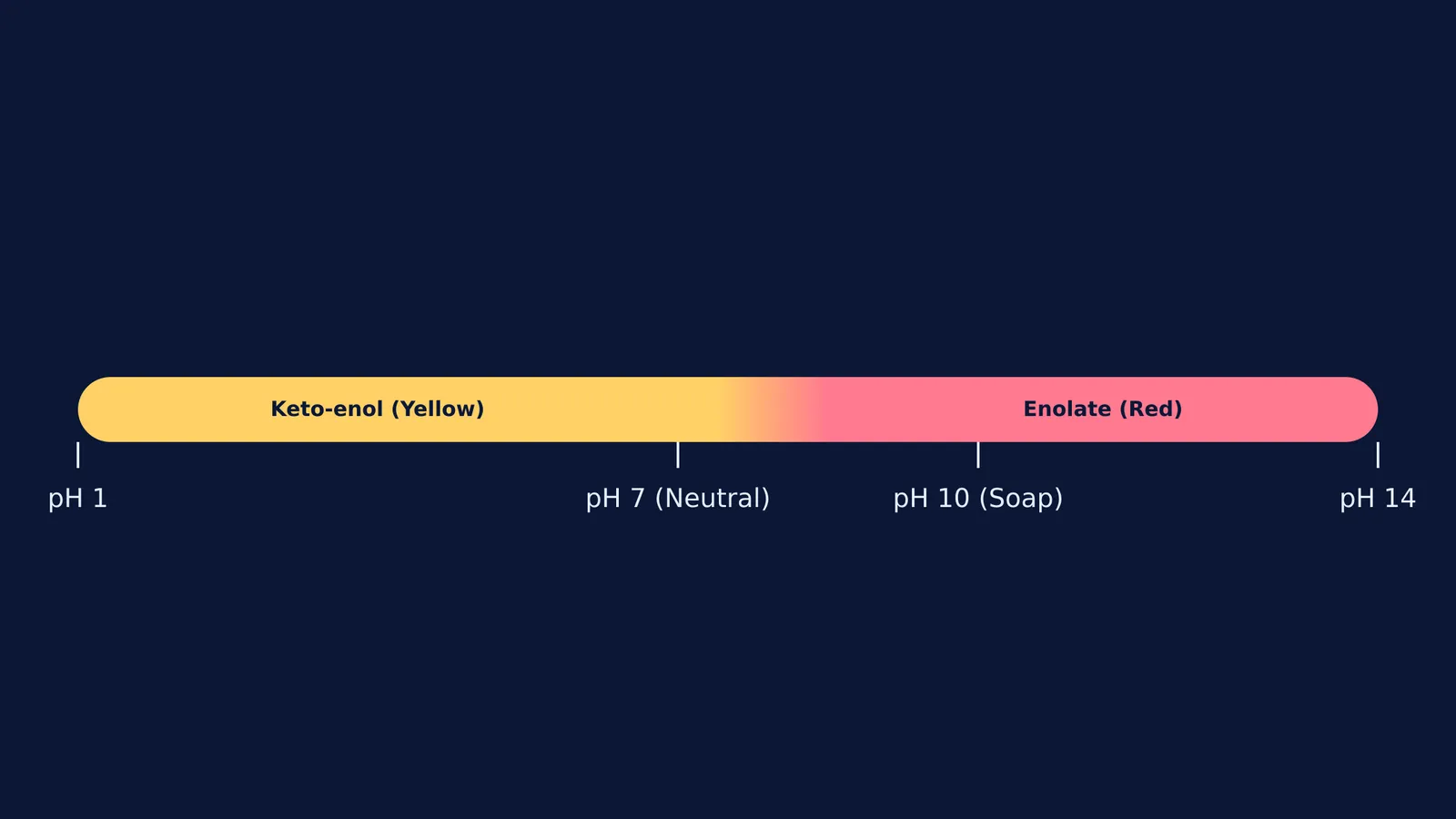
Curcumin is highly sensitive to the pH of its environment. In acidic and neutral aqueous solutions (pH below 7.4), curcumin exists predominantly in a neutral keto-enol form that absorbs light in the blue-violet region of the spectrum, making it appear yellow to our eyes. A comprehensive structural review in *Molecules* by chemist Kavirayani Indira Priyadarsini confirms that this structure changes dramatically when exposed to alkaline environments (10.3390/molecules191220091).
As the environment becomes more basic, the curcumin molecule undergoes a sequence of structural changes. The first shift occurs when the pH rises above 8. At this point, the molecule loses its first proton from a phenolic hydroxyl group, transitioning from its neutral state into a monovalent enolate ion. This dissociation continues if the pH rises further, leading to the loss of additional protons at even higher alkalinity levels.
What makes laundry soap so alkaline?
Soaps and laundry detergents are typically highly alkaline. As explored in our guide on how soaps clean, soaps are made through saponification, leaving the final product basic. A study of common bathing soaps in the Indian market published in the *Indian Journal of Dermatology* found that the majority have a pH between 9 and 10 (10.4103/0019-5154.139861).
When you apply soap to the stain, the highly alkaline environment causes the curcumin molecule to immediately deprotonate to become an enolate. This structural shift alters the way the molecule's electrons are distributed, causing a redshift in its absorption spectrum. Instead of blue light, the molecule begins absorbing different wavelengths, making it appear a deep reddish-brown.
How can you test this acid-base reaction at home?
Understanding this reaction offers a perfect opportunity to move textbook chemistry into the real world. If you want to visualise how indicators work without buying laboratory supplies, you can use turmeric as a reliable kitchen indicator using this simple procedure:
Create the indicator: Mix a pinch of turmeric powder with a few drops of water to create a yellow paste, and smear it onto a piece of white paper. Let it dry.
Test a base: Dip a cotton swab in soapy water and draw a line on the yellow paper. The line will instantly turn deep red.
Test an acid: Dip a second swab in lemon juice (citric acid) and trace over the red line. The acid neutralises the base, returning the curcumin to its yellow keto-enol form.
Instead of memorising that bases turn indicators red, you can explore the underlying concepts in the Fermi Simulation Lab. It features interactive simulations for the ideas that are easier to see than to read, letting you watch exactly how molecular structures shift to produce the colours we see.


