On this page
Every microwave oven has a magnetron, and every description of it says the same thing: a magnet bends the electrons into curved paths. Almost none say how strong that magnet is, or why. You can work it out with one Class 12 formula, and the answer contains a surprise. The field that makes an electron circle at the oven's frequency is not strong enough to run the oven.
How fast does an electron circle in a magnetic field?
A charge q moving at right angles to a uniform field B moves in a circle. The magnetic force qvB supplies the centripetal force mv²/r, so r = mv/qB. The time for one circle is 2πr/v = 2πm/qB, and the speed cancels. The frequency is
f = qB/2πm
This is the cyclotron frequency. A faster electron runs a bigger circle in the same time, which is explained in why cyclotron frequency does not depend on speed.
What field makes an electron circle at 2.45 GHz?
Domestic ovens work in the 2400–2500 MHz band set aside for industrial, scientific and medical equipment, centred on 2450 MHz (NTIA report on emissions in this band). Here is the worked example.
Rearrange. B = 2πfm/e.
Substitute. B = 2π × 2.45 × 10⁹ × 9.109 × 10⁻³¹ / 1.602 × 10⁻¹⁹.
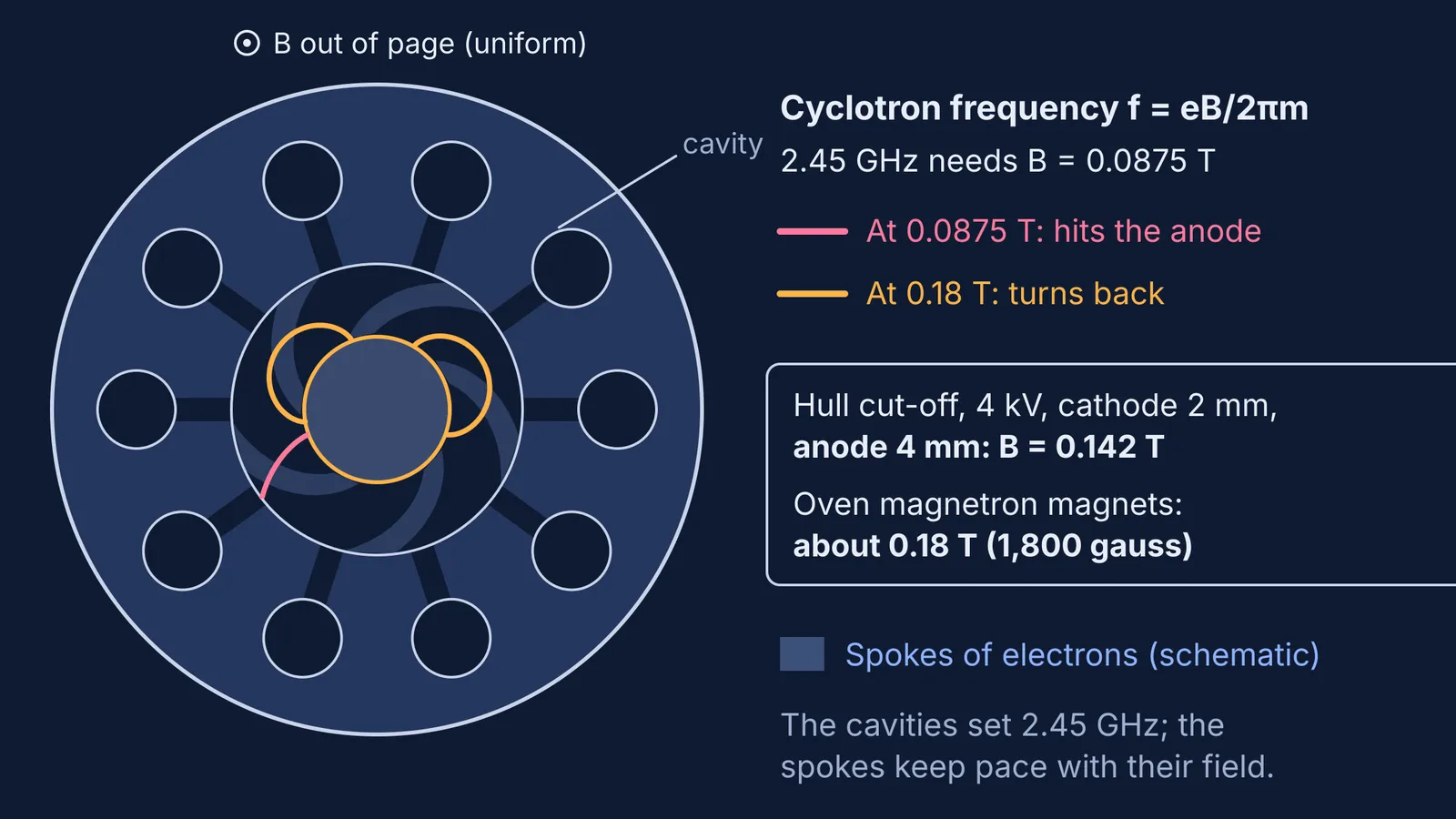
Result. B = 0.0875 T. One circle takes 1/f = 0.408 ns.
Find the speed. Oven magnetrons run at an anode voltage of about 4 kV. A US patent for an oven-type magnetron gives an example with "the anode voltage is 4 kV" (US 5,676,873). An electron accelerated through 4 kV has ½mv² = eV, so v = √(2eV/m) = 3.75 × 10⁷ m/s, which is 0.125c.
Check relativity. γ = 1 + eV/mc² = 1 + 4000/511,000 = 1.008. The exact speed is 3.73 × 10⁷ m/s (0.124c), less than 1% different, so the classical formula is fine at this level.
Find the radius. r = mv/eB = 9.109 × 10⁻³¹ × 3.75 × 10⁷ / (1.602 × 10⁻¹⁹ × 0.0875) = 2.44 mm.
That last number is the problem. In a magnetron with a cathode of radius 2 mm and an anode of radius 4 mm (round illustrative sizes), the gap is only 2 mm. A circle of radius 2.44 mm is too wide to fit. The electron reaches the anode, current flows straight across, and nothing oscillates.
What is the Hull cut-off field in a magnetron?
A magnetron is a cylindrical diode: a hot cathode on the axis, a copper anode around it, a radial electric field between them, and a magnetic field along the axis. Electrons leave the cathode almost at rest, speed up towards the anode and are bent sideways by the magnetic field. If B is large enough, each electron turns round before reaching the anode and comes back towards the cathode. The smallest B that does this is the Hull cut-off field:
Bₕ = [2b/(b² − a²)] √(2mV/e)
where a is the cathode radius, b is the anode radius and V is the anode voltage.
√(2mV/e) = √(2 × 9.109 × 10⁻³¹ × 4000 / 1.602 × 10⁻¹⁹) = 2.13 × 10⁻⁴ T m.
Geometry factor with b = 4 mm and a = 2 mm: 2 × 0.004/(0.004² − 0.002²) = 667 m⁻¹.
Cut-off. Bₕ = 667 × 2.13 × 10⁻⁴ = 0.142 T.
For the sizes in the patent above (cathode 1.5 mm, anode 3.8 mm, 4 kV) the same formula gives 0.133 T, and the patent applies 1,800 gauss, which is 0.18 T. An older Raytheon patent says that for a 700 W oven magnetron "a magnetic field of approximately 1800 Gauss is required" (US 3,794,879). So real oven magnets give about 0.18 T, roughly twice the 0.0875 T from the cyclotron formula. The hero diagram shows both cases, computed numerically: at 0.0875 T an electron hits the anode; at 0.18 T it rises to about 3.2 mm and curls back.
The Hull formula assumes a smooth cylinder with no oscillation and no space charge. It tells you the minimum field, not the working field.
If the magnet does not set 2.45 GHz, what does?
The anode is not a smooth cylinder. It is a copper block with a ring of cavities cut into it, as described in how Randall and Boot's cavity magnetron works. Each cavity behaves like a tiny LC circuit: the hole is the inductance and the narrow slot is the capacitance. Their size fixes the resonant frequency at 2.45 GHz.
At 0.18 T, the cyclotron frequency is eB/2πm = 5.04 GHz, nowhere near 2.45 GHz. The electrons do not each circle at the oven frequency. Instead, the cloud around the cathode forms rotating spokes that sweep past the cavity mouths in step with the oscillating field, handing energy to it.
You can check the speed with the velocity-selector idea from crossed fields. In crossed E and B, charges drift sideways at v = E/B.
Suppose the anode has 10 cavities (an illustrative number) and oscillates so that neighbouring vanes are always opposite in charge. Then there are 5 spokes, and the pattern turns once every 5 cycles: 2.45 × 10⁹/5 = 4.9 × 10⁸ turns per second.
At a radius of 3.3 mm, the spoke speed is 2π × 4.9 × 10⁸ × 0.0033 = 1.0 × 10⁷ m/s.
The field in a cylindrical diode is E = V/[r ln(b/a)] = 4000/(0.0033 × 0.693) = 1.75 × 10⁶ V/m, so E/B = 1.75 × 10⁶/0.18 = 9.7 × 10⁶ m/s.
The two speeds agree to within a few per cent. That match between drift speed and cavity wave is what the magnet field and voltage are really chosen for.
To watch a charge curl in crossed electric and magnetic fields, try the interactive models in the Simulation Lab.
Why should you never open a microwave oven?
The magnetron needs about 4 kV. The oven makes it with a step-up transformer and a high-voltage capacitor, and that capacitor can stay charged after the plug is pulled. The US Consumer Product Safety Commission warns that "the possibility for electrical shock from a microwave oven still exists even after the oven is disconnected from the power source" (CPSC Publication 5061). Never open a microwave oven or remove its cover, even to look at the magnets. Repairs belong to trained technicians. How the microwaves then heat the food is covered in how a microwave oven heats food from the inside.
Quick checklist
Cyclotron frequency f = eB/2πm does not depend on speed.
For 2.45 GHz, B = 0.0875 T; a 4 kV electron then circles with r = 2.44 mm.
Hull cut-off Bₕ = [2b/(b² − a²)]√(2mV/e): 0.142 T for 2 mm and 4 mm radii at 4 kV.
Oven magnetron magnets give about 0.18 T, so the cyclotron frequency is about 5 GHz.
Cavities set the 2.45 GHz; spokes drift at about E/B in step with them.
Never open a microwave oven: its high-voltage capacitor can stay charged.